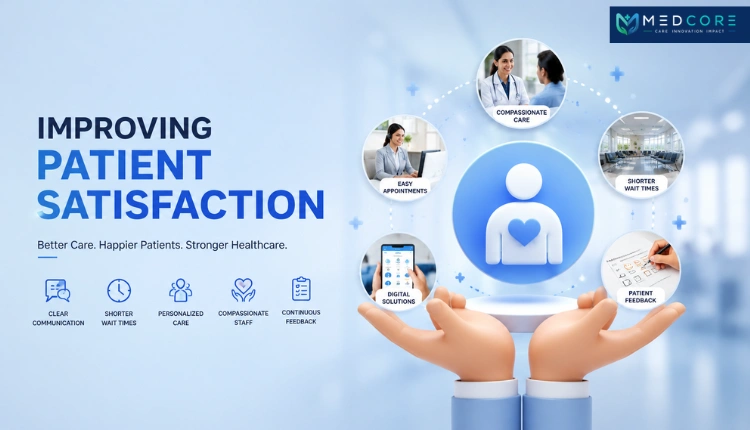
Patient satisfaction shapes how people remember their hospital visit long after the treatment itself fades from memory. A confusing bill, a rushed conversation, or an hour spent waiting in a crowded lobby can outweigh even the most skilled clinical care.
Patients today expect more than a correct diagnosis. They want to feel heard, respected, and informed at every step. That expectation is why this metric has become a core measure of hospital reputation.
Trust drives everything else. A patient who trusts their provider follows treatment plans more closely and recommends the hospital to others. Below, we’ll break down what actually moves the needle.
Read Aloud!
Short Answer
Patient satisfaction improves when healthcare providers combine quality clinical care with clear communication, shorter wait times, personalized treatment, efficient operations, digital tools, and continuous feedback. None of these works well in isolation. Together, they build the kind of trust that keeps patients coming back.
What Is Patient Satisfaction and Why Does It Matter?
What Does It Mean?
At its core, patient satisfaction measures the gap between what a patient expected and what they actually experienced. Someone who expected a 15-minute wait but sat for an hour will rate their visit poorly, even if the diagnosis was accurate.
Expectations aren’t always about medical outcomes. Often, they’re about how a person was treated, not just how their case was handled.
Why It Matters
Hospitals that prioritize this area see measurable benefits. Patients tend to trust providers who communicate clearly, and that trust translates into better treatment adherence and fewer missed follow-ups.
Happy patients also leave positive reviews, refer friends and family, and stick with the same provider for years. In a competitive healthcare market, that kind of loyalty is hard to buy through advertising alone.
Patient Satisfaction vs Patient Experience: What’s the Difference?
These two terms get used interchangeably, but they aren’t the same thing. Patient experience refers to everything that happens during care: the appointment process, the wait, and the interactions with staff. Satisfaction is the patient’s judgment of that experience against what they expected going in.
| Aspect | Patient Experience | Patient Satisfaction |
| What it measures | Actual events during care | Perception and judgment of those events |
| Example | Wait time was 40 minutes | Patient felt the wait was too long |
| Focus | Objective, observable | Subjective, expectation-based |
A hospital can deliver a technically smooth visit and still end up with unhappy patients, simply because expectations weren’t managed well beforehand. That’s why both metrics deserve attention.
What Influences Satisfaction the Most?
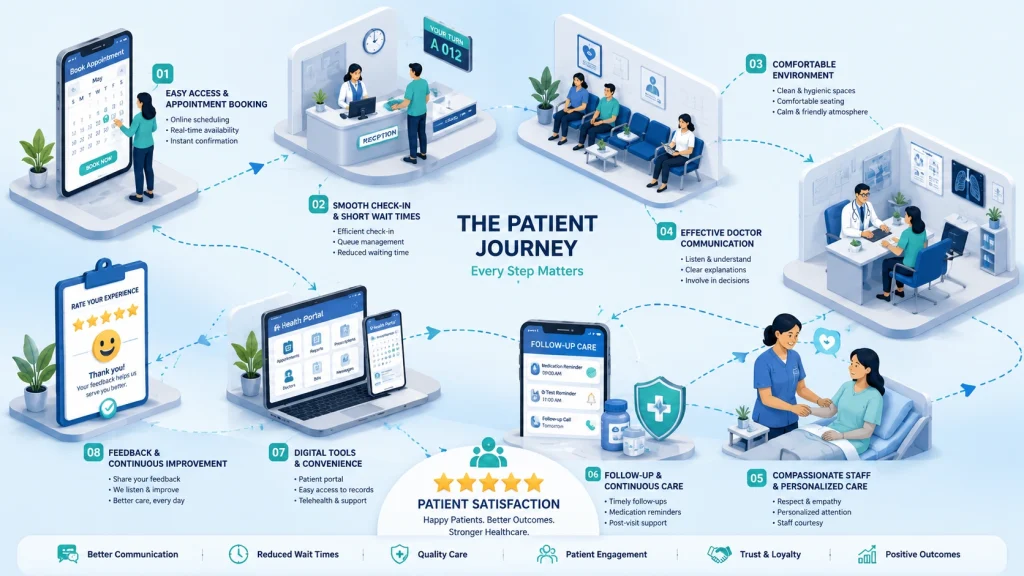
Several factors shape how a patient rates their visit, often before treatment even begins:
- Communication clarity from doctors and staff
- Waiting time in reception and consultation areas
- Staff behavior and courtesy
- Cleanliness of the facility
- Transparency around costs and procedures
- Ease of accessing care and specialists
- Quality of follow-up after discharge
- The convenience of digital tools like online booking
Think of these as checkpoints along a patient’s journey. A weak link at any single point can undo good work done elsewhere.
Read More!
MedCore vs Practo for Mid-Size Hospitals: Which Is Better for AI Clinical Documentation EHR?
10 Practical Ways to Improve Patient Satisfaction
Communicate Clearly and Compassionately
Skip the jargon. Explain diagnoses and next steps in plain language, and check whether the patient actually understood before moving on.
Reduce Waiting Times
Long waits are consistently cited as the biggest satisfaction killer. Smarter scheduling and real-time queue updates can shrink perceived delays even when actual wait times are hard to avoid.
Personalize Every Interaction
Referencing a patient’s history during a visit signals they’re more than a file number. Remembering a name or a prior concern builds real rapport.
Make Scheduling Easy
Confusing booking systems frustrate people before they’ve even walked through the door. Online scheduling with automatic confirmations removes friction from the start.
Train Staff in Empathy

Clinical skill isn’t enough anymore. Front-desk staff, nurses, and technicians all shape a patient’s perception, so empathy training should reach well beyond the doctor’s office.
Keep Patients Informed
Uncertainty breeds anxiety. Regular updates, even brief ones, reassure patients that their care is progressing and nothing has been forgotten.
Create a Comfortable Environment
Clean waiting areas, comfortable seating, and reduced noise levels aren’t luxuries. They directly affect how anxious or at ease a patient feels.
Collect and Act on Feedback
Running a patient satisfaction survey after each visit gives hospitals a direct line into what’s working. The real value comes from acting on that feedback, not just archiving it.
Improve Care Coordination After Discharge
Follow-up calls, medication reminders, and clear discharge instructions prevent the confusion that often leads to frustration and readmissions.
Use Digital Healthcare Technology
Digital tools, from appointment reminders to patient portals, cut down on manual errors and give patients more control over their own care.
Real-Life Applications Across Healthcare Settings
Outpatient clinics benefit most from faster check-ins and shorter consultation waits, since visits are typically quick and focused.
Hospitals handling inpatient stays need stronger coordination between departments, since patient care in hospital settings often involves multiple specialists over several days.
Specialty practices should focus on detailed, personalized communication, given the often complex nature of the conditions being treated.
Telemedicine providers need to prioritize connection quality and simple interfaces, since technical friction can undermine an otherwise good consultation.
A Simple Framework Hospitals Can Use
A useful way to organize these efforts is the CARE framework:
- C- Communicate clearly. Set expectations early and explain things in plain terms.
- A- Act on feedback. Treat every survey response as an opportunity, not just data.
- R- Reduce friction. Simplify scheduling, billing, and check-in processes.
- E- Empower patients. Give them tools and information to take part in their own care.
Administrators can use this as a quick checklist when evaluating any new policy or process change.
Common Mistakes That Reduce Patient Satisfaction
Even well-intentioned hospitals fall into predictable traps:
- Collecting feedback but never acting on it
- Letting wait times grow unchecked
- Overusing medical jargon during consultations
- Neglecting follow-up care after discharge
- Allowing inconsistent service between staff members
- Being vague about costs and procedures
- Adding technology that removes, rather than adds, human connection
Avoiding these pitfalls often matters more than launching new initiatives.
How MedCore Helps
Operational inefficiency is one of the quietest reasons patient satisfaction in healthcare settings suffers. MedCore, an AI-powered hospital management system, addresses this at the operational level.
Key features include:
- AI-assisted appointment scheduling that reduces booking conflicts
- Electronic Health Records, for instant, seamless information access
- Faster patient registration to cut down front-desk delays
- Automated follow-up reminders that support post-discharge care
- Centralized communication across departments
- Queue and workflow management to reduce waiting times
- Real-time operational dashboards for administrators
- Secure digital patient records
- Billing integration for smoother, faster discharge
- Analytics that support continuous quality improvement
By streamlining these behind-the-scenes processes, hospitals free up staff time to focus on what actually matters: the person in front of them.
Looking Ahead: The Future of Satisfaction in Healthcare

The next phase of improvement will lean heavily on data and prediction. Predictive analytics can flag potential dissatisfaction before a patient even voices a complaint, giving staff a chance to intervene early.
AI-assisted engagement tools, voice assistants, and remote monitoring are already reshaping how care is delivered outside hospital walls. Real-time sentiment analysis is also starting to replace the once-a-year survey model.
Personalized care journeys, built on a patient’s own history and preferences, will likely become the new baseline.
Conclusion
Improving patient satisfaction isn’t about one dramatic change. It comes from combining compassionate communication, efficient operations, honest feedback loops, and the right technology into a single, consistent experience. Hospitals that commit to this combination don’t just treat patients well. They build the kind of trust that keeps people coming back and telling others to do the same.
Frequently Asked Questions
What is patient satisfaction in healthcare?
It’s a measure of how well a patient’s actual care experience matched their expectations, covering both clinical outcomes and interpersonal interactions.
How is it measured?
Most commonly through post-visit surveys, standardized questionnaires like HCAHPS, and increasingly through real-time feedback tools.
What factors affect it the most?
Communication, wait times, staff behavior, transparency, and access to care consistently rank as the top influences.
Why does this matter for hospitals?
It directly affects patient retention, reputation, treatment adherence, and, in many regions, reimbursement rates tied to quality metrics.
How often should hospitals run surveys?
Many now survey after every visit rather than annually, since frequent feedback catches problems while they’re still fixable.
What’s the difference between satisfaction and experience?
Experience refers to what actually happened during care. Satisfaction refers to how the patient judged that experience against what they expected.
How can patient satisfaction be improved?
Patient satisfaction can be improved by providing quality care, communicating clearly, reducing wait times, personalizing treatment, and regularly acting on patient feedback.