An Electronic Health Record holds everything a clinician needs to treat a patient: diagnoses, prescriptions, lab results, allergies, and billing details. That convenience also makes it one of the most valuable targets for cybercriminals. Stolen medical data can be misused for identity fraud, insurance scams, and blackmail, and unlike a credit card, it cannot simply be cancelled and reissued.
For hospitals and clinics, a single breach can mean legal penalties, disrupted care, and lost patient trust. The good news is that many incidents are preventable with the right habits and tools. In this guide, you will learn why security matters, the threats to watch for, the regulations that apply, and practical steps to keep patient information safe, along with how to choose a platform that makes protection easier.
What Is the Electronic Health Record?
An Electronic Health Record, often shortened to EHR, is a digital version of a patient’s medical history maintained by a healthcare provider. Unlike paper charts that sit in a single cabinet, it can be updated in real time and accessed by authorised staff across departments. A complete entry typically includes demographics, visit notes, medications, immunisation history, imaging, and lab reports. Many facilities also use the term EMR for a record that lives inside a single practice, while an EHR is designed to be shared more widely.
This richness is exactly why attackers want it. One record can contain a name, address, phone number, government ID, and detailed medical history, giving criminals everything required to impersonate someone. Protecting that information is therefore a clinical responsibility as much as a technical one.
Why Electronic Health Record Security Matters
Security failures in healthcare are different from those in other industries because lives are involved. If ransomware locks a hospital’s systems, doctors may be unable to view allergies, previous diagnoses, or current medications. Delays like these can affect treatment decisions within hours.
There is also a financial and reputational cost. Patients share sensitive details only when they trust that the information will stay private. A breach can push people to withhold symptoms or avoid care altogether, which harms outcomes in the long run. Regulators can impose penalties, and recovery often involves forensic investigations, notification costs, and system rebuilding.
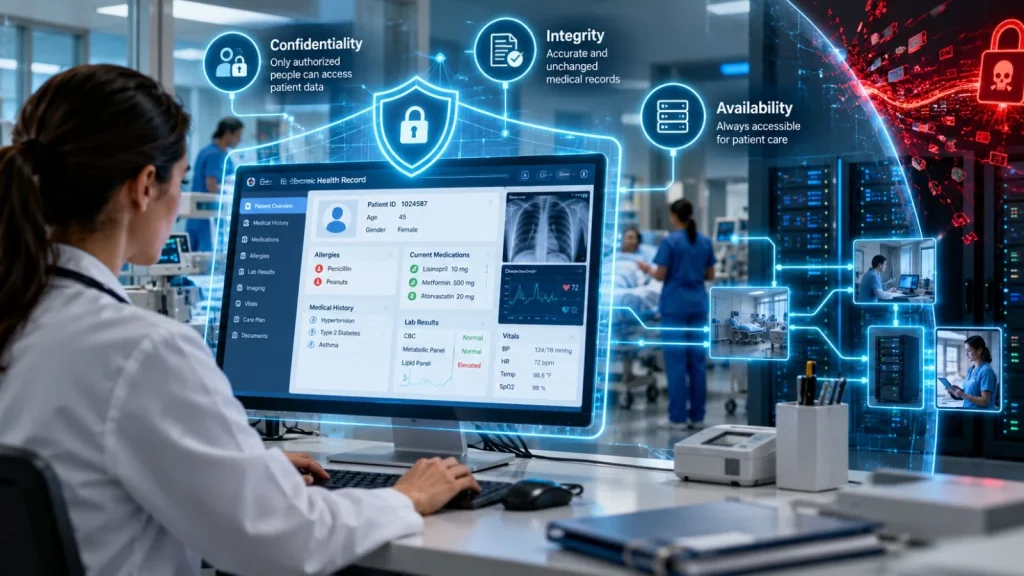
Strong Electronic Health Record security protects three things at once: confidentiality, so only the right people see data; integrity, so information stays accurate; and availability, so clinicians can access it whenever they need it.
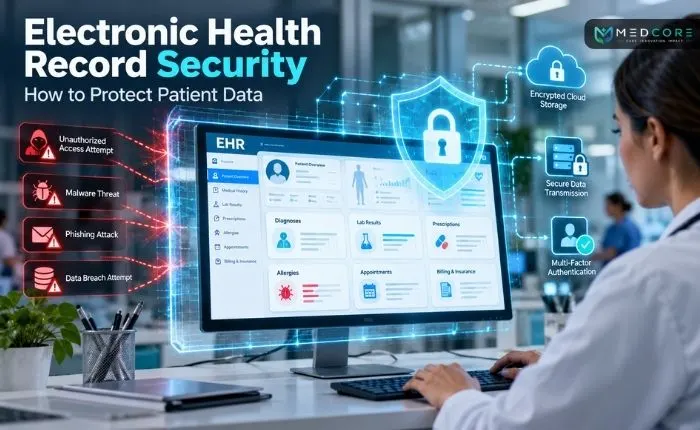
Common Threats to Your Electronic Health Record
Understanding how breaches happen makes them easier to prevent. The most frequent threats include:
- Phishing emails: Staff receive messages that look genuine and trick them into sharing passwords or clicking harmful links.
- Ransomware: Malicious software encrypts files and demands payment to restore access.
- Weak or shared passwords: Common credentials and shared logins make unauthorised access simple and hard to trace.
- Insider misuse: Employees may browse records out of curiosity or, in rare cases, sell information.
- Lost or unsecured devices: Unencrypted laptops, phones, and USB drives can expose data if misplaced.
- Outdated software: Unpatched systems contain known vulnerabilities that attackers actively scan for.
Notice that many of these threats involve people rather than technology. That is why a secure system must be paired with sensible policies and regular awareness training.
Regulations and Compliance You Should Know:
Compliance is not just paperwork; it gives you a framework for protecting patients. In the United States, HIPAA sets standards for safeguarding health information. In Europe, GDPR classifies health data as a special category that deserves extra protection. In India, the Digital Personal Data Protection Act, 2023 governs how personal data is collected, processed, and stored, and the Ayushman Bharat Digital Mission encourages secure, consent-based sharing of health information through ABHA-linked accounts.
Although the details differ, the core expectations are similar: collect only what you need, obtain consent, restrict access, keep audit logs, and report breaches promptly. When evaluating electronic health record software, confirm that it supports these requirements natively instead of relying on manual workarounds. Compliance gaps are far easier to fix during selection than after an incident.
Technical Safeguards for Electronic Health Record Protection:
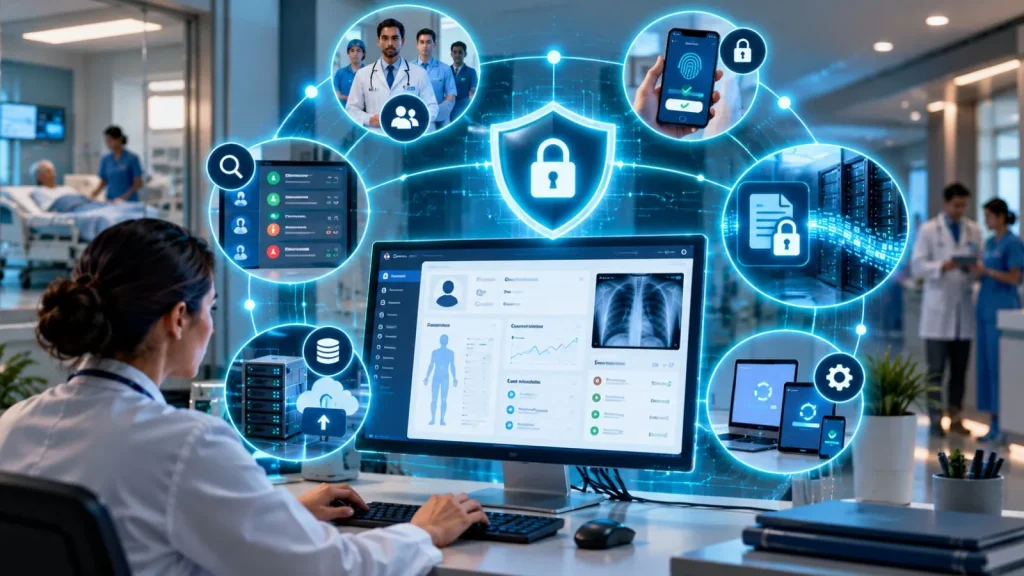
Technology forms the first line of defence. Start with these controls:
- Role-based access: Give each user only the permissions their job requires. A receptionist rarely needs to open clinical notes.
- Multi-factor authentication: A second verification step helps stop many password-theft attempts.
- Encryption: Protect data both in transit and at rest so intercepted files remain unreadable.
- Audit trails: Log who viewed or changed each entry, so unusual activity can be spotted and investigated.
- Regular backups: Keep tested, offline copies so you can recover quickly from ransomware.
- Timely updates: Apply security patches promptly across servers, workstations, and mobile devices.
Well-designed electronic health record systems include many of these controls by default, which reduces the burden on small IT teams.
Building a Security-Aware Team:
Even the best tools fail when people are unprepared. Train every employee, from doctors to front-desk staff, to recognise phishing attempts and report suspicious activity without fear of blame. Short, regular sessions work better than a single annual lecture.
Create clear written policies covering password hygiene, device usage, remote access, and the handling of printed reports. Make sure staff understand that sharing login credentials is never acceptable, even during busy hours.
Prepare an incident response plan before you need it. It should state who to contact, how to isolate affected systems, when to inform patients and authorities, and how to restore operations. Rehearse it at least once a year.
Finally, review access rights whenever someone changes role or leaves. Dormant accounts on EMR systems are a common and avoidable entry point for attackers. Every Electronic Health Record is only as safe as the habits of the people who use it.
How to Choose a Secure Electronic Health Record Platform:
When comparing vendors, look beyond the feature list and ask how each one protects data. A practical checklist includes:
- Granular role-based permissions and detailed audit logs
- Data residency options that keep information within your country
- Support for standards such as FHIR and HL7 for safe data exchange
- Patient consent tools and data export capabilities
- Clear backup, recovery, and incident response commitments
- Transparent privacy terms and data processing agreements
Ask for a live demonstration and test real scenarios. For example, check what a nurse can see compared with a billing clerk, and see how easily an administrator can trace changes to a patient chart.
Also consider ease of use. Complicated security controls tend to be bypassed by busy staff, so the safest Electronic Health Record is one that clinicians find simple to use every day.
How MedCore Supports Electronic Health Record Security
MedCore, built by Globussoft Technologies in Bangalore, is a hospital management platform designed for Indian clinics and hospitals. Its system of record keeps every clinical event, lab, prescription, vital, and billing entry in one tenant-scoped, auditable Electronic Health Record. Key security-focused features include:
- Full mutation audit trail with archival
- Seven role levels with hardened role-based access control
- DPDP-compliant data residency, with AI inference inside India
- ABDM and ABHA linking for consent-based sharing
- FHIR R4 export and HL7 v2 inbound for secure interoperability
- Patient self-service data export under the DPDP Act 2023
- Multi-tenant ready, with tenant-scoped records
Instead of juggling disconnected tools, your team works in one platform where access, activity, and compliance stay visible. You can explore the platform through the live demo or book a 30-minute session at medcore.software.
Conclusion:
Protecting patient data is an ongoing commitment, not a one-time project. Threats evolve, staff changes, and software ages, so security needs regular attention rather than occasional fixes. The most effective approach combines strong technical controls such as role-based access, encryption, audit trails, and backups with well-trained staff and clear policies. Compliance with laws like the DPDP Act, HIPAA, or GDPR then becomes a natural outcome of good habits instead of a last-minute scramble. A secure environment also strengthens patient confidence, which encourages honest conversations and better outcomes.
FAQs:
Q1. Which security feature matters most?
Role-based access combined with multi-factor authentication gives the strongest starting point. Together, they reduce the chance of unauthorised logins significantly.
Q2. How often should staff receive security training?
At least twice a year, plus whenever policies or tools change. Short refresher sessions keep awareness high.
Q3. Can small clinics afford strong data protection?
Yes. Many controls, such as access rules, backups, and training, are low-cost, and modern platforms bundle several of them.
Q4. What should we do after a suspected breach?
Isolate affected systems, activate your response plan, document every step, and notify the relevant authorities and patients as the law requires.
Q5. Is cloud storage safe for patient records?
It can be, provided the provider offers encryption, access controls, audit logs, and clear data residency terms.