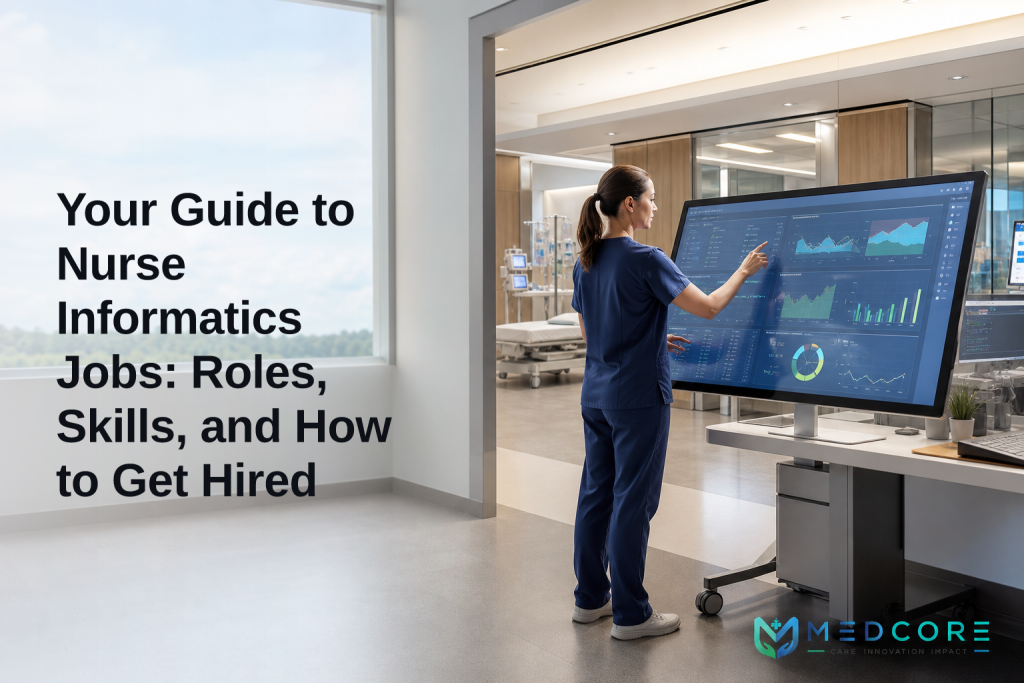
80% of facilities still run on fragmented workflows (Source: MedCore Stats). Think of this as your guide nurse informatics playbook for 2026, written by a colleague who’s been in your shoes.
Nursing informatics blends bedside care, data skills, and health IT to reduce harm, speed decisions, and lift quality. You’ll get hired by pairing RN experience with EHR fluency, standards literacy, and a small portfolio that proves real-world impact.
As a result, you’ll move from “power user” to builder and change leader. Moreover, you’ll learn to translate clinical needs into safe, efficient digital workflows. Therefore, this guide covers roles, skills, missteps to avoid, and a 30-day plan to land interviews this year.
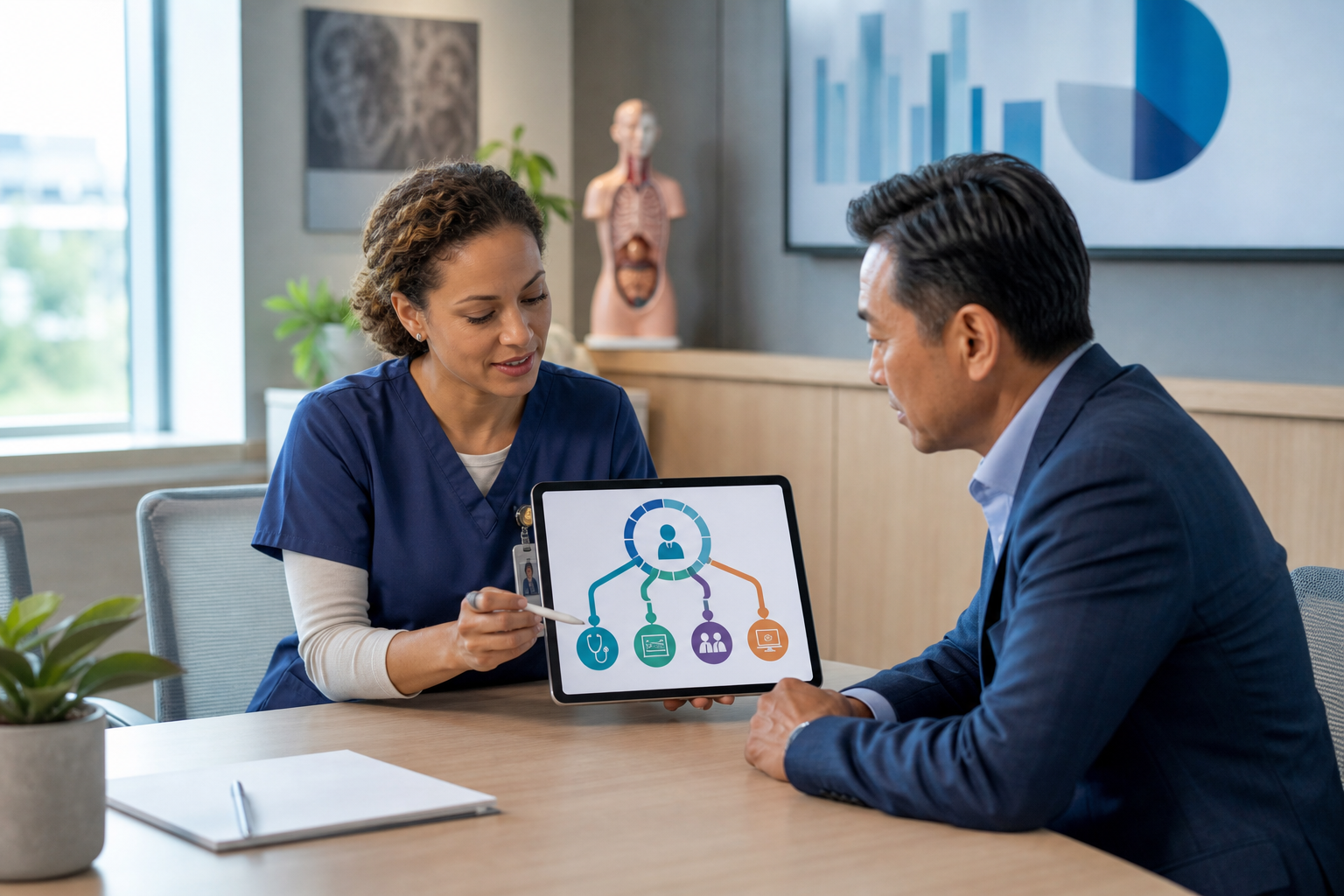
What Are Nurse Informatics Jobs and Why Are They Growing?
Nursing informatics is the intersection of clinical nursing, data, and health IT. In practice, you use your bedside know-how to design EHR (electronic health record) workflows, shape decision support, improve documentation, and guide change across units. You’ll translate the realities of handoffs, med safety, and discharge planning into data models and screens that staff will actually use.
Growth is steady because health systems are digitized and under pressure. For evidence, see the U.S. Bureau of Labor Statistics occupational outlook for medical and health services managers. While job titles vary, the demand for leaders who connect clinical operations and data is clear. In addition, organizations like AMIA (American Medical Informatics Association) have expanded training and networking that feed this pipeline.
Specifically, nurse informaticists work at the seams: clinical judgment, data standards, and interoperability. For example, you might map vitals, allergies, and problem lists to FHIR R4 (Fast Healthcare Interoperability Resources) and legacy HL7 v2 feeds, then sanity-check that bedside flow makes sense during peak hours. In fact, AI-driven clinical documentation, such as an ambient SOAP (Subjective, Objective, Assessment, Plan) scribe, now reduces note burden while preserving ICD-10 and CPT coding opportunities.
Common Nurse Informatics Job Titles
- Clinical Informatics Nurse: Designs and tests EHR workflows; rounds with end users and leads training.
- Nursing Informatics Specialist: Bridges clinical teams and IT; manages data quality and decision support.
- EHR Analyst (RN): Configures order sets, smart forms, and KPIs; triages tickets with clinical context.
- Clinical Applications Specialist: Supports go-lives, integrations, and upgrades across service lines.
- Nursing Informatics Educator: Builds curricula for super users; measures adoption and safety outcomes.
- Chief Nursing Informatics Officer (CNIO): Sets informatics strategy; governs standards and change at scale.
Tip: In 2026, titles blur. Read the body of the posting, then match your portfolio projects to the “must-haves.”
As your guide nurse informatics summary for this section: these roles grow because better EHR workflows, interoperable data (FHIR/HL7), and AI documentation tools now sit at the core of safe, efficient care.
Step-by-Step: How to Land a Nurse Informatics Job
Breaking in is less about luck and more about sequence. Follow these six steps and you’ll stand out fast.
The Hiring Sequence (Follow It In Order)
-
Get RN experience
Two to three years in med-surg, ED, ICU, peri-op, or ambulatory gives you the clinical instincts to design safe workflows. However, any unit works if you can show measurable improvements (e.g., handoff errors dropped after your new checklist). -
Earn informatics certification (ANCC)
The ANCC Nursing Informatics board certification signals rigor. Moreover, the prep work forces you to learn governance, data ethics, and evaluation methods. If you’re early-career, consider bridge certificates or graduate courses that align with ANCC domains. -
Build EHR proficiency
Pick one major platform used by your employer (Epic, Cerner, or Meditech). Therefore, volunteer for order-set reviews, build councils, or upgrade testing. Keep a running log of fixes you shaped and the results (fewer clicks, faster triage, safer meds). -
Learn data standards (FHIR, HL7, SNOMED)
FHIR R4 and HL7 v2 are the pipes. SNOMED CT is the clinical terminology you’ll map to problems and symptoms. Furthermore, add ICD-10 (diagnosis) and CPT (procedures) basics so your documentation and claims stay aligned. As a result, you’ll ace “how would you integrate triage notes into downstream billing?” interview questions. -
Build a portfolio
Create one or two one-page case studies. For example, “Sepsis Triage Revamp: ESI 2–3 patients flagged 6 minutes sooner; 0 new clicks; SNOMED-anchored routing; FHIR Observation resources feed analytics.” Redact PHI. Then add screenshots of test build, a simple flow diagram, and outcomes tracked for 30 days. -
Target the right employers
Shortlist hospitals hiring for quality improvement, EHR upgrades, ambulatory growth, or new service lines. In addition, look at payers, digital health vendors, and AI-native platforms building unified systems-of-record. Network through ANIA, AMIA, and HIMSS local chapters to learn who is staffing projects now.

What Your Portfolio Must Prove
- You can map real clinical tasks to EHR builds without adding clicks.
- You understand FHIR R4, HL7 v2, and SNOMED enough to route data correctly.
- You can explain ICD-10 and CPT impacts in plain language to clinicians.
- You know change management — from stakeholder mapping to go-live support.
- You track outcomes with simple, honest metrics and can trend them over time.
As part of your guide nurse informatics journey, add one polished win per quarter in 2026. Over a year, four tight case studies beat any long resume.
Also Read!
Your Guide to Nursing Informatics Jobs: Roles, Salaries, and How to Get Hired
Your Guide to Appointment Plus: What It Is, How It Works, and the Best Alternatives
Common Mistakes When Pursuing Nursing Informatics Careers
Skipping clinical experience
If you jump straight into IT without RN time, your designs may look fine in a lab and fail at 7 a.m. med pass. Instead, bring 18–36 months of bedside to the table and show the scars you turned into better flows.
Ignoring data literacy
You don’t need to be a data scientist. However, you must read a data dictionary, trace a FHIR resource, and spot weird HL7 segments. Moreover, if you avoid terms like SNOMED, ICD-10, and CPT, interviewers will worry about downstream billing and analytics.
Only learning one EHR vendor
Depth matters, but breadth helps. Therefore, shadow teams on two modules you don’t own, such as lab and pharmacy. In addition, document how upstream nursing notes affect claims, inventory, and discharge scripts. Hiring managers love cross-boundary thinking.
Underestimating change management
Builds don’t fail because JSON broke. They fail because people weren’t heard. Map stakeholders.
Run huddles. Write one-page “why this change” notes in plain English. As a result, your pilots will stick and adoption will spread.
Not networking in AMIA/HIMSS/ANIA communities
Jobs in this niche move through meetups and SIGs (special interest groups). Furthermore, volunteer to scribe a session or co-lead a workgroup. Then share a short portfolio win. Your next manager might be on that Zoom.
Quick “Fix-This-Now” Checklist
- Add one bedside-led metric to every build you touch.
- Learn three FHIR resources this month: Patient, Observation, Condition.
- Join one AMIA or HIMSS call and ask a thoughtful, specific question.
- Pair with pharmacy or lab for one mini-project outside nursing.
Keep your your guide nurse informatics mindset: blend clinical sense, data clarity, and people-first rollout.
Tools, Platforms, and Resources for Aspiring Informatics Nurses
You don’t need every tool. You need the few that match your setting and goals.
Start with EHR platforms. Epic, Cerner, and Meditech dominate hospital builds, while ambulatory networks may use different suites. Learn how each handles orders, notes, and interfaces. In addition, study how FHIR R4 endpoints and HL7 v2 feeds move allergies, meds, and labs to analytics.
Next, stack your credentials. The ANCC Nursing Informatics board certification is the gold mark for RNs. Moreover, AHIMA offers respected credentials for health data, coding, and privacy fundamentals that complement informatics roles. For community and mentoring, plug into AMIA and ANIA; both groups publish case studies and host SIGs where hires are born.
Finally, expect AI-native healthcare systems to show up in 2026 projects. Tools like MedCore offer an integrated, unified EHR with 45+ modules co-designed with doctors, nurses, and administrators. Furthermore, they include an ambient SOAP scribe, triage agents in 8 Indian languages with SNOMED-anchored routing, and FHIR R4 plus HL7 v2 support. For security and compliance, look for DPDP Act 2023 compliance and ABDM/ABHA linking, plus India data residency where required. These signals double as interview talking points that show you vet platforms for safety and scale.
Reality check: “We replaced three tools with MedCore. Billing, pharmacy and lab now talk to each other without exports.” — Ravi Prasad, Administrator, Sunrise Clinic
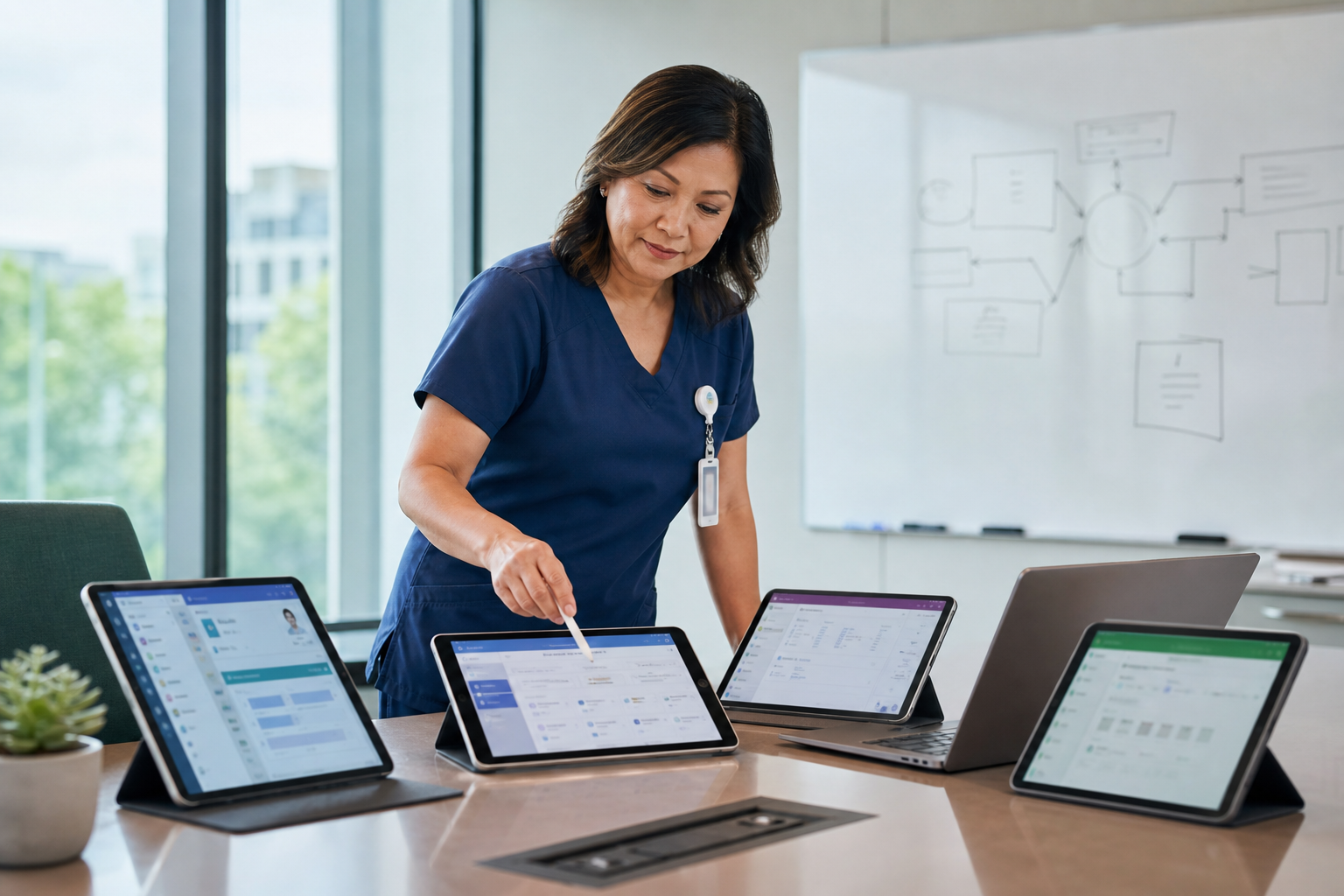
Use this section in your guide nurse informatics prep: list the EHR you know, the standards you can prove, and one AI-native feature you can explain in plain language.
What to Do Next: Your 30-Day Action Plan
Week 1.
List units you’ve worked, projects you’ve improved, and EHR modules you’ve touched. Then map these to ANCC domains. Moreover, pick two standards gaps to close (e.g., SNOMED basics and FHIR Observation).
Week 2.
Register for an ANCC review or a credible university-run short course. In addition, set a weekly quiz goal and build flashcards for ICD-10, CPT, FHIR, HL7. As a result, your vocabulary will match interview prompts.
Week 3.
Join an EHR optimization or safety committee at work. Propose a tiny, safe win: reduce duplicate vitals entries or fix a discharge med list. Then build a one-page case study with baseline and 30-day follow-up.
Week 4.
Apply to five roles that match your portfolio. Meanwhile, ping two ANIA or AMIA contacts for referral insight. Furthermore, tailor your resume with one-line metrics under each project.
How to Handle Salary Talks
- Use the BLS occupational outlook as your baseline for the region and role family.
- Bring two concrete, recent wins tied to time saved, fewer errors, or faster throughput.
- Ask about ranges at the end of the first call; align to scope, not title alone.
Keep your your guide nurse informatics momentum: one case study, one exam milestone, and five tailored applications by day 30.
**Start signup, no credit card →
Key Takeaways
- Nurse informatics blends bedside skill, data standards, and EHR design to improve care and careers.
- Hiring in 2026 rewards RN experience plus FHIR R4, HL7 v2, SNOMED, ICD-10, and CPT literacy.
- A two-page portfolio with real outcomes beats a long resume.
- Avoid common traps: no clinical time, weak data chops, single-vendor tunnel vision, and no community ties.
- Evaluate tools by interoperability, AI documentation support, and compliance — including DPDP Act 2023 and ABDM/ABHA signals.
What to Do This Week
Pick one small EHR fix to pursue at work, enroll in a certification prep, and draft a one-page case study. Then book one networking chat through AMIA or ANIA and apply to a role that matches your best win. Keep moving, your guide nurse informatics path is built one tight project at a time.