
The Short Answer: What “Outpatient” Actually Means
Outpatient services are medical treatments, tests, and procedures you receive without being formally admitted to a hospital overnight. You arrive for care, complete the visit or procedure, and return home the same day. Most people encounter outpatient services examples long before they understand the term itself, from annual checkups to same-day scans.
Many people assume outpatient care only happens in clinics. That is not always true. You can receive services inside a hospital and still never be considered an inpatient.
The key difference comes down to admission status. If your doctor does not formally admit you to the hospital, your care is usually classified as outpatient care.
You may also hear the term ambulatory care. It means the same thing.
More Happens Outside the Hospital Than You Might Think
Modern healthcare has shifted dramatically toward outpatient services. Procedures that once required several days in a hospital now happen in a few hours.
That change is not small. Outpatient care now accounts for more than half of total hospital revenue in the United States. At the same time, outpatient visits have steadily increased over the last two decades.
Why the shift? Technology plays a huge role.
Minimally invasive surgery, safer anesthesia, faster recovery methods, and better monitoring systems allow patients to recover safely at home instead of staying in a hospital bed.
Patients also prefer it. Most people would rather sleep in their own home after a procedure than spend unnecessary time in a medical facility.
Cost matters too. Outpatient services are often less expensive than inpatient treatment because there are fewer facility and overnight care charges.
That does not mean outpatient care is a “lighter” version of medicine. Many advanced treatments now happen entirely in outpatient settings.
The Four Main Types of Outpatient Services
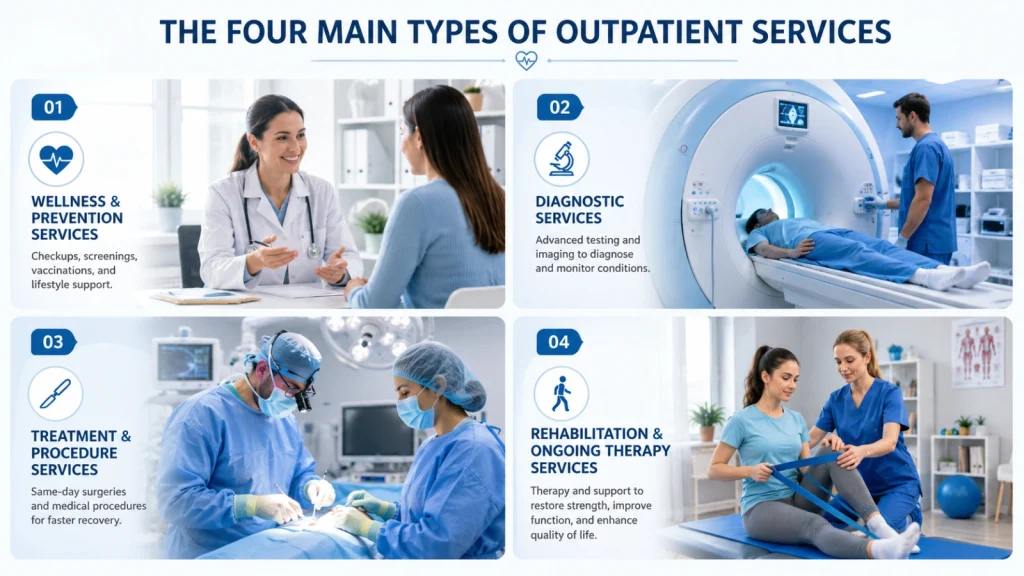
People often search for types of outpatient services because the category is broader than expected. If you have ever wondered what is outpatient services, the simplest answer is medical care that does not require an overnight hospital admission. Outpatient care includes everything from annual checkups to chemotherapy.
1. Wellness and Prevention Services
Preventive care is one of the most common forms of services. These visits focus on identifying health issues early or helping people stay healthy long term.
Examples include:
- Annual physical exams
- Vaccinations and immunizations
- Blood pressure screenings
- Cholesterol testing
- Nutritional counseling
- Weight management programs
- Mental health assessments
Insurance coverage can vary here. Some preventive outpatient services are fully covered under health plans, while others may involve copays or deductibles.
2. Diagnostic Services
Many people use outpatient services without realizing it during diagnostic testing.
If you have ever visited a lab for blood work or scheduled an MRI, you have already used outpatient care.
Common outpatient diagnostic services include:
- Blood and urine testing
- MRI scans
- CT scans
- X-rays
- Mammograms
- PET scans
- Colonoscopies
- Endoscopies
- Cardiac monitoring
- Echocardiograms
These services help doctors confirm diagnoses, monitor chronic conditions, and guide treatment decisions.
3. Treatment and Procedure Services
This category surprises people the most. Many surgical and medical treatments now qualify as outpatient services.
Same-day procedures are increasingly common because recovery times have improved significantly.
Examples include:
- Cataract surgery
- Hernia repair
- Gallbladder removal
- LASIK eye surgery
- Knee arthroscopy
- Dental implants
- Root canals
- Chemotherapy sessions
- Radiation therapy
- Dialysis
- Infusion therapy
Years ago, many of these treatments required hospitalization. Today, patients often recover safely at home within hours.
4. Rehabilitation and Ongoing Therapy
Outpatient services also support recovery after surgery, injury, or illness.
These programs are designed to improve mobility, communication, strength, and daily function over time.
Common rehabilitation services include:
- Physical therapy
- Occupational therapy
- Speech therapy
- Cardiac rehabilitation
- Pulmonary rehabilitation
- Substance use recovery programs
- Post-surgical therapy
Some patients attend outpatient rehab for weeks or even months, depending on their recovery goals.
Where Outpatient Services Are Actually Delivered
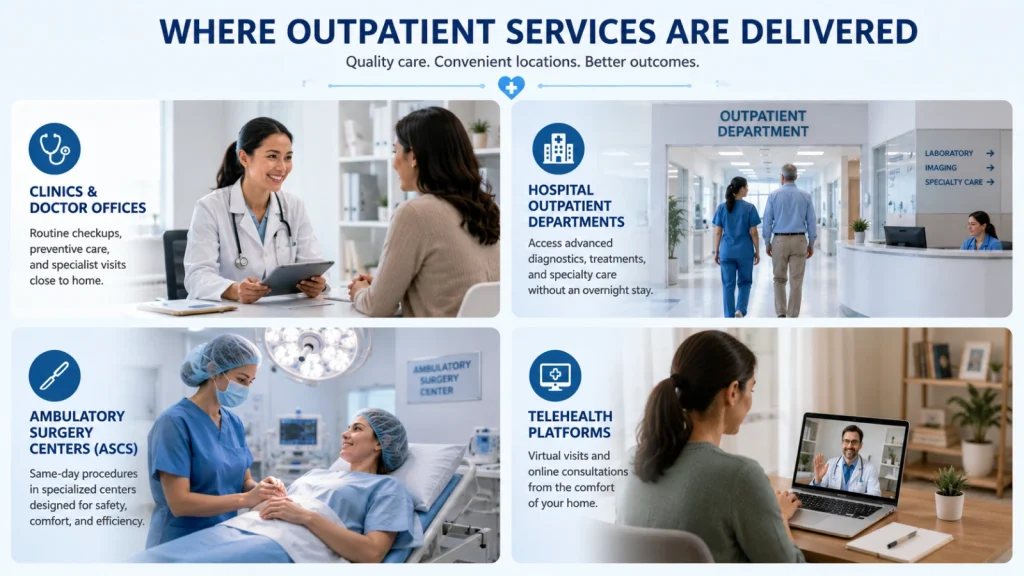
Many people picture outpatient service happening inside a small clinic. In reality, outpatient care happens across many different healthcare settings.
Primary care offices handle routine preventive visits and chronic disease management. Specialist clinics provide focused care for areas like cardiology, dermatology, or orthopedics.
Hospital outpatient departments are another major category. Even though these departments are physically located inside hospitals, patients are still classified as outpatients if they are not formally admitted.
Ambulatory Surgery Centers, often called ASCs, specialize in same-day procedures. These facilities usually focus on efficiency and lower-cost surgical care.
Other common outpatient settings include:
- Urgent care centers
- Imaging centers
- Community health clinics
- Behavioral health facilities
- Dialysis centers
- Infusion therapy centers
- Telehealth platforms
The location itself does not determine outpatient status. Admission status does.
The Gray Zone Most Patients Never Hear About: Observation Status
Observation status confuses patients more than almost anything else in healthcare billing.
Here is why.
You can stay inside a hospital for many hours, sometimes even overnight, and still technically be classified as an outpatient.
This is called observation status.
Hospitals use observation status when doctors need extra time to monitor symptoms, evaluate test results, or determine whether full admission is necessary.
From the patient’s perspective, it can feel identical to inpatient care. You may receive medications, meals, scans, and monitoring inside a hospital room.
The billing difference, however, can be significant.
For Medicare patients, especially, outpatient observation status falls under Part B rather than Part A coverage rules. That affects medication costs, deductibles, and eligibility for skilled nursing coverage afterward.
A patient might spend two nights in a hospital and still receive outpatient billing.
That is why asking questions matters.
Before or during a hospital stay, ask directly:
“Am I considered inpatient or outpatient under observation status?”
Federal law now requires hospitals to notify Medicare patients if they are placed under observation status for an extended period.
Outpatient Mental Health Services: An Area Growing Rapidly
Mental health outpatient services have expanded quickly in recent years, yet many healthcare articles barely mention them.
For millions of people, outpatient mental health treatment provides structured support without requiring residential hospitalization.
Standard Outpatient Therapy
This is the most familiar form of outpatient mental healthcare.
Patients meet with therapists, psychologists, counselors, or psychiatrists regularly for treatment and ongoing support.
Sessions may include:
- Individual therapy
- Family therapy
- Couples counseling
- Group therapy
- Medication management
Standard outpatient therapy works well for mild to moderate mental health conditions and long-term emotional support.
Intensive Outpatient Programs (IOP)
An Intensive Outpatient Program offers a higher level of care than weekly therapy.
Patients usually attend treatment several days per week for multiple hours each day while continuing to live at home.
IOPs are commonly used for:
- Depression
- Anxiety disorders
- Substance use disorders
- Eating disorders
- Mood disorders
These programs provide structure and accountability without requiring 24-hour supervision.
Partial Hospitalization Programs (PHP)
Partial Hospitalization Programs involve even more intensive treatment.
Patients often attend therapy and medical monitoring sessions five days per week for several hours daily.
PHPs are frequently used as:
- A step-down option after inpatient psychiatric care
- A step-up option when weekly therapy is not enough
Despite the name, PHPs are still classified as outpatient services.
Most insurance plans, including Medicare, provide at least partial coverage for outpatient mental health treatment. Coverage rules, however, vary widely between plans.
Outpatient vs. Inpatient: Understanding the Real Difference
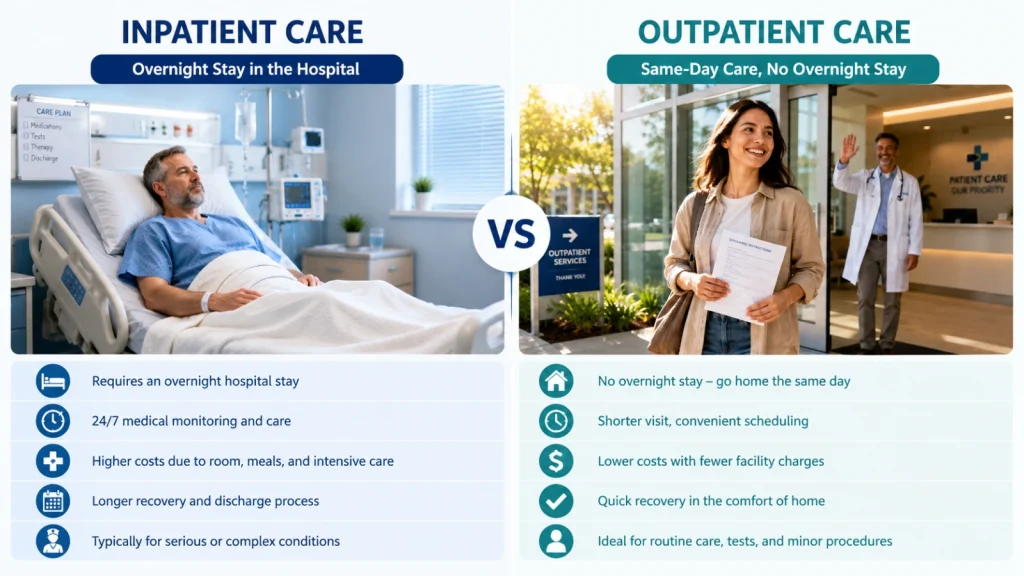
Many people believe the difference between inpatient and outpatient care depends on whether you are physically inside a hospital.
That is not correct.
The real distinction is whether a physician formally admits you for overnight hospital care.
| Dimension | Outpatient | Inpatient |
| Overnight stay | No | Yes |
| Admission order required | No | Yes |
| Typical cost | Lower | Higher |
| Insurance classification | Outpatient benefits | Inpatient benefits |
| Recovery location | Home | Hospital |
| Best for | Diagnostics, minor surgery, preventive care | Serious illness, emergency care, major surgery |
| Common examples | MRI, colonoscopy, cataract surgery | ICU care, pneumonia treatment, heart surgery |
Doctors determine the classification based on several factors:
- Procedure complexity
- Expected recovery time
- Safety concerns
- Monitoring requirements
- Whether formal admission is medically necessary
The setting alone does not determine the category.
How to Access Outpatient Services Without Getting Burned
Healthcare becomes much less stressful when you know what questions to ask before treatment begins.
A few simple steps can help you avoid surprise bills, denied claims, and unnecessary confusion.
Step 1: Confirm Your Procedure Status Before the Appointment
Always ask your provider whether your care will be classified as outpatient or inpatient.
That single distinction affects insurance coverage, billing rules, and out-of-pocket costs.
It also helps to request the CPT or HCPCS billing codes before your visit. Those codes allow your insurance company to estimate your costs more accurately.
If surgery is involved, ask where the procedure will happen.
A hospital outpatient department may cost significantly more than an Ambulatory Surgery Center for the same procedure.
Step 2: Verify Insurance Coverage Early
Never assume all outpatient services are covered equally.
Before treatment:
- Confirm the procedure is covered
- Verify whether the provider is in-network
- Ask about deductibles and coinsurance
- Clarify whether preauthorization is required
- Confirm which part of Medicare applies if relevant
Even routine outpatient services can become expensive when providers are outside your insurance network.
Step 3: Choose the Right Facility Carefully
Not every outpatient facility offers the same pricing, experience, or quality standards.
Accreditation matters.
Look for facilities accredited by recognized organizations and confirm physicians are board-certified in the appropriate specialty.
Patients often overlook this step because outpatient care feels less serious than hospitalization. That can be a costly assumption.
Step 4: Review Bills and Benefits Closely
Request an itemized estimate before treatment whenever possible.
Afterward, review your Explanation of Benefits carefully.
Look for:
- Incorrect billing classifications
- Duplicate charges
- Out-of-network fees
- Observation status designations
If something looks wrong, ask for clarification immediately.
Read More!
How To Choose The Best Ehr Systems For Your Hospital ?
Top 10 Benefits of Hospital Information Systems (HIS)
Common Misconceptions About Outpatient Care
Misunderstandings about outpatient services can create unnecessary stress and financial surprises.
Myth 1: If I Am Inside a Hospital, I Must Be an Inpatient
False.
Many hospital visits, surgeries, and observation stays are still classified as outpatient care.
Myth 2: Outpatient Care Means Lower Quality Treatment
Not necessarily.
Many outpatient surgery centers specialize in high-volume procedures and often produce excellent outcomes.
Myth 3: Observation Stays Are Always Short
Observation status can last much longer than people expect.
Some patients remain under observation for two or three days while still classified as outpatients.
Myth 4: Insurance Covers Every Outpatient Facility the Same Way
Coverage varies widely.
Two facilities performing the same outpatient procedure may charge very different amounts depending on contracts, location, and billing structure.
Myth 5: Outpatient Mental Health Programs Are Not Serious Treatment
Programs like IOPs and PHPs are structured, evidence-based forms of care used across major healthcare systems.
How Medcore Fits Into the Outpatient Services Landscape
Navigating outpatient services can feel overwhelming because healthcare decisions rarely involve just one step.
Patients often need to compare facilities, understand insurance rules, coordinate appointments, and prepare for billing questions all at once.
That is where platforms like Medcore can help simplify the process.
Depending on the services available, Medcore can assist with:
- Appointment booking with live OPD queue visibility
- Telemedicine with integrated virtual consultations
- Insurance and TPA claims support for outpatient procedures
- In-app lab reports and prescription QR access for patients
- Real-time appointment reminders and discharge follow-ups
For patients managing ongoing outpatient care, having centralized support can reduce confusion and save time.
The Future of Outpatient Care
Healthcare delivery continues moving toward outpatient care models.
Industry forecasts expect outpatient visits and same-day procedures to grow steadily over the next several years.
Telehealth is also reshaping how outpatient services work.
Virtual appointments now handle:
- Mental health therapy
- Medication management
- Follow-up visits
- Chronic disease monitoring
- Routine consultations
Artificial intelligence is beginning to improve outpatient diagnostics as well. Faster imaging analysis and automated lab workflows may reduce waiting times for patients.
Another major shift involves Hospital-at-Home programs.
These programs allow certain patients to receive advanced monitoring and treatment inside their homes rather than traditional inpatient settings.
Meanwhile, Ambulatory Surgery Centers continue expanding because many procedures can now be completed safely outside large hospitals.
The trend is clear. Healthcare is becoming more flexible, decentralized, and patient-focused.
Understanding outpatient services now prepares patients for how medical care will increasingly work in the future.
Conclusion: Navigate Outpatient Care With Confidence
Outpatient services now cover far more than quick clinic visits.
They include advanced diagnostics, same-day surgery, rehabilitation, chronic disease treatment, and structured mental health programs. For many patients, outpatient care has become the standard way modern medicine is delivered.
The system can still feel confusing. Billing classifications, insurance rules, and observation status create uncertainty that many patients never expect.
Still, understanding how outpatient services work gives you a major advantage.
You now know what questions to ask, how to compare facilities, when to verify insurance coverage, and how to avoid common billing surprises.
Most importantly, outpatient care is designed around flexibility. It allows people to receive medical treatment while spending less time away from work, family, and daily life.
If you are preparing for an upcoming procedure or exploring treatment options, consider speaking with your healthcare provider or using resources like Medcore to make informed decisions about your outpatient care journey.
Frequently Asked Questions
What is the difference between outpatient and inpatient services?
Outpatient services do not require formal hospital admission or overnight stays. Inpatient care involves a physician’s admission order and at least one overnight hospital stay.
Does insurance cover outpatient services?
Most health insurance plans cover services, but coverage levels vary. Costs depend on deductibles, copays, coinsurance, and whether the provider is in-network.
Can I go to the ER and still be considered an outpatient?
Yes. If you visit the emergency room and are treated without formal admission, the visit is usually classified as outpatient care.
What are examples of outpatient surgical procedures?
Common outpatient surgeries include cataract surgery, colonoscopy, LASIK, hernia repair, gallbladder removal, knee arthroscopy, carpal tunnel surgery, and dental implant procedures.
Is outpatient care cheaper than inpatient care?
In many situations, yes.
Outpatient services often cost less because patients do not require overnight hospital stays or extended facility care.