
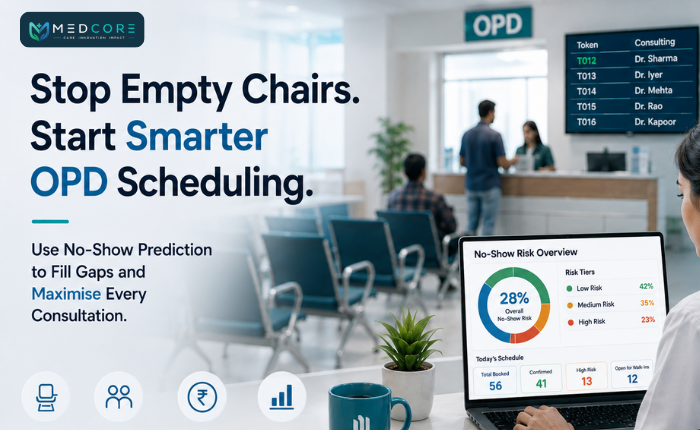
Your 10 am slot looks full on paper. By 10:15, three chairs are empty and your doctor is waiting. Nobody forecasted the no-shows, nobody routed a walk-in to fill the gap, and the lost consultation time simply vanishes it never appears in any report you run at end of day.
This is the most expensive failure mode in Indian OPD management, and almost every clinic I speak to has normalised it. They call it “part of the game.” It isn’t. It’s a solvable operational problem dressed up as an immutable fact of patient behaviour.
The Invisible Revenue Leak
When a booked patient doesn’t show, the slot dies. Unlike a cancellation with lead time where you can rebook a no-show gives you nothing to work with after a certain point. A patient who leaves the waiting area after 20 minutes without a clear ETA may not call back; that’s revenue leakage that never surfaces in your billing dashboard because it was never billed in the first place.
Scale that across a week. India’s hospital market is approximately $200B, with 75% of it underserved by existing technology, and 80% of facilities still run on fragmented OPD workflows. Fragmented workflows mean no historical booking data in structured form which means no ability to predict which patients will skip.
Most practice managers compensate with gut instinct: “Dr. Sharma’s Monday morning slots always have two no-shows, so we overbook by two.” That works until it doesn’t. When it fails and three extra patients show up, you’re running 40 minutes late by noon and the waiting-area tension is audible.
Why Manual Overbooking Is the Wrong Fix
Blanket overbooking is a blunt instrument. It shifts the problem rather than solving it. Instead of an empty chair at 10 am, you get a furious patient at 11:30 who was told to “come at 10” and has been sitting there for 90 minutes. More than three walkaways per session, or frequent rescheduling requests, are threshold signs that a queue system is failing and aggressive overbooking is often the trigger.
The real fix is patient-level no-show probability, calculated before the slot is confirmed, so you can act proportionally rather than uniformly.
How No-Show Scoring Actually Works in Practice
MedCore‘s Predictions Agent includes no-show scoring as one of its core functions, alongside pharmacy demand forecasting and ER triage severity prediction. The mechanism matters: rather than applying a flat rate across all appointments, the agent scores individual bookings. A first-time patient who booked via walk-in the day before, for a new-consult slot, carries a different risk profile than a follow-up patient who has attended seven consecutive appointments.
What you do with that score is where the operational discipline lives. Here’s the framework:
Step 1: Segment, Don’t Average
Split your daily schedule into risk tiers low, medium, high based on no-show scores surfaced before the session starts. A patient flagged at high risk warrants a different response than one at low risk. Treating all bookings identically wastes the prediction entirely.
Step 2: Reserve Walk-In Capacity Deliberately
The recommended hybrid scheduling model 50–60% of capacity in bookable slots, 40–50% reserved for walk-ins exists precisely for this reason. High no-show-risk periods should skew toward the walk-in end of that range. You’re not leaving slots empty; you’re holding them for patients who appear at the door and can fill them the same morning.
Step 3: Trigger Targeted Outreach for High-Risk Bookings
This is where an outbound follow-up workflow earns its keep. MedCore’s Outbound Follow-up Agent contacts patients via voice and WhatsApp not as a reminder blast to everyone, but as targeted re-confirmation for slots flagged as high risk. A patient who confirms via WhatsApp at 8 am is meaningfully more likely to show than one who never acknowledged the reminder. A patient who responds with a reschedule request gives you 90 minutes of lead time to fill the slot, instead of finding out at 10:05 when they simply don’t appear.
Step 4: Build Buffer Slots at Predictable Pressure Points
A buffer slot every 60–90 minutes does two things simultaneously. It absorbs overruns when an unexpected complex case extends a consultation. It also serves as a natural insertion point for walk-ins when a predicted no-show materialises. Without buffer slots, the system has no slack every gap is a crisis, every overrun compounds.
Step 5: Close the Loop at Reception – Fast
When a high-risk slot goes empty at its start time, the front desk needs to make a routing decision in under two minutes. Is there a walk-in waiting who can be moved up? Is there a patient in a lower-priority queue who fits the slot type? Token issuance at reception should take approximately 10 seconds per patient if your desk is also manually juggling a re-sequencing problem, that target collapses. The queue management layer and the no-show prediction layer have to be connected, not running in parallel spreadsheets.
The Hidden Failure Mode at Chain Scale
For multi-branch operations, no-show prediction compounds in importance. One patient can simultaneously exist in three separate department queues cardiology, ophthalmology, ortho in a multi-specialty setup. If any of those appointments are high no-show risk and no one has flagged them, you may have three clinicians holding a slot at the same time for the same patient who isn’t coming to any of them.
That’s not a scheduling edge case. It happens regularly at chains with manual coordination between departments. A shared no-show score, visible to all relevant department desks before the session begins, is the only way to catch it.
What Doesn’t Work (And Why Clinics Keep Doing It)
The most common mistake is treating no-show prediction as a reporting exercise rather than an operational one. A clinic runs a monthly analysis, discovers a pattern in afternoon no-shows, and adjusts their overbooking rule accordingly. Useful but weeks too late to help any individual session that has already passed.
Prediction is only valuable when it’s surfaced before the event and connected to an action. A score sitting in a report that nobody checks before 9 am is not a prediction it’s a historical curiosity.
The second mistake: optimising only for no-shows while ignoring the walk-in absorption side. A clinic that appears “full” on paper but is half-empty in chairs failed twice once by not predicting the no-shows, and again by not routing walk-ins into the gaps. Both failures need a fix. Solving only the prediction side without fixing walk-in routing gives you a more accurate picture of an empty chair. Nothing more.
The Slot Duration Piece Nobody Talks About
No-show scoring also changes how you think about slot duration standards. Named slot durations at reception 5 minutes for follow-ups, 10–15 minutes for new consults, 20 minutes for procedures assume the booked patient shows up. When a 20-minute procedure slot is vacated by a no-show, replacing it with a walk-in follow-up leaves dead time unless the next patient is moved up. The routing decision at reception requires knowing both the no-show score and the slot type before the session begins.
This is why short slot labels like “F/U 5,” “New Adult 12,” and “Proc 20” matter under operational pressure. Front-desk staff making a two-minute routing call cannot be hunting through a detailed schedule. The slot type has to be readable at a glance.
Where to Start if You’re Running This Manually Today
If your practice currently manages this with manually sent WhatsApp reminders and a mental model of which patients tend to skip, you’re not starting from zero you have intuition that can be formalised. The fastest wins:
- Audit which appointment types and booking channels produced the most no-shows over the last 90 days, even from rough records.
- Reserve explicit walk-in capacity in your daily schedule rather than treating every open slot as bookable.
- Set a specific cutoff typically 48–24 hours out for targeted re-confirmation outreach to your highest-risk slots.
- Assign one person at the desk the explicit responsibility of gap management: matching walk-ins to vacated slots in real time.
That framework holds at low volume. It stops working around 30–40 patients per session. That’s exactly when a platform with integrated no-show scoring and outbound follow-up automation starts to justify itself on operational grounds alone before you factor in billing or documentation.
MedCore was built inside a 40-bed hospital in Bangalore. It was refined through a beta with 12 hospitals across Karnataka and Tamil Nadu, then shipped as 45 modules that connect the queue, the prediction layer, and the outreach workflows in one system. The Predictions Agent’s no-show scoring isn’t a bolt-on report it feeds directly into the live OPD queue and can trigger the Outbound Follow-up Agent without manual intervention between the two.
If your OPD regularly looks full on paper and feels half-empty by mid-morning, that’s a solvable problem. Start your free 14-day MedCore trial and see what your actual no-show pattern looks like when the data is structured most practices are surprised by which slots are bleeding and which ones aren’t.