There’s one part of running a healthcare practice that no one gets excited about, but it quietly determines whether your business thrives or struggles: billing.
A delayed claim here, a rejected submission there, and suddenly your revenue cycle starts slowing down. Multiply that across dozens (or hundreds) of patients, and you’re looking at serious financial leakage.
That’s exactly why choosing the right medical billing software in 2026 isn’t just a tech decision it’s a business-critical move.
In this guide, we’ll break down everything you need to know from what medical billing software is to how to choose the best solution for your practice, plus the top options worth considering this year.
What Is Medical Billing Software?

Let’s start with the basics,
Medical billing software is a digital system designed to automate and manage the entire billing lifecycle of a healthcare practice. This includes:
- Creating and submitting insurance claims
- Verifying patient eligibility
- Tracking payments and denials
- Managing patient invoices
- Generating financial reports
Instead of relying on manual processes (which are slow and error-prone), this software streamlines operations and ensures you get paid faster, with fewer mistakes.
In simple terms:
It’s the engine that keeps your revenue cycle running smoothly.
Why Medical Billing Platform Is No Longer Optional
Healthcare billing has become more complex than ever. With changing regulations, coding standards, and payer requirements, manual billing simply can’t keep up.
Here’s how the right software for medical billing transforms your practice:
1. Faster Payments, Better Cash Flow
Automated claim submissions and real-time tracking significantly reduce delays. Clean claims = quicker reimbursements.
2. Reduced Errors & Claim Denials
Built-in claim scrubbing tools catch mistakes before submission, reducing rejections and resubmissions.
3. Improved Compliance
Modern tools stay updated with HIPAA and ICD standards automatically, keeping your practice safe from penalties.
4. Time Savings for Staff
Administrative teams spend less time on repetitive tasks and more time on patient-centric work.
5. Enhanced Patient Experience
Clear billing statements, online portals, and flexible payment options make life easier for patients.
Types of Medical Billing Platform You Should Know
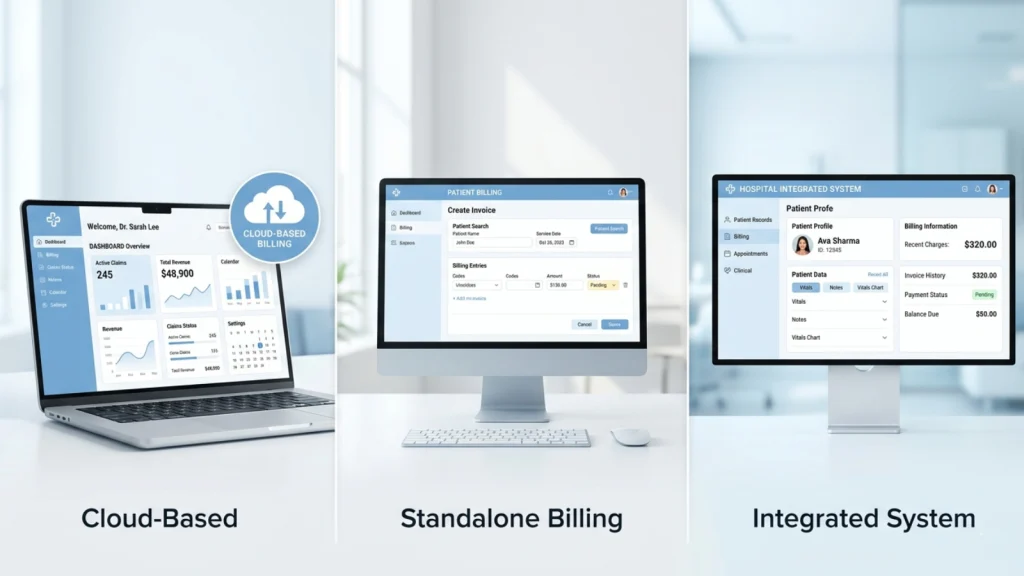
Not all solutions are built the same. Understanding the types helps you pick what fits your workflow best.
1. Cloud-Based Billing Software
The most popular choice in 2026.
Why it works:
- Accessible from anywhere
- No IT infrastructure needed
- Automatic updates and compliance
Best for: Small to mid-sized practices that want flexibility and scalability.
2. Standalone Billing Software
Focused purely on billing functions.
Pros:
- Simple and specialized
- Lower upfront complexity
Cons:
- Limited integration with other systems
3. Integrated Billing Software
Combines billing with EHR, scheduling, and patient management.
Why it’s powerful:
- One unified system
- Eliminates duplicate data entry
Best for: Growing practices that want everything in one place.
4. Custom-Built Solutions
Tailored software designed specifically for your practice.
Best for:
- Large organizations with unique workflows
Drawback: High cost and longer implementation time.
5. EHR-Integrated Billing Systems
Billing directly connected with patient records.
Key advantage:
- Seamless clinical + financial workflow
Key Features to Look for in Medical Billing Software

Choosing the best software for medical billing isn’t about picking the most popular tool, it’s about finding the right fit.
Here’s what truly matters:
✔ Claim Management & Scrubbing
Your software should:
- Submit claims electronically
- Detect errors automatically
- Reduce rejection rates
✔ Seamless Integration
Look for tools that integrate with:
- EHR systems
- Patient management software
- Payment gateways
This eliminates manual data entry and improves accuracy.
✔ HIPAA Compliance & Security
This is non-negotiable.
Ensure your software includes:
- Data encryption
- Access controls
- Regular security updates
✔ Customization Options
Every practice is different.
The right tool should allow:
- Flexible billing workflows
- Custom reports
- Multiple payment methods
✔ Patient Portals
A must-have in 2026.
Patients should be able to:
- View bills
- Make payments
- Track history
✔ Reporting & Analytics
Insight = growth.
Look for dashboards that show:
- Revenue trends
- Claim success rates
- Outstanding payments
Best Medical Billing Software of 2026
Here are some of the top-performing tools dominating the healthcare billing space this year:
1. Tebra
Best for: All-in-one billing + practice management
- Claims management and denial tracking
- Integrated payments and analytics
- Easy-to-use interface
2. AdvancedMD
Best for: Mid-sized practices
- Strong reporting tools
- Integrated EHR and billing
- Scalable pricing options
3. DrChrono
Best for: Mobile-first practices
- iOS-friendly platform
- Real-time eligibility checks
- Automated payment posting
4. NextGen Healthcare
Best for: Enterprise-level solutions
- Comprehensive reporting
- Strong integration capabilities
- Customizable workflows
But here’s something most lists miss, billing doesn’t operate in isolation anymore. Modern hospitals need systems where billing, patient records, pharmacy, lab, and operations all work together in real time. That’s where platforms like Medcore stand out, offering a unified ecosystem instead of just standalone billing functionality.
Medcore: The All-in-One Platform Simplifying Hospital Billing & Operations
If you’re looking beyond just software for medical billing and want a complete hospital management ecosystem, Medcore is built exactly for that purpose.
Instead of juggling multiple tools for billing, OPD management, pharmacy, and lab operations, Medcore brings everything under one platform, with 45 fully integrated modules designed specifically for modern hospitals and clinics.
From the moment a patient walks in to the final billing and even post-visit engagement, the entire journey is connected, automated, and streamlined.
What Makes Medcore Stand Out?
✔ Smart, Healthcare-Ready Billing
- GST-compliant invoicing (CGST + SGST split)
- UPI and Razorpay integration
- Insurance & TPA claims handling
- Refunds, packages, and payment plans
A strong upgrade from typical software for medical billing, especially for Indian practices.
✔ Live OPD & Patient Flow Management
- Real-time token system
- Queue visibility across counters
- Priority tagging for critical cases
✔ Patient Mobile App
- Live queue tracking
- Lab reports & prescriptions via QR
- In-app bill payments
✔ All-in-One System (45 Modules)
- Clinical: EHR, prescriptions, lab orders
- Operations: Admissions, OT, emergency
- Finance: Billing, expenses, reporting
- HR: Payroll, shifts, roles
- Engagement: WhatsApp, SMS, feedback
If your goal is just billing, there are plenty of tools available.
But if you want to simplify your entire hospital workflow, not just billing – Medcore is a powerful choice.
👉 Book a demo and see how it fits your workflow
👉 Try the live demo to experience it in action
Because in 2026, the real advantage isn’t just better billing, it’s connected healthcare operations.
Medical Billing Software Pricing: What to Expect
One of the biggest concerns practices have is cost and rightly so.
Here’s a simplified breakdown:
💰 Subscription-Based (Most Common)
- ₹4,000 to ₹50,000+ per provider/month
- Includes updates, support, and hosting
💰 Percentage-Based Pricing
- 3%–9% of collected revenue
- Ideal for full-service billing solutions
💰 One-Time License (Rare Now)
- High upfront cost
- Minimal recurring fees
Hidden Costs to Watch Out For
Even the best software for medical billing can surprise you with extra charges:
- Setup & implementation fees
- Staff training costs
- Data migration expenses
- Integration fees
- Premium support plans
👉 Always calculate the total cost of ownership, not just the monthly fee.
ROI: Is Medical Billing Platform Worth It?
Short answer: Absolutely.
Here’s why:
- 15–30% faster payments (due to clean claims)
- Lower denial rates
- Significant time savings for staff
- Better financial visibility
Most practices report achieving ROI within 6–12 months.
How to Choose the Right Medical Billing Software
With so many options available, here’s a simple framework to make the right decision:
1. Understand Your Needs
Do you need:
- Basic billing?
- Full revenue cycle management?
- Integrated systems?
2. Evaluate Scalability
Choose software that grows with your practice, not one you’ll outgrow in a year.
3. Test Before You Commit
Always:
- Request demos
- Use free trials
- Involve your billing team
4. Ask the Right Questions
- Does it integrate with existing tools?
- How often is it updated?
- Are there hidden fees?
- What support options are available?
5. Prioritize Ease of Use
The most powerful software is useless if your team struggles to use it.
Special Note: Medical Store vs Medical Billing Software
Many people confuse medical store billing software or medical shop billing software with healthcare billing tools, but they serve different purposes.
- Medical store billing software focuses on inventory, GST billing, and retail pharmacy operations
- Medical billing software is designed for insurance claims, patient billing, and healthcare revenue cycles
👉 If you run a pharmacy, you need store billing software.
👉 If you run a clinic or hospital, you need medical billing software.
Final Thoughts
Choosing the right software for medical billing in 2026 is less about features and more about impact.
The right solution will:
- Speed up your revenue cycle
- Reduce administrative burden
- Improve patient satisfaction
- Give you complete financial visibility
The wrong one?
It’ll cost you time, money, and unnecessary stress.
So take your time, evaluate your needs, and choose a platform that doesn’t just manage billing, but truly simplifies it.
Frequently Asked Questions (FAQs)
1. What is medical billing software?
Medical billing Platform is a digital tool that automates the process of managing healthcare payments. It helps practices create and submit claims, track payments, reduce errors, and streamline the entire revenue cycle.
2. Why is medical billing software important for healthcare practices?
Medical billing software improves accuracy, reduces claim denials, speeds up reimbursements, and minimizes manual work. It ultimately helps practices maintain better cash flow and focus more on patient care.
3. What features should I look for in medical billing software?
Key features to consider include:
- Claim management and error detection
- EHR integration
- HIPAA compliance and security
- Patient billing portals
- Reporting and analytics
These features ensure smoother billing operations and fewer payment delays.
4. How much does medical billing software cost?
The cost varies depending on the provider and features:
- Subscription-based: ₹4,000 to ₹50,000+ per provider/month
- Percentage-based: 3%–9% of collections
- One-time licenses (rare): Higher upfront cost
Additional costs may include setup, training, and integrations.