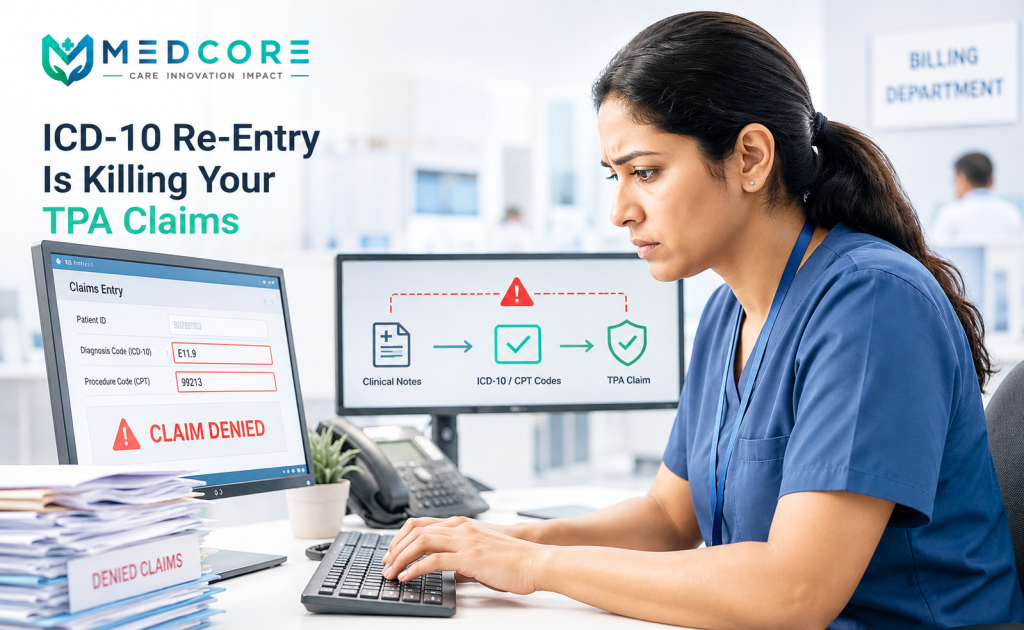
Every denied TPA claim starts the same way: someone retyped a code that already existed somewhere else in the system.
I’ve watched billing teams spend hours chasing denials that were, at root, a transcription problem not a clinical one. The diagnosis was correct. The procedure was correct. But by the time the claim left the hospital, the ICD-10 or CPT code on it had drifted from what the doctor actually documented. That drift is what our billing research describes as “code entry drift” CPT and ICD-10 codes typed by billing staff rather than fed directly from clinical notes. Each retype is, as we’ve put it plainly, a denial risk and a day lost in AR.
Most hospitals know denials are a problem. Few have correctly diagnosed where the break happens.
The Real Break in the Chain
Here is the typical workflow in an Indian mid-size hospital. Doctor sees patient. Doctor dictates or scribbles a note. Note goes to a medical records officer, who assigns codes. Those codes get handed verbally, on paper, or via a shared spreadsheet to the billing desk. Billing staff enter them into the claim form. Each hand-off is a chance for error.
Now add the clinical changes that happen after the initial note: a day-care case shifts to in-patient, or an implant gets added to a surgical package. These changes rarely make it into the claim because staff are re-entering details by hand at each step. The claim goes out reflecting a reality that no longer exists. The TPA rejects it. The hospital raises an appeal. AR days climb.
According to 2025 denial management data, the most frequent rejection triggers are coding errors with ICD-10 or CPT codes, missing medical necessity documentation, and eligibility inaccuracies. All three are downstream effects of the same upstream problem: the clinical record and the claim are produced by two separate, manually-linked processes.
Why “Train Your Coders Better” Doesn’t Fix This
The instinctive response is staff training. Understandable. Undertrained staff who struggle with coding and payer rules do increase denial risk that’s real. But training addresses competence, not architecture. Even a perfectly trained coder working from a paper note can introduce drift. The note is a lossy summary. It doesn’t carry the structured code; it carries prose. The coder infers the code from the prose. That inference step is where the error lives, and training cannot eliminate inference entirely.
The fix isn’t better inference. It’s removing the inference step.
The Workflow That Actually Stops It
MedCore approaches this as a chain-of-custody problem, not a training problem. The claim should inherit its codes from the clinical note directly no re-entry, no interpretation gap.
Here’s how the connected workflow runs:
- Ambient documentation at the point of care. The Scribe Agent captures the consultation as a SOAP note with speaker tagging and pre-fills ICD-10 and CPT codes before the doctor leaves the room. The code isn’t inferred later from prose it’s anchored to the clinical event in real time.
- Codes travel with the note. Because the Scribe Agent’s output is structured, the ICD-10/CPT pre-fill is machine-readable, not a free-text field a human has to interpret downstream. When clinical facts change procedure upgraded, consumable added those changes update the structured record, not just a narrative.
- The Claims Agent reads from the structured record. MedCore’s Claims Agent reads the diagnosis, procedures, and consumables from the SOAP output and pre-fills the TPA claim using those same ICD-10/CPT values. The billing desk reviews and submits they don’t retype.
- Denial-risk prediction before submission. The Claims Agent runs a denial-risk check on the draft claim before it leaves the system. If a code pairing is flagged mismatched procedure and diagnosis, missing supporting documentation it surfaces the issue while there’s still time to fix it, not after the TPA has already rejected it.
The result is that the code on the claim is the same code the doctor’s note generated. Not a copy of a copy. Not an inference from prose. The same structured value, carried forward without human transcription in between.
What This Requires From Your Setup
This workflow depends on a few things being true simultaneously, and it’s worth being honest about the dependencies.
First, your clinical documentation has to be structured at source. An ambient scribe that produces only a PDF note doesn’t help the claims workflow the claims system can’t read a PDF the way it reads structured data. MedCore’s Scribe Agent produces the code pre-fills as part of the SOAP output specifically so the Claims Agent can consume them downstream.
Second, your system needs to handle the SNOMED-to-ICD-10 mapping cleanly. SNOMED CT and ICD-10-CM don’t map 1:1 some ICD-10 codes carry laterality or episode-of-care information that SNOMED concepts don’t natively encode. This is where clinical routing and code pre-fill can diverge if the system isn’t built to handle the gap. MedCore’s Triage Agent uses SNOMED-anchored routing for symptom intake; the ICD-10/CPT pre-fill in the Scribe Agent is a separate, code-specific layer. The two are connected, but the mapping gap is real and any system you evaluate should have a documented approach to it.
Third, you need interoperability if you’re pulling in external records. FHIR R4 APIs and HL7 v2 inbound let external data flow into your clinical record in structured form. ABHA linking under ABDM extends that to national health ID records. Without these, external data arrives as scanned PDFs which someone has to re-read and re-key before claiming, reintroducing the exact transcription risk you’re trying to close.
The Non-Coverage Denial You Can’t Automate Away
Code drift is the biggest structural cause of denials, but it isn’t the only one. Non-coverage denials happen when patients arrive unaware of their authorizations or out-of-pocket obligations and no claims agent can fix a prior-authorization that wasn’t obtained before the procedure.
This is where the AI Voice Receptionist matters more than people expect. When it qualifies callers and books them into the OPD queue, it can surface coverage and authorization requirements at the point of scheduling before the patient arrives, before the procedure happens, before there’s anything to deny. The denial-risk prediction in the Claims Agent can flag likely non-coverage issues at submission, but the cheapest intervention is always the one that happens earliest.
One Practical Starting Point
If you’re trying to audit your own denial exposure before changing any system: pull your last 90 days of denied TPA claims and categorize them by type coding mismatch, missing documentation, eligibility, duplicate. Most hospitals find their denials concentrate heavily in one or two categories rather than spreading evenly across all of them. That concentration tells you which part of the chain is breaking.
If the concentration is in coding mismatch codes on the claim don’t match codes in the clinical record the break is almost certainly the re-entry step. That’s the architecture problem, not the training problem. And architecture problems don’t respond to training solutions.
The broader picture of how billing, GST compliance, and claims connect in a modern Indian hospital is worth reading alongside this. The ICD-10 re-entry problem doesn’t exist in isolation it sits inside a billing stack that also has to handle CGST/SGST splits, Razorpay/UPI payment reconciliation, and DPDP Act data residency requirements. Fixing one seam without understanding the others just moves the problem.
MedCore’s 14-day free trial includes the full claims workflow the Scribe Agent, the Claims Agent, and the denial-risk check so you can run your actual case mix through it before committing. Start your free MedCore trial and see how many of your current denials trace back to a retype.