The denial letter arrives after the patient has left, the bed has been filled twice over, and the billing team has already moved on. That’s the trap. Most hospitals treat denials as a collections problem when they are actually a documentation problem one that starts the moment a doctor finishes an exam and someone opens a spreadsheet to type the codes by hand.
MedCore was built inside a 40-bed hospital in Bangalore, which means the team watched this failure mode up close. As our billing research has documented, the root causes of most Indian hospital claim denials are not mysterious they are four specific, repeatable data-entry failures. Fix those four, and denial rates fall. Leave them, and you are paying between $25 and $181 to rework every rejected claim, according to OS Healthcare’s 2025 denial-rate analysis.
The Four Failure Points Nobody Audits
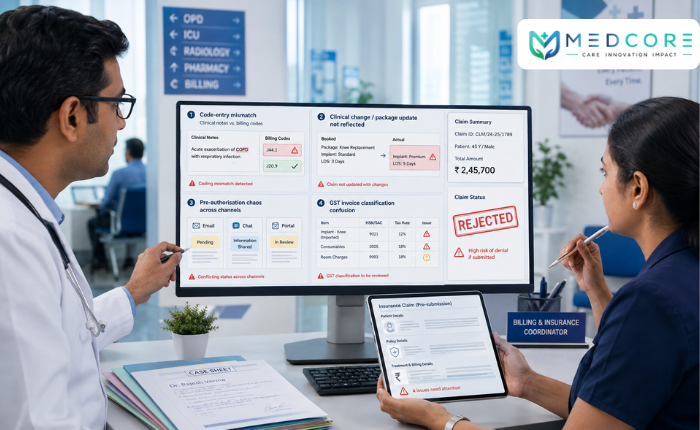
1. Code-Entry Drift: The Gap Between the Doctor and the Billing Desk
A physician documents a procedure. A billing staffer, working from a printed or verbal summary, translates that into CPT and ICD-10 codes from memory or a lookup sheet. Two people. Two interpretations. One claim.
This is what our billing team calls code-entry drift CPT and ICD-10 codes typed by billing staff rather than fed directly from clinical notes. The doctor might document “right knee arthroscopic meniscectomy with partial synovectomy.” The billing desk submits a code that covers the meniscectomy but drops the synovectomy. The payer audits. The claim comes back. And now someone spends half a day on a rework cycle that never had to happen.
The fix is structural, not motivational. The Scribe Agent in MedCore captures the consultation as ambient audio and applies speaker tagging to separate the physician’s voice from the patient’s. It then produces a structured SOAP note with ICD-10 and CPT codes pre-filled from the clinical narrative not re-entered from it. That note feeds the Claims Agent directly. The billing team reviews and confirms; they do not retype.
2. Clinical Changes That Never Reach the Claim
A patient is admitted for a day-care procedure. Overnight complications shift it to an inpatient stay. Or a surgical package adds an implant that was not in the original pre-auth. These are common. What is also common: the claim goes out reflecting the original plan, not the actual care delivered.
Package drift addendum charges not captured automatically when clinical details are re-entered by hand is cited as a CFO-level loss source, and it is easy to see why. The denial comes in, the team investigates, and they find the claim simply did not reflect what happened in the ward. The clinical record and the billing record diverged somewhere between the nursing station and the billing desk.
When the SOAP note is the source of truth for the claim, and the claim drafts automatically from that note, the gap closes. The Claims Agent in MedCore auto-drafts the TPA claim from the SOAP output and ICD-10 coding, which means a clinical change captured in the Scribe Agent flows into the claim without a second manual entry step.
3. Pre-Auth Chaos Across Too Many Channels
Ask any billing coordinator at a mid-size hospital how pre-authorisations are tracked. The honest answer is usually: email threads, a WhatsApp group with the TPA liaison, a portal that logs out every 20 minutes, and a notebook on someone’s desk. No single audit trail. No escalation path if the liaison goes on leave. No visibility for the administrator who wants to know how many pending pre-auths are sitting unresolved tonight.
Pre-auth queues managed across email, portals, and WhatsApp with no single audit trail is one of the named root causes of Indian hospital claim denials, and it causes two distinct problems. The first is a missing document at claim time if the pre-auth response came via WhatsApp and nobody saved the PDF, it is not in the file when the payer asks for it. The second is a discharge delay: patients sitting in a ward bed while staff chase a pre-auth that should have been resolved 12 hours earlier.
The Agent Console in MedCore consolidates escalations in one screen, with full transcript of every agent interaction and one-click hand-off to a human. For pre-auth specifically, that means the coordinator sees every outstanding item, every communication, and every pending document in one place not spread across three apps.
4. GST Misclassification on the Invoice Itself
This one is specific to India and underappreciated outside finance teams. Healthcare services under SAC 9993 are exempt from GST. Non-clinical add-ons premium room upgrades, interpreter services, wellness packages, cosmetic procedures without therapeutic intent are taxed at 18%. The ₹5,000/day room charge threshold is a practical test case: rooms priced above that level trigger the taxable classification.
When billing staff manually map HSN/SAC codes to line items, GST misclassification an exempt procedure billed as taxable, or vice versa appears on the invoice before the claim is even drafted. A TPA reviewing a claim with a GST error on the supporting invoice has grounds to query or deny. MedCore’s GST-aware invoicing auto-splits CGST and SGST and connects to Razorpay and UPI payment flows with the classification logic built in, so the error has fewer places to enter.
What the Data Actually Shows in 2025
None of this is theoretical anxiety. Benchmarking data for 2025 shows the overall initial denial rate climbed from 11.4% to 11.6%, with final denial rates moving from 2.5% to 2.7%. Amounts at stake are rising too: denied inpatient claim amounts increased 12% and outpatient amounts 14% year over year. And approximately 20% of all medical claims are denied, with the rate climbing as insurance plans grow more complex.
The hospitals losing the most are not losing because their care was inadequate. They are losing because their documentation workflow has a gap between the clinician and the claim file.
A Practical Pre-Submission Checklist
Before any TPA claim goes out, run this check. The billing coordinator should confirm each point without opening a second system or calling a doctor:
- ICD-10 and CPT codes trace to the SOAP note, not to a re-entry. If codes were typed manually from a verbal summary, treat the claim as unverified.
- The claim reflects the actual care delivered, including any inpatient conversion, additional implants, or package addenda that occurred after admission.
- Pre-auth confirmation is in the file not in a WhatsApp thread. The document, the date, the reference number.
- GST classification on every line item matches the correct SAC code. Non-clinical add-ons fall under the taxable 18% rate; therapeutic services under SAC 9993 are exempt.
- Discharge summary and ICD-10 coding have been checked against payer policy terms before submission. TPA claim validation requires this step, and skipping it is the fastest way to generate a request-for-information denial.
If any of those five checks requires the billing team to open a second system, send a message, or trust a re-entry, you have a process risk. The honest fix is to close the gap structurally so the clinical note, the invoice, and the claim are all drawing from the same source rather than being re-typed in sequence.
Where Most Hospitals Actually Are
Roughly 80% of Indian hospital facilities run on fragmented billing and claims workflows, and 75% of the hospital market remains underserved by existing billing technology. That is not a market-size talking point it is the reason denial rates keep climbing even as hospitals invest in better equipment and staff training. The bottleneck is not clinical. It is the handoff between the ward and the billing desk.
Fixing that handoff does not require replacing everything at once. It requires closing the four specific gaps above: code-entry drift, clinical change capture, pre-auth audit trails, and GST classification. Everything else is downstream.
MedCore was designed with 45 modules built and tested with doctors, nurses, and administrators people who live inside these failure modes. The 14-day free trial is the fastest way to run your own claims workflow through the system and see where the gaps are before the next payer audit finds them for you.