Information shared by patients in their treatment process is extremely personal and confidential. Thus, it is very important that hospitals store this data with utmost security.
Hospitals can potentially suffer serious criminal attacks if patients’ data isn’t secured and exposed to unauthorized access. In this blog, we will discuss how patient data security is one of the most important issues in a hospital management system.
The Need For Patient Data Security.
In October 2021, Hillel Yaffe Medical Center, a major hospital in Israel, suffered a ransomware attack that locked its computer systems and encrypted many of its servers. The hospital had to disconnect its network to prevent the attack from spreading
The consequences were serious:
- Doctors and staff lost access to electronic medical records (EMRs).
- Laboratory and imaging results became inaccessible.
- Staff could not properly access patient lists and appointment information
Patients share their confidential information with the medical staff as a part of their treatment journey, and hospitals have full access to that information. Thus, holding complete accountability for this information is one of the primary responsibilities of hospital management.
The Importance of Patient Data Security.
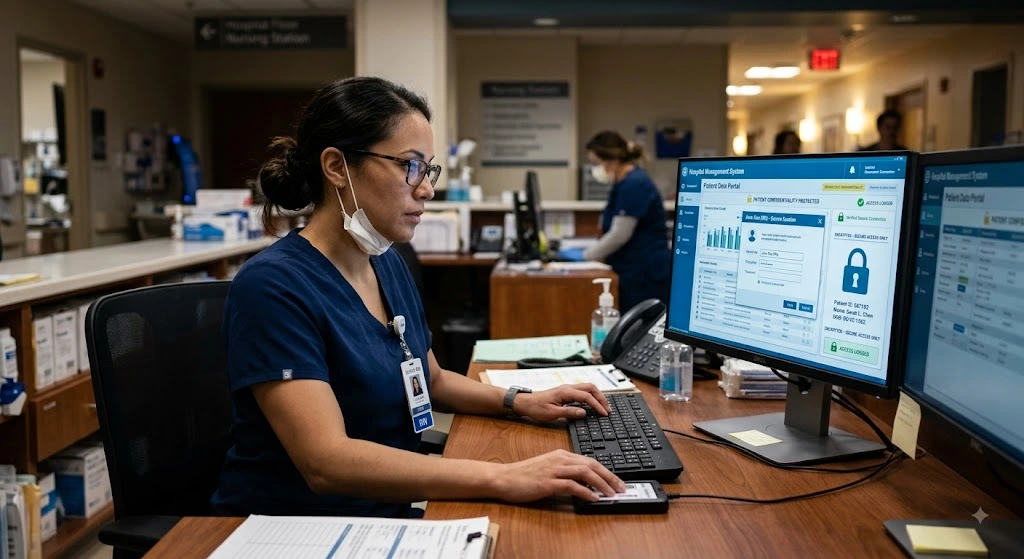
Patient data security is a critical part of modern healthcare management. Hospitals and healthcare providers handle large amounts of sensitive information, including patients’ names, contact details, medical histories, diagnoses, prescriptions, laboratory reports, insurance information, and billing records. If this information is not properly protected, it can be accessed, modified, or stolen by unauthorized individuals. Therefore, maintaining patient data security is essential for protecting both patients and healthcare organizations.
1. Protects Patient Privacy
Patients expect their personal and medical information to remain confidential. Strong security measures ensure that sensitive information is accessible only to authorized doctors, nurses, administrators, and other healthcare professionals. This helps prevent unauthorized disclosure of private health information.
2. Prevents Data Breaches
Healthcare organizations are attractive targets for cybercriminals because they store valuable personal and medical information. Effective security measures such as encryption, access controls, secure authentication, and regular monitoring can reduce the risk of data breaches and cyberattacks.
3. Ensures Accurate Patient Records
Patient records directly influence medical decisions. If someone modifies, deletes, or corrupts important information, it could result in incorrect diagnoses or treatments. Data security helps maintain the accuracy and integrity of medical records.
4. Improves Patient Trust
Patients are more likely to share accurate and complete information with healthcare providers because they trust that their data will be protected. Strong data security demonstrates that a hospital takes patient privacy seriously and helps build long-term trust.
5. Supports Better Healthcare
Doctors need quick and reliable access to accurate patient information to make informed decisions. A secure hospital management system allows authorized healthcare professionals to access necessary records while preventing unauthorized users from viewing or changing them.
6. Helps Meet Compliance Requirements
Healthcare organizations must follow applicable data protection and privacy laws and regulations. Proper security practices help hospitals protect sensitive information and reduce the risk of legal penalties, compliance issues, and disputes.
7. Reduces Financial and Reputational Risks
A major data breach can result in significant financial losses through recovery expenses, legal costs, and regulatory penalties. It can also damage a hospital’s reputation. Investing in data security can prevent these consequences.
8. Protects Against Internal Threats
Not every data security problem comes from external hackers. Unauthorized access by employees, accidental sharing, weak passwords, or misuse of information can also put patient data at risk. Role-based access and activity monitoring can help control these internal risks.
9. Ensures Data Availability
Patient information must be available when healthcare professionals need it. Secure backups and reliable data management systems can help hospitals recover important records in case of system failures, cyberattacks, or accidental data loss.
The Problem: Why Does HMS Fail to Keep Patient Data Safe?

A Hospital Management System (HMS) is designed to store and manage sensitive patient information digitally. However, simply using an HMS does not automatically make patient data secure. Weak security practices, outdated systems, human errors, and poor access controls can expose healthcare data to various risks.
Here are some common reasons why an HMS may fail to keep patient data safe:
1. Weak Access Controls
If an HMS gives too many employees access to sensitive patient information, unauthorized users may view or misuse confidential records. Proper role-based access control is necessary to ensure that employees can access only the information required for their responsibilities.
2. Outdated Software
Older hospital management systems may contain security vulnerabilities that hackers can exploit. Without regular software updates, security patches, and maintenance, the system becomes increasingly vulnerable to cyberattacks.
3. Weak Passwords and Authentication
Simple passwords, shared accounts, and the absence of multi-factor authentication can make it easier for unauthorized individuals to enter the system. Strong authentication is therefore essential for protecting patient records.
4. Human Errors
Employees can accidentally send patient information to the wrong person, click on phishing links, download malicious files, or use unsecured devices. Even a well-designed HMS can become vulnerable because of careless or untrained users.
5. Poor Data Encryption
Patient information should be protected both when it is stored and when it is transferred. If sensitive data is not properly encrypted, attackers may be able to intercept or access it.
6. Lack of Regular Security Monitoring
Hospitals need to continuously monitor their systems for suspicious activity. Without proper logging, monitoring, and alerts, unauthorized access or unusual activity may remain unnoticed for a long time.
7. Inadequate Data Backup
System failures, ransomware attacks, or accidental deletion can result in the loss of important patient records. If hospitals do not maintain secure and regularly tested backups, recovering this information can become extremely difficult.
8. Third-Party Security Risks
HMS platforms may connect with laboratories, pharmacies, insurance providers, cloud services, and other external systems. A security weakness in one connected service can potentially create risks for patient information across the wider healthcare environment.
9. Lack of Employee Training
Technology alone cannot guarantee data security. Employees need regular training on password security, phishing, access controls, data handling, and privacy practices. Without proper awareness, even minor mistakes can create major security problems.
10. Poor Security Policies
Some hospitals may not have clear policies defining who can access patient data, how information should be shared, how long it should be retained, and what should happen after a security incident. Without proper policies and procedures, data can easily be mishandled.
The Solution: Optimized HMS.
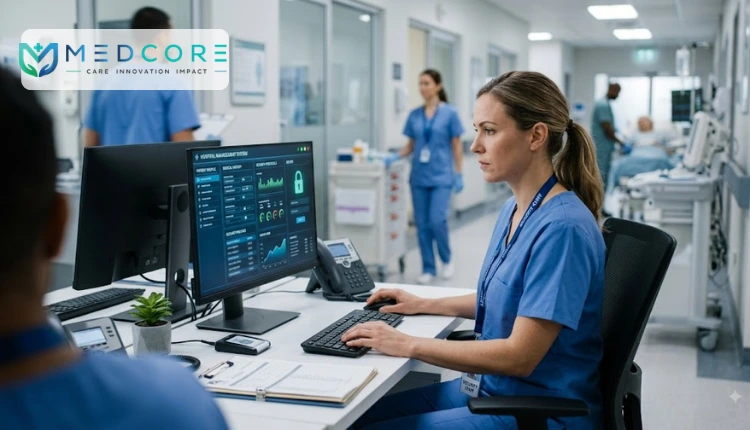
An optimized Hospital Management System (HMS) can significantly improve the way hospitals store, manage, and protect patient information. Instead of relying on basic data storage, a well-designed HMS combines security, automation, access control, monitoring, and reliable data management to protect sensitive information throughout its lifecycle.
1. Role-Based Access Control
An optimized HMS ensures that employees can access only the information required for their specific roles. For example, doctors may access medical records, while billing staff can access payment-related information. This reduces the chances of unauthorized access.
2. Strong Data Encryption
Sensitive patient information should be encrypted both during storage and transmission. Even if someone manages to access the data without authorization, encryption makes it much harder to understand and misuse.
3. Secure Authentication
Features such as strong passwords, multi-factor authentication, and secure login procedures add additional layers of protection. They help ensure that only verified users can enter the system.
4. Automated Data Backups
An optimized HMS can automatically back up important patient records. Secure backups help hospitals recover data in situations such as system failures, accidental deletion, or ransomware attacks.
5. Real-Time Monitoring
Continuous monitoring can identify unusual login attempts, unauthorized access, and other suspicious activities. Administrators can respond quickly before a small security issue becomes a major data breach.
6. Regular Updates and Security Patches
An optimized HMS should be regularly updated to address newly discovered vulnerabilities. Keeping the system and its security components updated reduces the risk of attackers exploiting outdated software.
7. Secure Data Sharing
Healthcare professionals often need to share patient information across departments. An optimized HMS allows authorized users to share relevant information securely without unnecessarily exposing the patient’s complete medical record.
8. Audit Trails
A good HMS keeps a record of who accessed, modified, or shared patient information and when. These audit trails improve accountability and help hospitals investigate suspicious activities.
9. Employee Security Awareness
The system should work alongside proper employee training. Staff should understand how to handle patient information, identify phishing attempts, create strong passwords, and follow hospital security policies.
10. Better Overall Hospital Management
Beyond security, an optimized HMS can streamline patient registration, appointments, medical records, billing, reporting, and communication. This reduces manual errors while making healthcare operations faster and more organized.
Medcore: The Perfect Solution
MedCore is an AI-native Hospital Management System (HMS) designed specifically for Indian hospitals and clinics. It aims to bring clinical care, hospital operations, finance, HR, patient engagement, and AI-powered automation together on a single platform. According to its website, MedCore offers 55+ modules and support for 8 Indian languages.
Key Features of MedCore
- Clinical EHR: Manages patient records, vitals, allergies, diagnoses, prescriptions, lab orders, discharge summaries, referrals, and more.
- OPD & Hospital Operations: Includes live OPD queues, admissions, bed management, emergency workflows, OT scheduling, ambulance dispatch, and blood-bank management.
- Billing & Finance: Supports GST-aware invoicing, UPI and Razorpay payments, insurance/TPA claims, payment plans, refunds, packages, and expense tracking.
- AI-Powered Triage: Uses AI to assist with symptom triage and specialty routing in multiple Indian languages.
- Ambient AI Scribe: Can create SOAP notes during consultations, helping doctors reduce manual documentation.
- AI Radiology: Helps draft radiology findings and impressions, with a human-in-the-loop workflow where the radiologist reviews and approves the output.
- AI Claims Automation: Uses consultation information and coding to prepare TPA claim drafts, reducing repetitive data entry.
- Patient Mobile App: Patients can access live queues, prescriptions, lab reports, appointments, and payments through the mobile application.
- Communication & Engagement: Supports WhatsApp, SMS, email, push notifications, appointment reminders, feedback, complaints, and patient communication.
- HR Management: Includes staff rosters, leave management, payroll, certifications, doctor schedules, and role-based access.
- AI Predictions: Provides features such as no-show prediction, pharmacy demand forecasting, emergency triage severity estimation, and medication adherence reminders.
Why Medcore?
Patient Data Security & Compliance
For your topic of patient data security, MedCore is particularly relevant because it states that its platform includes role-based access controls, audit trails, tenant-scoped EHR data, data residency in India, and DPDP-related capabilities. It also supports ABDM/ABHA, FHIR R4, and HL7 v2 interoperability.
The platform also states that every mutation can be audit-logged and that its AI infrastructure uses India-region inference for certain workflows.
Why MedCore Can Be Useful for Hospitals
The biggest advantage of MedCore is that it goes beyond traditional hospital billing software. It attempts to connect the patient journey, clinical workflow, hospital operations, and financial processes within one system. Its AI agents can automate tasks such as appointment handling, triage, documentation, follow-ups, radiology drafting, and claims preparation.
Conclusion
Patients’ data are among the most sensitive and private data in the world; thus, they become easy targets of criminal hackers.
Losing authority over this data can result in worse consequences that can cause harm to both the patients and the hospital.
Thus, to escape situations like these, hospitals use efficient hospital management systems like Medcore that provide Clinical EHR, AI-Powered Triage, and top-notch data security; medical treatment can become a better experience for both the hospital and the patients.
Frequently Asked Questions
1. Why is patient data security important in hospitals?
Patient data security protects sensitive medical and personal information from unauthorized access, theft, loss, or misuse.
2. What happens if patient data is not secure?
Poor data security can lead to data breaches, privacy violations, financial losses, legal issues, and loss of patient trust.
3. How does an HMS protect patient data?
A secure Hospital Management System can use encryption, role-based access, secure authentication, backups, and activity monitoring to protect patient information.
4. Can patient data security improve patient care?
Yes. Secure and accurate patient records allow authorized healthcare professionals to access the right information when needed, supporting better and safer medical decisions.
5. What should hospitals look for in a secure HMS?
Hospitals should look for strong access controls, encryption, regular security updates, audit trails, secure backups, and compliance with applicable healthcare data protection requirements.