The appointment slot at 11:15 goes empty. The doctor waits. The next patient in the OPD queue wasn’t told to come up because, officially, 11:15 still belongs to someone who left home at 7 a.m. and then didn’t. That’s a no-show. And if your front desk is still treating it as an unpredictable event a shrug, a rescheduled slot, a vague note in the register you’re leaving something fixable on the table.
No-shows are not random. They are patterned. The difference between a clinic that absorbs that pattern and one that acts on it is, increasingly, whether the practice management layer is doing any scoring at all.
Why “We’ll Just Call and Remind” Isn’t Enough
Every clinic calls patients the day before. That’s table stakes. A reminder call treats all appointments as equally likely to stick a follow-up consult for a post-surgical patient, a new-patient booking made four weeks ago, a slot booked by a walk-in family member who may or may not pass the message on. These are not the same risk profile.
The low-risk patient gets a call they didn’t need. The high-risk patient gets the same call and it may do nothing. A patient who booked three weeks ago, came through an unfamiliar channel, and hasn’t confirmed via any touchpoint since needs an actual call, not a template message. That distinction is what a scoring model surfaces. A blanket reminder blast misses it entirely.
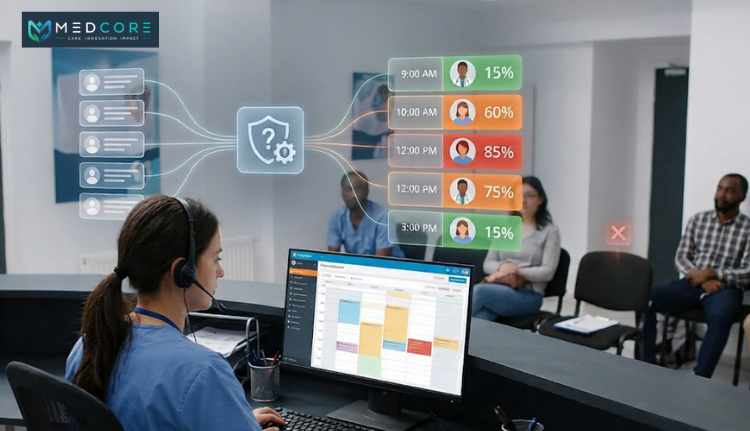
Clinics that run on MedCore get a different starting point. The platform’s Predictions Agent runs a no-show scoring model that evaluates each booked appointment before the day begins. It doesn’t just flag who is at risk it creates a queue-level view of where the OPD schedule is likely to develop gaps, connecting predictive scheduling signals directly to the live queue.
What a Score Actually Measures
The details of any no-show model depend heavily on what signals are available. In a system that connects appointment history, booking channel, lead time, patient type, and live queue data, the score is doing something qualitatively different from a reminder list.
Consider what a front desk team cannot hold in their head at once: how far in advance the slot was booked, whether it was self-booked or staff-booked, whether the patient has a track record with the clinic, which channel the confirmation went through. A scoring model weights all of these continuously across every appointment on the schedule something a three-person front desk handling walk-ins, calls, and WhatsApp simultaneously cannot do.
The practical consequence shows up in queue design. In a single-doctor clinic handling 50 patients in three hours, a five-minute delay repeating ten times pushes the end time by almost an hour. That compounding effect starts with the first unmanaged gap. No-show scoring changes the math by giving the front desk a ranked view before the session begins which slots are almost certain to fill, which are likely to drop, which are genuinely borderline. That ranking is what turns no-show management from a reactive scramble into a planned workflow.
The Action Layer: What You Do With a High-Risk Flag
This is where most discussions of predictive scoring fall apart. Knowing a slot is at risk is useless without a pre-built response. Here’s what the response layer actually looks like in practice.
Targeted outreach, not blanket reminders
A patient flagged as high risk warrants different outreach not the same automated WhatsApp message, but an actual call, or a follow-up through MedCore’s Outbound Follow-up Agent. That agent contacts patients via voice and WhatsApp, then bridges to reception if there’s no response. The goal is to surface the reason for likely absence early enough to act, not to discover it when the slot goes cold at 11:14.
Standby list activation
High-risk flags should trigger standby list review for that time block. This requires the standby list to be a real, maintained queue not a notebook entry and the front desk to have a clear protocol for who calls standby patients and how far in advance. With a live OPD queue that updates in real time, moving a standby patient into a vacated slot can happen in under two minutes if the workflow is pre-set.
Controlled selective overbooking
This is the uncomfortable one. Overbooking gets a bad reputation because it is usually done blindly someone adds a patient “just in case” with no visibility into what the actual schedule looks like. Applied to a specific high-risk slot, with a meaningful probability of non-arrival already in hand, it’s a different calculation. The risk is a queue backup. The risk of not doing it is a wasted consult slot and underutilised physician time. Selective overbooking against a scored slot is a real operational tool it just requires honest probability handling, not wishful thinking.
Try MedCore free for 14 days and see how the Predictions Agent’s no-show scoring integrates with your OPD queue from the first session.
The Downstream Effect Most Clinics Miss
No-shows don’t only waste the empty slot. They distort the rest of the day.
When a patient doesn’t arrive and the slot isn’t filled, the next patients in the OPD queue move up unevenly. If the clinic is running a live token display which MedCore’s OPD queue supports, with real-time Socket.IO updates visible to patients those token estimates drift. Patients in the waiting area see inaccurate wait times. Satisfaction drops. Complaints follow. A high-risk slot that gets proactively backfilled keeps the queue moving as designed, token display accurate, physician time productive.
There’s a second downstream effect worth naming: pharmacy demand. The Predictions Agent also runs a pharmacy demand forecast directly affected by how many patients actually present versus how many were booked. A clinic that accurately predicts its real patient volume for the day is one whose pharmacy isn’t holding unnecessary stock on low-attendance days or running short on high-attendance ones. No-show scoring and pharmacy forecasting are connected signals. Running them from the same platform closes that loop without a separate manual reconciliation step.
Why Indian Clinics Face a Harder Version of This Problem
India’s hospital and healthcare market is valued at approximately $200 billion. Roughly 75% of it remains underserved by existing technology, and about 80% of facilities run on fragmented workflows and manual coordination. That fragmentation means the data that would feed a no-show model appointment history, channel, lead time, confirmation status lives in WhatsApp threads, paper registers, and disconnected booking tools. You cannot score what you cannot see.
Predictive scheduling only works when appointment data is clean, centralised, and connected to the queue in real time. That’s an infrastructure problem before it’s an AI problem. Clinics evaluating any no-show tool should audit their appointment data hygiene first: are bookings captured consistently across every channel? Is cancellation data recorded, or silently overwritten? Are no-shows distinguished from last-minute cancellations in the record?
If the answer to any of those is “sometimes” or “it depends who’s at the front desk,” the scoring model will reflect that noise. Garbage in, confident-looking garbage out.
For a fuller picture of how the OPD scheduling stack connects beyond no-show management, the complete OPD queue and scheduling guide covers slot configuration, buffer logic, and walk-in ratios in detail. If you’re evaluating how no-show rates affect billing missed slots are lost revenue cycle events MedCore’s deep-dive on billing, GST, and insurance claims is worth reading alongside this piece.
The Honest Limitation
No scoring model eliminates no-shows. The patient whose car broke down, the family emergency, the appointment booked for a relative who didn’t know about it these are not predictable. What scoring changes is your baseline: instead of treating every appointment as equally uncertain, you concentrate limited front-desk bandwidth on the slots that genuinely need attention.
That reallocation of attention is the real return. Not a magic number. Not a percentage reduction promised in a sales deck. Just a front desk that spends less time chasing every patient equally and more time on the ones where outreach actually changes the outcome.
A scored list, not a reminder blast. That’s where the difference starts.
Start your free MedCore trial — 14 days, no commitment and see how the Predictions Agent fits into your OPD workflow from day one.