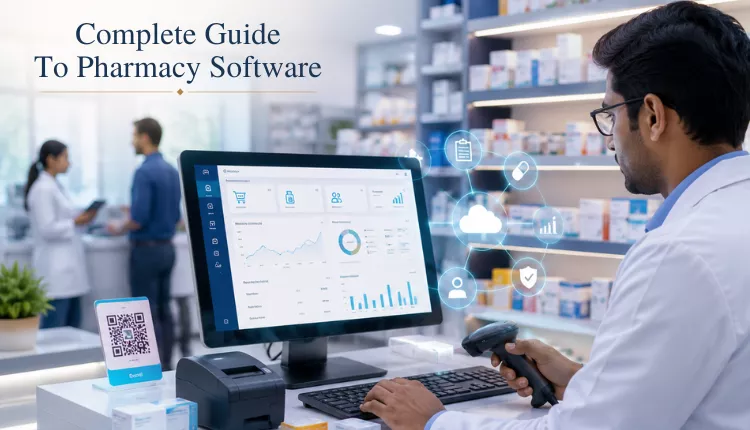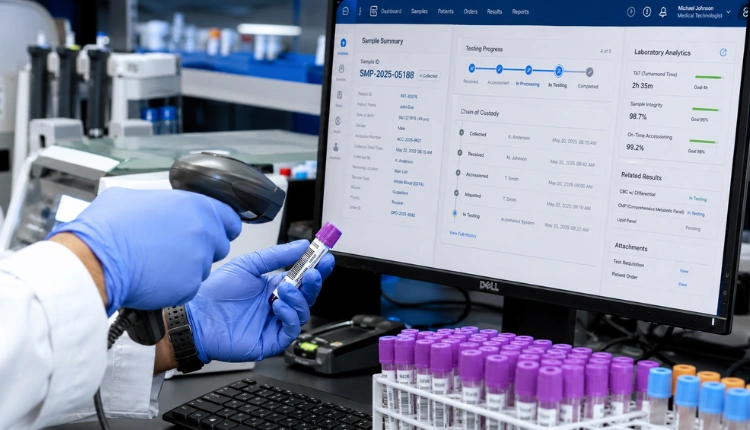
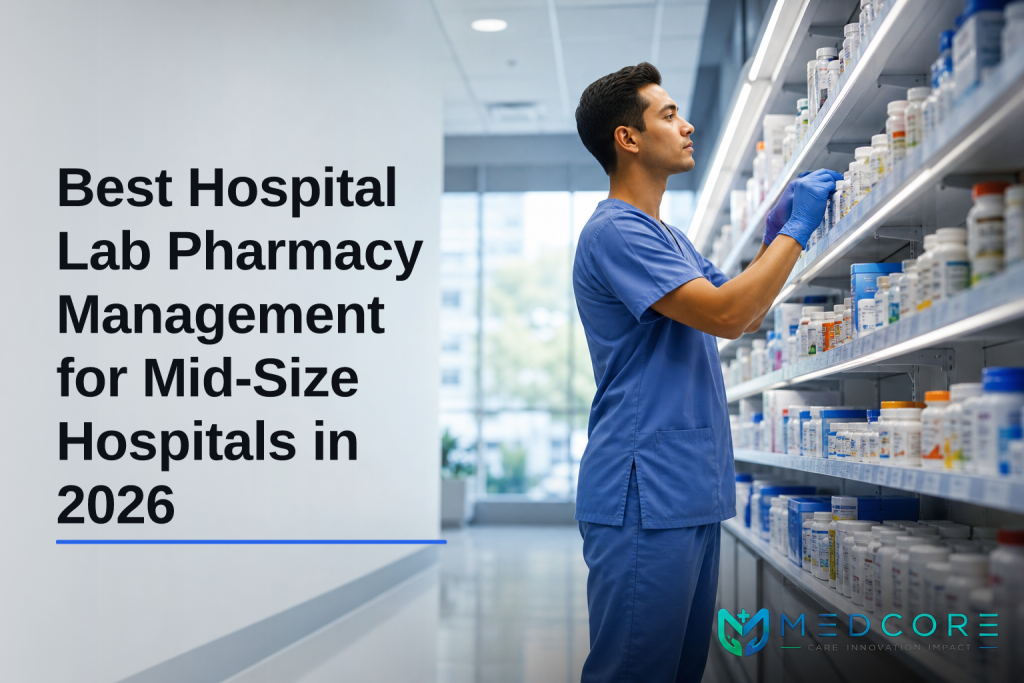
In 2026, the winning setup for AI radiology, lab, pharmacy, and blood bank management is a unified system that links orders, results, stock, billing, and reports without manual re-entry.
Across India, 80% of facilities run on fragmented workflows, and 75% of the market is underserved by existing tech. That mix leads to extra keystrokes, missed alerts, and cash stuck in disputes. For a 50–300 bed hospital, it also means staff spend hours fixing data that software split apart. You feel it every day: duplicates in the LIS, NARCOTICS logs that don’t match billing, and radiology reports that live outside the EHR.
MedCore was built for that reality. It brings one tenant-scoped EHR to lab, pharmacy, radiology, and billing, with AI that speeds up work while a clinician stays in control. Pricing stays flat, no per-bed surprises, and standards like FHIR R4 and HL7 v2 inbound connect to analyzers and PACS you already own. The result is less swivel-chair, fewer errors, and fewer patient complaints.
ai radiology, lab, pharmacy, and blood bank management works best when it runs on one shared EHR with AI that drafts, not decides.
Moreover, this guide is education-first. You’ll get a clear buyer checklist, a candid comparison to legacy HMS/LIS tools, and a practical onboarding plan. You’ll also see where AI helps today and where it still needs a human in the loop.

Why Mid-Size Hospitals Struggle With Lab, Pharmacy, and Radiology Management
Eight out of ten facilities still work across fragmented tools. For a 100-bed hospital, that means lab results in one place, prescriptions in another, and billing in a third. As a result, staff re-enter data and reconcile mismatched IDs for hours each week for ai radiology, lab, pharmacy, and blood bank management.
Errors creep in. Turnaround slows. Patients notice.
In addition, mid-size hospitals carry the same compliance load as large systems but without their budgets. DPDP Act 2023 requires careful data handling. ABDM/ABHA linking asks for clean patient identity and consent flows. Meanwhile, many LIS and pharmacy apps don’t talk to the EHR in real time. Therefore, clinicians wait, call, or export to bridge gaps.
Budget pressure compounds the issue. Per-bed or per-user pricing punishes growth. Per-module add-ons turn “basic” into “bloated” bills by month three. You end up choosing which department gets integrated and which one stays manual. That is a hard trade when radiology, lab, and pharmacy all affect care on the same day for the same patient.
Furthermore, 75% of the market is underserved by current tech. Mid-size hospitals sit in an oversight: too complex for clinic apps, too lean for corporate-hospital stacks. You need depth across lab, pharmacy, radiology, and billing, not just a list of modules. You also need speed: go-live in days, not quarters.
The mid-size reality checklist
- One patient, many orders: results must flow into the EHR and billing without re-entry for ai radiology, lab, pharmacy, and blood bank management.
- Pharmacy needs true stock, batch, and controlled substance logs tied to the chart.
- Radiology needs AI help that saves minutes but keeps the radiologist in charge.
- IT needs FHIR R4 and HL7 v2 inbound so existing analyzers and PACS still work.
- Finance needs flat monthly pricing to plan growth without per-bed math.
For deeper context on rollouts like yours, see this step-by-step piece: How to Choose and Implement Lab, Pharmacy, and Radiology Management for Mid-Size Hospitals.
What to Look for in a Lab, Pharmacy, and Radiology Management System
First, insist on one source of truth for ai radiology, lab, pharmacy, and blood bank management. A single tenant-scoped EHR with shared state across billing, lab, pharmacy, and radiology removes duplicate typing and ID mismatches. Orders, results, stock moves, and bills then live in the same record. That’s how you cut errors without adding headcount.
Second, confirm AI is human-in-the-loop. AI should draft radiology impressions with per-finding confidence and show its work. However, a radiologist must review and sign every report. The goal is faster TAT, not cuts to clinical judgment. The same applies to pharmacy drug-safety checks: AI can flag interactions; a pharmacist approves the plan.
Third, check standards and compliance. FHIR R4 and HL7 v2 inbound support let you connect to current lab analyzers and PACS. DPDP Act 2023 alignment, ABDM/ABHA linking, and India data residency support your legal and patient-trust needs. DLT-compliant SMS matters for reminders at scale. On-premise or dedicated cloud options give you control.
Moreover, for AI radiology, lab, pharmacy, and blood bank management, pricing should be flat per month. Avoid per-bed or per-user fees that penalize busy OPDs. All-in plans help you budget and expand clinics or satellites without calling sales for every seat. In addition, controlled substance tracking must be built in, with audit trails tied back to the EHR. That protects your license and simplifies audits.
Buyer essentials you can verify
- Unified EHR shared across lab, pharmacy, radiology, and billing (one patient timeline) for ai radiology, lab, pharmacy, and blood bank management.
- AI radiology drafting with per-finding confidence and HITL review.
- Drug-safety checks and controlled substance tracking with audit logs.
- FHIR R4 and HL7 v2 inbound for device and PACS connections.
- Flat per-month pricing; no per-bed or per-user fees.
- DPDP Act 2023 compliance, ABDM/ABHA linking, and India data residency.
- Patient app for reports, tokens, and QR prescriptions to cut front-desk load.
For mid-size hospital deployment patterns and medical tourism nuances, this guide goes deeper: How to Set Up Lab, Pharmacy, and Blood Bank Management for Medical Tourism Hospitals in India.
**Get pricing, flat, no per-bed →
Also Read!
Best OPD Queue Management & Appointment Scheduling for Medical Tourism Hospitals in India — 2026
Best Hospital Lab, Pharmacy & Radiology Management for Medical Tourism Hospitals in India — 2026
How MedCore Unifies Lab, Pharmacy, and Radiology for Mid-Size Hospitals
MedCore runs a single tenant-scoped EHR with shared state across billing, lab, and pharmacy, powering ai radiology, lab, pharmacy, and blood bank management end to end. As a result, one order drives lab draws, analyzer results, billing line items, and patient notifications without re-entry. Digital prescriptions include QR codes; pharmacists scan once, see allergies and vitals, and dispense with stock and batch traceability logged to the chart. The blood bank module manages ABO compatibility and links transfusions to the same patient timeline.
In radiology, MedCore’s AI drafts findings and impressions with per-finding confidence. However, a radiologist always reviews, edits, and signs. This human-in-the-loop setup trims minutes per report in ai radiology, lab, pharmacy, and blood bank management and evens out after-hours load. Moreover, the radiology worklist shows clinical context from the EHR, so reads align with the latest labs and meds.
In the lab, delta-flag alerts highlight results that swing beyond set thresholds. Technologists see prior values in-line, reducing misses in high-volume days. In pharmacy, demand forecasts help heads plan purchases. For OPDs that see 150+ patients per day, that steadies stock without tying up cash. Meanwhile, GST-aware billing posts charges and supports Razorpay and UPI for fast collections.
"We replaced three tools with MedCore. Billing, pharmacy and lab now talk to each other without exports." — Ravi Prasad, Administrator, Sunrise Clinic
Furthermore, patient experience improves on day one. The mobile app shows live tokens, lab reports, and bills to pay. Front desks get fewer “Is my report ready?” calls. For example, Dr. Meera Rao saw OPD wait time drop sharply after going live with live token displays and unified queues.
"Our OPD wait time dropped from 40 minutes to 12. The live token display alone was worth the switch." — Dr. Meera Rao, Medical Director, Asha Hospital
AI that assists, not replaces
- AI radiology drafting with HITL and confidence per finding, visible to the reader.
- Drug-safety checks that surface interactions before dispense; pharmacists confirm.
- Predictions that score no-shows and forecast pharmacy demand to improve planning.
 → AI-drafted radiology report (HITL) → pharmacy dispense with QR and controlled substance log → billing and patient app notifications)
ai radiology, lab, pharmacy, and blood bank management inside one EHR means fewer clicks and a smaller chance to miss key context. Compared to alternatives that bolt on LIS or PACS via loose interfaces, MedCore keeps orders, results, and charges in sync by design. That reduces rework and speeds discharge.
MedCore vs. Legacy Hospital Management Systems: An Honest Comparison
Legacy HMS or standalone LIS/pharmacy apps promise modules for ai radiology, lab, pharmacy, and blood bank management. However, they often sync by export or batch jobs. That leaves gaps when staff need data now. MedCore’s shared EHR state keeps everything live and linked. In addition, MedCore focuses on HITL AI, not “auto-reporting.” You keep oversight and gain time.
Moreover, pricing and onboarding matter for ai radiology, lab, pharmacy, and blood bank management at scale. Flat per-month pricing removes per-bed math. A self-serve onboarding wizard brings you live in days, not months. With 55+ modules, you start with the core and add more when you’re ready. The patient app reduces phone traffic with live tokens and reports, which helps front desks breathe.
"The patient mobile app reduced our front-desk calls by half in the first month." — Shalini Kumar, Operations Head, Greenleaf Care
Side-by-side at a glance
| Dimension | MedCore | Legacy HMS/LIS |
|---|---|---|
| Integration Depth | Single tenant-scoped EHR; shared state across billing, lab, pharmacy, radiology | Siloed modules; exports and batch syncs |
| AI Features | AI radiology drafting (HITL) with per-finding confidence; drug-safety checks; demand forecasts | Limited or add-on AI; minimal HITL support |
| Pricing Model | Flat per-month pricing; no per-bed or per-user fees | Per-bed/per-user fees; per-module add-ons |
| Onboarding Speed | Self-serve onboarding wizard; live in days | Vendor-led projects; weeks to months |
| Compliance | DPDP Act 2023, FHIR R4, HL7 v2 inbound, ABDM/ABHA linking, India data residency, DLT SMS | Varies by vendor; features spread across tiers |
| Breadth | 55+ modules with clinical and admin depth | Modules vary; third-party add-ons common |
| Patient Experience | Mobile app with live queue, reports, QR prescriptions, and bill pay | SMS/email portals; limited live info |
 , front-desk calls (reduced by half), OPD wait time (40→12 minutes), pricing predictability (flat vs per-bed); clear labels and Indian hospital context)
Compared to alternatives, MedCore’s ai radiology, lab, pharmacy, and blood bank management approach reduces context switches. Instead of toggling three systems, staff work one patient timeline. That builds speed and lowers error risk on busy days.
For a deeper clinic-scale view, this article can help you cross-check needs with growth plans: Best Hospital Lab & Pharmacy Management for Small Clinics in India, 2026.
Trust, Compliance, and Credentials That Matter
Your hospital holds sensitive health data. Therefore, compliance isn’t optional for ai radiology, lab, pharmacy, and blood bank management.
-
Security & compliance: MedCore aligns with DPDP Act 2023, supports ABDM/ABHA linking, and keeps India data residency.
-
Security & assurances: DLT-compliant SMS keeps patient outreach on the right side of carrier rules; SLAs and uptime credits protect operations.
-
FHIR R4 and HL7 v2 inbound support enable links to analyzers and PACS already on your floor.
-
For national programs and identity linking details, review the official ABDM portal from the National Health Authority: Ayushman Bharat Digital Mission (ABDM).
-
To understand why data standards matter, the FHIR R4 standard explains how modern EHRs exchange data safely and in a structured way.
Social proof: performance data should be public, especially for ai radiology, lab, pharmacy, and blood bank management. At Asha Hospital, OPD wait time fell from 40 minutes to 12 after going live with MedCore’s live token display and queue tools. The patient app further reduced call volume at Greenleaf Care by half in the first month. Those gains improve staff morale and patient trust.
Finally, you choose where to host. On-premise or dedicated cloud options support data sovereignty needs and local IT policies. Authority: with 55+ modules (45 built with direct clinician and admin input), you don’t need to juggle vendors to cover daily work.
ai radiology, lab, pharmacy, and blood bank management is safer and faster when identity, consent, and data exchange all follow the same rulebook, and when your vendor proves it in production.
Also Read!
Best Patient Engagement WhatsApp Reminders for Mid-Size Hospitals in 2026
Best Hospital Billing with GST and Insurance Claims for Medical Tourism Hospitals in India — 2026
Getting Started: Onboarding Lab, Pharmacy, and Radiology on MedCore
MedCore’s self-serve onboarding wizard guides you from signup to first orders in days for ai radiology, lab, pharmacy, and blood bank management. You’ll map master data, connect devices, and set user roles with guardrails along the way. Because lab, pharmacy, radiology, and billing share one EHR, you don’t need to rebuild patient histories four times. The shared state removes most of the migration pain you might expect.
What to prepare
- Current patient and payer lists exported from your EHR (CSV or FHIR if you have it).
- Lab test catalog with reference ranges and delta rules you use today.
- Pharmacy item master with batches, vendors, and min/max stock levels.
- Radiology templates and PACS connection details (HL7 v2 inbound, DICOM routing).
- Controlled substance logs and audit policies.
Second, align a realistic timeline. Day 1–2: data import and device connectivity checks. Day 3–4: role-based access, billing setup, and patient-app branding.
Day 5: pilot OPD with live tokens, lab orders, and pharmacy dispense. Third, review AI guardrails. Radiology drafts stay HITL, and drug-safety checks prompt a pharmacist sign-off.
Pricing for the mid-size tier starts at ₹24,999/mo flat. That includes lab, pharmacy, radiology, and billing modules, no per-bed or per-user fees. With 45 modules built with direct input from doctors, nurses, and administrators, configuration aligns with real ward and OPD flow.
**Start now, instant pricing & tiers →

Frequently Asked Questions
How much does integrated lab, pharmacy, and radiology management cost for a mid-size hospital?
MedCore's mid-size tier starts at ₹24,999/mo flat, no per-bed or per-user fees, for ai radiology, lab, pharmacy, and blood bank management. All lab, pharmacy, radiology, and billing modules are included in that plan. As a result, budgets stay predictable as OPD volumes climb. Compared with legacy vendors that sell per-module add-ons, you don’t have to ration features across departments.
Can MedCore's AI radiology drafting replace a radiologist? No. It’s human-in-the-loop.
The AI drafts imaging impressions with per-finding confidence scores so the radiologist can move faster. However, a radiologist reviews and approves every report before it leaves the system. The tool shortens turnaround time; it does not replace clinical expertise or headcount.

How does MedCore handle controlled substance tracking in the pharmacy module?
MedCore includes built-in controlled substance tracking with audit trails, tied directly to the unified EHR. Prescriptions, dispensing, and stock reconciliation all log to the patient timeline. Therefore, audits are faster because records match across pharmacy and billing. In addition, role-based access helps enforce who can adjust counts.
What compliance standards does MedCore meet for Indian hospitals?
MedCore aligns with DPDP Act 2023 and supports FHIR R4 and HL7 v2 inbound. It also includes ABDM/ABHA linking, DLT-compliant SMS, and India data residency. On-premise and dedicated cloud hosting options are available for data sovereignty and internal IT policies. Those settings are set during onboarding.
Compliance isn’t optional.
How long does it take to onboard a mid-size hospital onto MedCore?
MedCore offers a self-serve onboarding wizard, and most mid-size hospitals go live in days, not months. Data import, device connectivity, and role setup happen in guided steps. The 45 modules were built with input from doctors, nurses, and administrators to reduce configuration time. A small pilot OPD can start first and expand within the same week.
How does MedCore compare to standalone LIS or pharmacy management software?
Standalone tools create data silos for ai radiology, lab, pharmacy, and blood bank management, lab results don’t flow to billing, and pharmacy doesn’t see prescriptions in real time. MedCore uses a single tenant-scoped EHR with shared state across all departments. That means orders, results, dispensing, and charges stay linked to the same patient record. In practice, it cuts rework and lost charges.
Does MedCore support integration with existing hospital equipment and systems?
Yes. FHIR R4 and HL7 v2 inbound support enable integration with existing lab analyzers, PACS, and third-party systems. You can keep your devices and connect them to the shared EHR state. Custom HL7 integrations are available on the Enterprise tier if your site has unusual feeds or needs for ai radiology, lab, pharmacy, and blood bank management.
Keep your devices; connect via FHIR R4/HL7 v2 inbound.
Is MedCore suitable only for Indian hospitals or can it work internationally?
MedCore is built for India first with GST billing, ABDM linking, and support for 8 Indian languages. However, multi-currency billing and international patient coordination also support medical tourism. That includes visa support, translation, and logistics inside workflows. For global rollouts, our team can advise on local data rules.

Final Takeaways
First, mid-size hospitals get the best results when ai radiology, lab, pharmacy, and blood bank management all share one EHR with HITL AI. That cuts errors and speeds care. Second, standards and compliance matter in 2026: FHIR R4, HL7 v2 inbound, DPDP Act 2023, ABDM/ABHA linking, and India data residency protect patients and keep audits smooth. Third, flat pricing and fast onboarding reduce risk so your team can focus on care, not software projects.
If you want to see your orders, results, stock, and bills on one screen, you’ll know it in minutes.
**Book a demo, instant walkthrough →
For a clinic-focused path you can adapt up or down, this article pairs well with your plan: How to Set Up Lab and Pharmacy Management for a Small Clinic in India.