
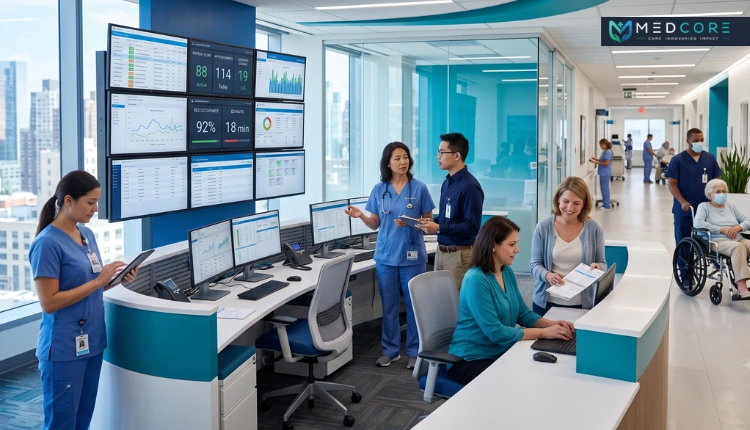
A hospital can employ the finest surgeons and stock the most advanced equipment on the market, and still fail its patients — if the system running behind the scenes is disorganized. Hospital management is what holds everything together. It decides whether a patient waits twenty minutes for a bed or two hours, whether medication reaches the right ward before a shift change, and whether a billing dispute gets resolved in days or drags into months.
Most people only notice management when it breaks down. A lost file, an overbooking at the front desk, a lab result that never made it to the attending physician. Those small, maddening failures almost always trace back to gaps in planning, staffing, or coordination — not to a lack of clinical skill. Understanding how hospitals are actually run explains why some deliver consistent, high-quality care while others struggle with identical resources and budgets.
Defining Hospital Management
Hospital management is the discipline of planning, organizing, coordinating, and controlling the people, processes, finances, and infrastructure that keep a healthcare facility operational. The goal sounds simple: ensure clinical and administrative work move together without one constantly stalling the other. In practice, that means a department head is simultaneously thinking about next quarter’s staffing ratios, today’s bed occupancy, and whether the pharmacy software is talking to the billing module.
It is not a support function. It is the operational backbone that allows doctors, nurses, and allied health professionals to do their actual jobs — diagnose, treat, and care — without drowning in logistics.
Why This Matters More Than Ever in 2026
The numbers tell a stark story. The global hospital management software market was valued at USD 28.39 billion in 2025 and is projected to reach USD 48.72 billion by 2031, growing at a 9.42% CAGR. Zoom out further, and the broader healthcare IT sector — which includes everything from EHR platforms to AI triage tools — was valued at $866.4 billion in 2025 and is on a trajectory toward $2.86 trillion by 2033, at a 16.2% annual growth rate. Those are not speculative figures. They reflect a healthcare industry that has accepted, after years of resistance, that digital infrastructure is not optional.
What is driving the urgency? Partly patient expectations: people now want shorter wait times, itemized, transparent billing, and the ability to book a follow-up appointment from their phone at 11 p.m. Partly complexity: a single patient admitted for a cardiac event might interact with the emergency department, radiology, cardiology, pharmacy, dietary services, and discharge planning before leaving — six or seven handoffs, each one a potential point of failure. And partly cost pressure that has become genuinely punishing. U.S. hospitals and health systems spent an estimated $19.7 billion in 2022 fighting payer denials alone, and registration-related errors now account for 27% of all hospital claim denials. Fixing that figure is not a clinical problem. It is a management and systems problem.
The Five Core Functions — and What They Look Like on the Ground
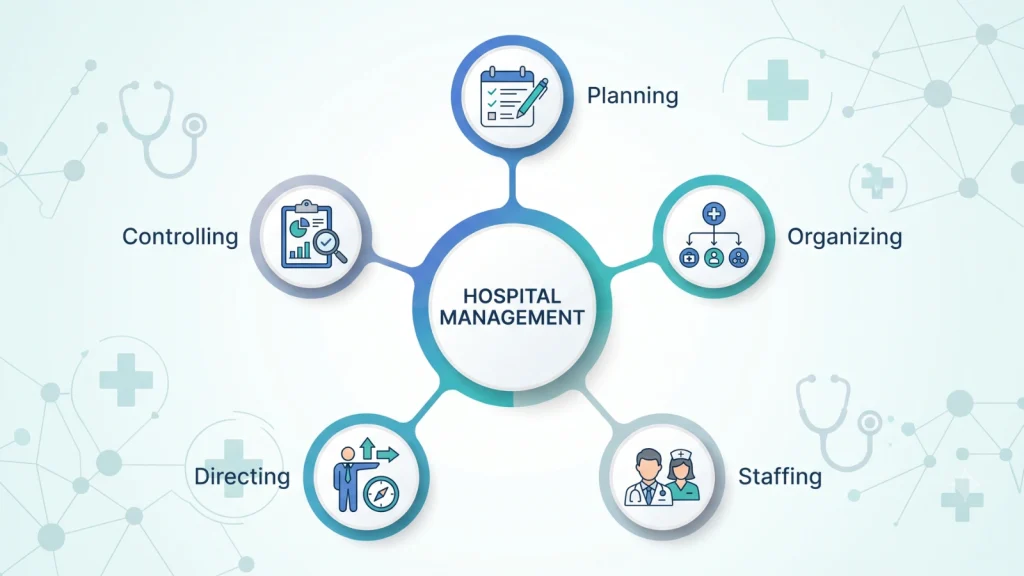
Planning
Good planning means a hospital anticipates a winter respiratory surge rather than scrambling when it arrives. It means bed-capacity models that account for regional demographics, not just last year’s admission numbers. At the strategic level, planning covers capital expenditure, service-line expansion, and partnership decisions. At the operational level, it covers something as granular as whether there are enough portable oxygen concentrators on the third floor for a Tuesday afternoon.
Organizing
Organizing structures, departments, defines workflows, and ensures that when a patient moves from the emergency department to the ICU, every system — orders, records, billing codes, nursing assignments — moves with them cleanly. The handoff is where hospitals most commonly lose information and time. A well-organized institution builds explicit protocols for every transition point.
Staffing
Understaffing burns out clinicians and increases error rates. Overstaffing bleeds budget. Neither is acceptable. Effective staffing management uses historical data to predict demand by day, shift, and season, then builds rosters accordingly. It also covers onboarding, credentialing, performance review cycles, and — critically — retention strategy. Replacing a single experienced nurse costs between $40,000 and $60,000 when recruitment and training time are factored in; keeping one costs far less.
Directing
Direction is leadership made operational. It is the department head who communicates clearly when protocols change, the administrator who resolves an interdepartmental conflict before it affects patient flow, and the culture that consistently centers patient safety over institutional convenience. Directing is hardest to systematize, which is exactly why it matters so much.
Controlling
Controlling means measuring, comparing against benchmarks, and acting on what the data reveals. Key performance indicators in hospital management typically include average length of stay, bed occupancy rate, patient satisfaction scores, readmission rates within 30 days, and claims denial rates. Without regular review of these metrics, small inefficiencies compound quietly until they become expensive crises.
What a Hospital Manager Actually Oversees
The scope is broader than most people outside healthcare realize. On any given day, hospital administration touches:
- Patient admissions and discharge coordination — ensuring beds are allocated efficiently and discharge planning starts early enough to avoid unnecessary overnight stays
- Human resources and scheduling — rosters, credentialing, conflict resolution, and compliance with labor regulations
- Financial management and revenue cycle — from charge capture and coding accuracy to accounts receivable follow-up and denial management
- Supply chain and pharmacy inventory — maintaining par levels without over-ordering, a balance that became especially visible during COVID-19 disruptions
- Regulatory compliance — HIPAA in the U.S., equivalent frameworks elsewhere, accreditation standards, and infection-control mandates
- Medical records and documentation quality — because poor documentation does not just affect billing; it directly affects clinical decisions made by the next provider who opens that chart
- Facility operations — HVAC, biomedical equipment maintenance, cleaning protocols, and physical plant security
Consider a straightforward patient journey: arrival, registration, triage, physician assessment, diagnostic imaging, laboratory work, prescription, and discharge with a follow-up appointment scheduled. That is eight distinct touchpoints. Each one involves a different team, a different system, and a different set of decisions. Hospital management is the connective tissue between all of them.
How Technology Is Reshaping Hospital Operations
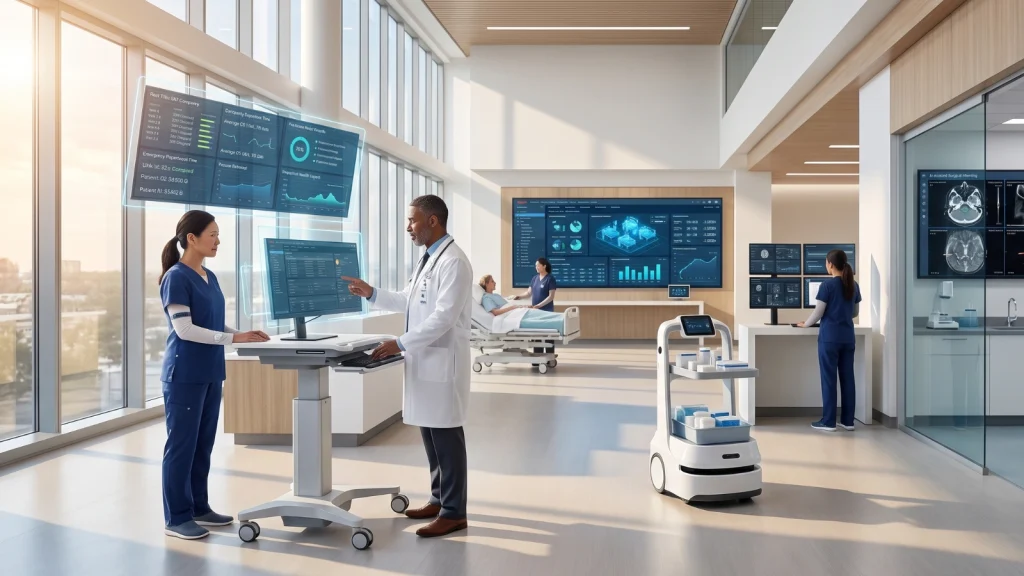
The shift from paper-based records to integrated digital platforms has been the most significant structural change in hospital management over the past two decades — and it is still accelerating. Electronic health records eliminated an entire category of transcription errors. AI-assisted scheduling now adjusts staff rosters in near-real time based on predicted patient inflow. Predictive analytics gives administrators early warning of bed shortages, equipment failures, and supply-chain gaps before they become operational emergencies.
The front desk, historically a bottleneck, has seen a particularly dramatic transformation. AI-driven tools now handle 24/7 appointment scheduling, call routing, insurance verification, and patient communications — a capability Commure, which raised $70 million at a $7 billion valuation, has built into enterprise-scale health system deployments. The upside is not just convenience: when registration errors account for more than one in four claim denials, automating and validating that intake step has a direct, measurable impact on revenue.
Meanwhile, the patient-centric healthcare app market — tools that put appointment booking, health records, and care coordination in patients’ hands — was worth $17.39 billion globally in 2025 and is projected to reach $72.87 billion by 2034. Patients are not waiting for hospitals to catch up. They are expecting the same digital fluency from their health provider that they get from their bank.
This is exactly the context in which a purpose-built hospital management system earns its value. Rather than running scheduling in one tool, billing in another, and records in a third, an integrated platform collapses those silos. The result is faster decisions, fewer transcription handoffs, and clinical staff who spend more time with patients and less time hunting down information across disconnected systems.
MedCore: Built for the Full Complexity of Modern Healthcare
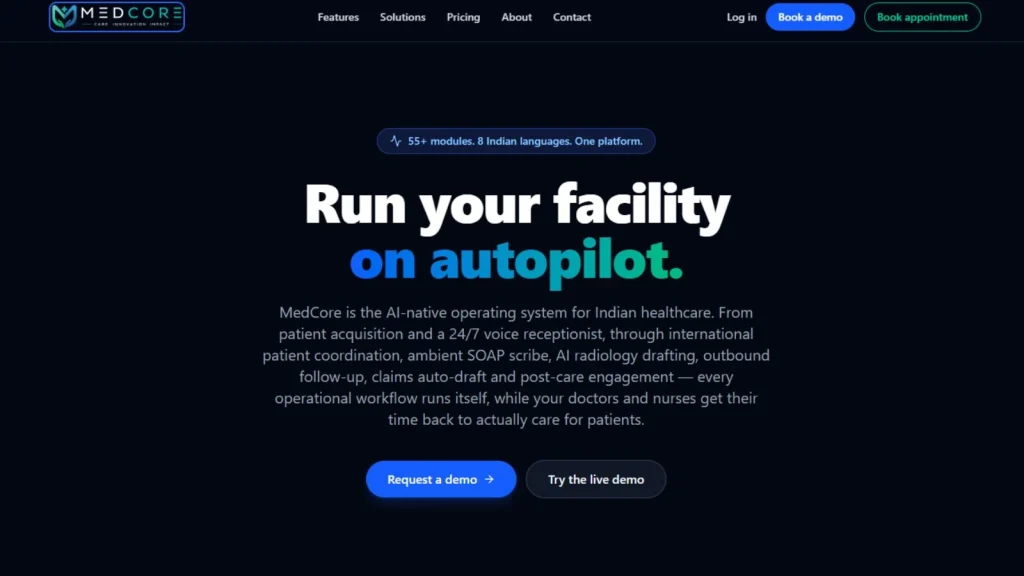
MedCore is a comprehensive hospital and clinic management platform designed for health systems that need more than a patchwork of disconnected tools. It addresses the full operational stack: patient admissions, appointment scheduling, electronic medical records, billing and revenue cycle management, pharmacy coordination, laboratory integration, and regulatory reporting — unified in a single environment.
For outpatient clinics, MedCore functions as a complete practice management solution, handling everything from the initial patient registration through appointment reminders, clinical documentation, and final invoices. For multi-department hospitals, it provides the cross-departmental visibility that administrators need: real-time bed status, staff scheduling across units, and consolidated financial dashboards that surface problems before they escalate.
What separates a well-managed hospital from a struggling one is rarely the quality of its clinical talent. It is usually the quality of its systems — how quickly information moves, how reliably handoffs happen, and how clearly leadership can see what is actually occurring across the organization. A platform like MedCore exists to close that gap.
Common Failure Points — and How to Avoid Them
Fragmented Data
When the admissions team cannot see pharmacy inventory, and the billing team is working from a different patient record than the clinical team, errors multiply. Integration is not a luxury feature. It is a precondition for safe, efficient care.
Reactive Staffing
Scheduling staff based on last week’s numbers rather than forward-looking demand models leads to a chronic mismatch — too many staff on slow Mondays, not enough on Friday afternoons. Hospitals that use predictive staffing tools consistently report better patient-to-nurse ratios and lower overtime costs.
Ignoring the Revenue Cycle Until Something Breaks
With 27% of claim denials tied to registration errors, the revenue cycle problem starts at the front desk, not in the billing department. Fixing it requires process design and validation tools at the point of entry, not just better follow-up after denials arrive.
Technology Without Process Redesign
Software accelerates whatever process it is built around. If that process is broken, the software just generates bad outputs faster. Every technology implementation in a hospital setting should begin with a clear-eyed audit of the existing workflow — what works, what does not, and what the system is actually being asked to do.
The Strategic View: What Excellent Hospital Management Produces
When all five management functions work together and are supported by the right technology infrastructure, the effects are concrete. The average length of stay comes down because discharge coordination starts on day one of admission, not day three. Readmission rates fall because follow-up appointments are scheduled before the patient leaves the building, not left to the patient to arrange. Staff turnover drops because schedules are predictable and workloads are visible. Claims denial rates decline because registration is validated at the point of entry.
None of those outcomes happens by accident. They are the product of deliberate management, well-designed workflows, and systems built to support both. As the healthcare IT market continues its expansion toward nearly $3 trillion by 2033, the gap between organizations that have invested in operational infrastructure and those that have not will widen — and patients will notice.
Frequently Asked Questions
What is the difference between hospital management and healthcare administration?
Hospital management typically refers to the operational oversight of a specific facility — staffing, patient flow, supply chain, daily logistics. Healthcare administration is a broader term that can include policy, public health systems, insurance operations, and multi-facility networks. In practice, the two overlap significantly at the department-head and C-suite level of large health systems.
What qualifications do hospital managers need?
Most senior hospital administrators hold a master’s degree in health administration (MHA), business administration with a healthcare concentration (MBA), or public health (MPH). Clinical backgrounds are common but not required. What is consistently required is fluency in financial management, regulatory compliance, and operational analytics.
What should hospitals look for in a management software platform?
Integration is the first criterion — the platform should connect admissions, EMR, billing, scheduling, pharmacy, and lab without manual data transfer between modules. Scalability matters for facilities that plan to grow. Compliance tooling matters for facilities in heavily regulated markets. And implementation support matters more than most buyers realize: the software is only as good as the rollout plan behind it.
Where to Go From Here
Hospital management is not a background function. It is the operational core that determines whether clinical excellence reaches patients or gets lost in process failures. Every metric that matters in healthcare — wait times, error rates, patient satisfaction, financial sustainability — has a management variable embedded in it.
If your facility is running on disconnected systems, reactive staffing models, or a revenue cycle that still loses more than a quarter of its claims to preventable registration errors, the problem is solvable. It starts with understanding what good management infrastructure looks like, and finding a platform built to support it. Explore MedCore to see how an integrated hospital and clinic management system can transform daily operations and patient outcomes across your organization.