Indian hospitals are digitizing faster than at any point in the last decade. Patient expectations have changed, government health schemes now run on digital rails, and paper-based OPD registers simply can’t keep up with modern compliance and billing demands. At the center of this shift sits one decision that shapes everything else a hospital does operationally: choosing the right hospital management software in India.
This guide breaks down what hospital management software actually does, walks through the current market landscape, and answers the two questions almost every hospital administrator is Googling in 2026: which platform ranks among the top 10 hospital management software in India, and which hospital management software is best for small hospitals in India specifically.
What Is Hospital Management Software?
Hospital management software in India, sometimes called a Hospital Information System (HIS) or HMIS, is a digital platform that brings a hospital’s clinical, administrative, and financial operations onto a single system. Instead of juggling a separate appointment register, a paper prescription pad, a standalone billing tool, and an Excel sheet for pharmacy stock, an HMS connects all of it: patient registration, doctor scheduling, electronic medical records (EMR), inpatient and outpatient management, billing, pharmacy, lab, and radiology, and reporting.
For any hospital management software in India built for 2026, a few things are now non-negotiable. The platform needs to create and link ABHA health IDs, store records in an interoperable format, support India’s data protection rules, and cover the full clinical workflow from OPD registration through discharge and billing, not just one piece of it.
Top 10 Hospital Management Software in India (2026): What the Market Looks Like
Search online for lists ranking hospital management software, and you’ll find dozens of them. Almost every list is published by a vendor that ranks its own product first. That doesn’t make these lists useless. It simply means they should be viewed as category maps rather than definitive rankings.
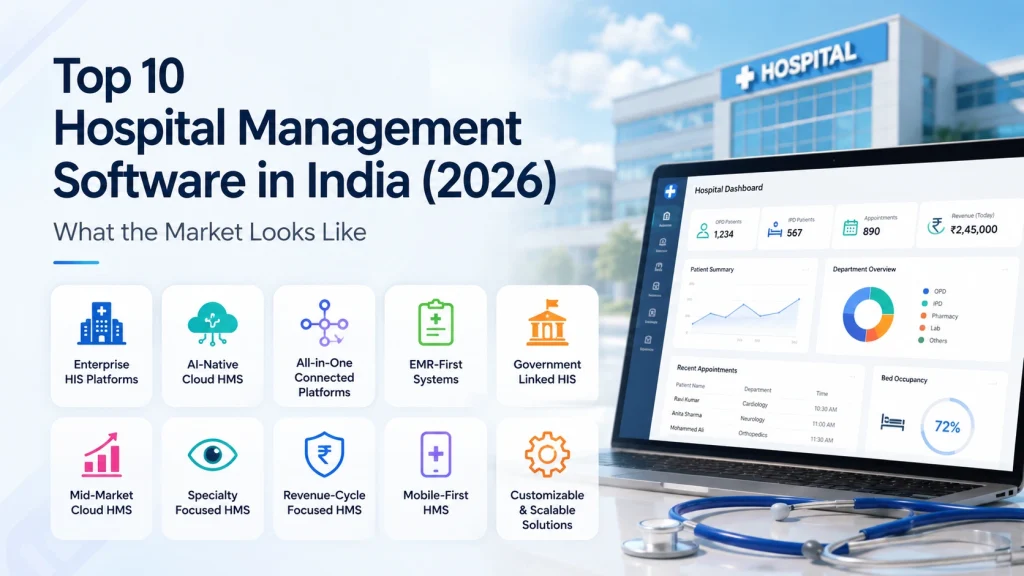
Today, the leading hospital management platforms in India generally fall into a few distinct categories:
- Enterprise HIS platforms are built for large hospital chains and government healthcare facilities, offering advanced ICU, OT, and multi-branch reporting capabilities. These solutions typically require longer implementation timelines and dedicated in-house IT support.
- AI-native cloud HMS platforms that offer features like voice-to-prescription, digital handwriting recognition, and regional language support. These are designed for clinics and mid-sized hospitals looking for faster deployment.
- All-in-one connected platforms that bring hospital, laboratory, and pharmacy operations together under a single system, eliminating the need to manage multiple disconnected applications.
- EMR-first systems that began as electronic medical record and prescription management tools but have since evolved into comprehensive hospital management solutions.
- Government-linked HIS deployments that are widely used across public hospitals and offer strong compliance with virtual healthcare regulations.
- Mid-market cloud HMS solutions designed for small and medium-sized hospitals, featuring modular functionality and flexible, pay-as-you-grow pricing.
- Specialty-focused HMS platforms tailored for healthcare segments such as ophthalmology, dental care, rehabilitation, and other specialized practices.
- Revenue cycle-focused HMS solutions built to streamline billing, insurance claims, and financial operations for hospitals with high claim volumes.
The honest answer to the question, “Which is the best hospital management software in India?” is that there isn’t a single solution that fits every hospital. The right choice depends on factors such as your hospital’s bed capacity, budget, deployment preference (cloud or on-premises), workflow requirements, and how quickly you need to become ABDM-ready.
Before signing any contract, insist on a live demonstration using your hospital’s actual patient volumes, workflows, and billing scenarios, not a scripted sales presentation.
Learn how AI is transforming patient care in our guide, 5 Ways The Use Of AI In Healthcare Is Transforming Patient Care.
MedCore, Our Pick for India’s Underserved Mid-Market
One thing most “top 10” roundups miss is a structural gap in the market itself. India’s hospital and future healthcare industry is worth roughly $200 billion, but large PE-backed and corporate hospital chains, the ones with budgets for custom-built tech, account for only about 20% of it. The remaining 75–80% of the market, made up mostly of clinics and mid-sized hospitals, is still running on fragmented workflows and manual coordination, largely because most hospital management software in India was designed around corporate-scale billing, not around this segment.
That gap is exactly where MedCore, our own platform, is built to compete, and we think it earns a place on this list on merit, not just because we built it.
Rather than bolting AI features onto a legacy billing system, MedCore is structured as three connected layers:
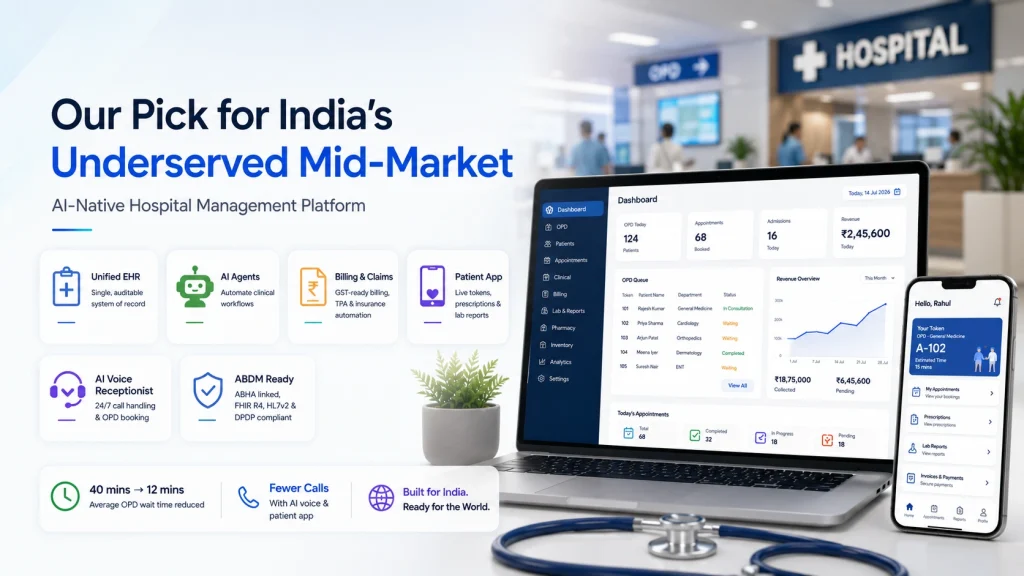
System of record: a single, tenant-scoped, auditable EHR covering every clinical event, lab result, prescription, vital sign, admission, and billing entry, with FHIR R4 export and HL7 v2 inbound support for interoperability.
System of action: AI agents that take over workflows staff used to run manually, patient triage in 8 Indian languages, an ambient scribe that drafts SOAP notes during the consult, AI-assisted radiology drafting, no-show prediction, and adherence reminders.
System of transaction: GST-aware invoicing, Razorpay and UPI payments, TPA pre-authorization, and insurance claims auto-drafted directly from the SOAP note instead of being re-keyed by hand.
On day one, hospitals get a live OPD queue with token displays, GST-compliant billing with automatic CGST/SGST splitting, and a branded patient mobile app for live tokens, prescriptions, and lab reports. On compliance, MedCore covers the same checklist we outlined earlier in this guide: ABDM/ABHA linking, FHIR R4 and HL7 v2 interoperability, and DPDP-compliant data residency inside India.
What sets it apart from most of the field: an AI voice receptionist that answers the hospital line 24/7 and books straight into the OPD queue, an outbound follow-up agent that chases new enquiries until they convert into booked appointments, and dedicated international-patient coordination, visa letters, multi-currency billing, and travel coordination for hospitals doing medical tourism. Hospitals on the platform have reported OPD wait times dropping from around 40 minutes to 12, and a meaningful drop in front-desk call volume once patients start using the mobile app.
Is MedCore the right fit for every hospital in India? No platform is; use the buyer’s checklist later in this guide to confirm fit for your own facility. But for the clinics and mid-sized hospitals that make up the bulk of the market and have been underserved by both legacy HMS and corporate-only stacks, it’s a genuinely strong shortlist candidate, and the one we’d put at the top of ours.
Which Hospital Management Software Is Best for Small Hospitals in India?
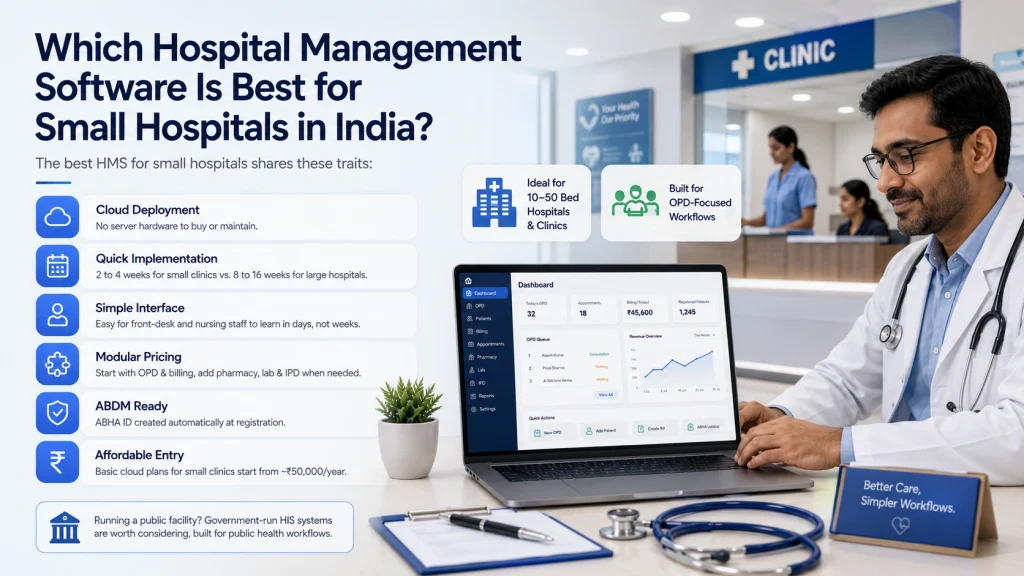
Small hospitals and standalone clinics, typically in the 10-to-50-bed range, need a very different HMS than a 200-bed multi-specialty chain, and this is where most buyers overspend on features they’ll never use.
The best hospital management software for small hospitals in India generally shares these traits:
Cloud deployment, so there’s no server hardware to buy or maintain.
A short implementation window, 2 to 4 weeks, is realistic for a small clinic, compared with 8 to 16 weeks for a large hospital rollout.
A simple interface that front-desk and nursing staff can learn in days, not weeks.
Modular pricing, so you can start with OPD and billing and add pharmacy, lab, and IPD modules only when you actually need them.
ABDM readiness is built in, so ABHA ID creation happens automatically at registration rather than as a separate manual task.
Affordable entry pricing, with basic cloud plans for small clinics typically starting from around ₹50,000 a year.
If you run a small hospital, resist the pull toward enterprise systems designed for 150-bed chains; the extra modules mean a longer, more expensive implementation for features your OPD-focused facility won’t touch. Government-run HIS systems are also worth considering for public facilities, though they’re generally built around the public health system rather than private small-hospital workflows.
Must-Have Features to Check Before You Buy

Regardless of hospital size, a handful of modules separate a genuinely useful HMS from a glorified digital register:
Patient registration and appointment scheduling, ideally with ABHA-linked registration built in.
EMR/EHR, so patient history and prescriptions are visible across every department, not siloed by doctor.
IPD and bed management, with real-time visibility into admissions, discharges, and bed availability.
Billing and insurance, including automated invoicing and TPA claim tracking.
Pharmacy and inventory management, with stock alerts tied directly to the prescription workflow.
Lab and radiology integration, so diagnostic orders and reports flow back into the patient’s record automatically.
Analytics and reporting covering occupancy, revenue trends, and doctor-level productivity.
Role-based access control, to keep sensitive patient data restricted to the right staff.
For a complete overview, read What Is Hospital Management? A Complete Guide.
ABDM Compliance: The New Baseline
No discussion of hospital management software in India is complete without ABDM, the Ayushman Bharat Digital Mission. Run by the National Health Authority, ABDM isn’t a product you buy; it’s the national digital health infrastructure your HMS needs to plug into.
Three registries matter most: the ABHA (Ayushman Bharat Health Account), a unique digital health ID created for each patient; the Health Facility Registry (HFR), the national directory your hospital needs to be listed in; and the Health Professional Registry (HPR), where your doctors need to be verified.
Private hospitals empanelled under schemes like AB-PMJAY increasingly need ABDM-certified systems to process claims through the National Health Claims Exchange, and several state health authorities have already tied continued empanelment to ABDM compliance in 2026. For hospitals outside government schemes, ABDM isn’t universally mandatory yet, but insurers, referral hospitals, and patients are all moving toward it, making early adoption a smart operational bet rather than a distant compliance concern.
When a vendor claims “ABDM-ready,” ask whether the integration has actually been tested and certified in the ABDM sandbox, rather than taking the label at face value.
What Hospital Management Software Costs in India
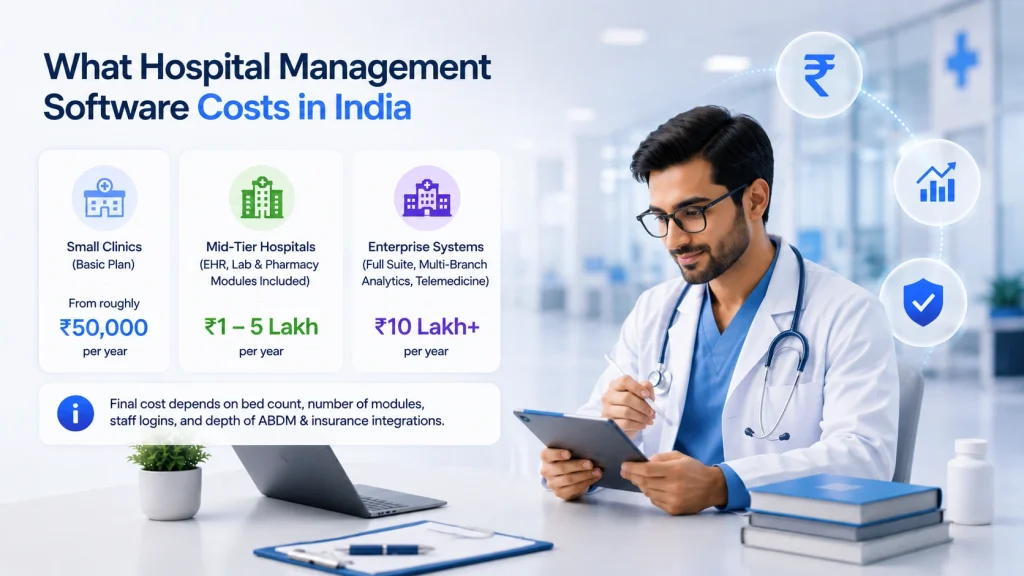
Pricing is almost always quote-based, but the typical market ranges look like this:
Small clinics (basic plan): from roughly ₹50,000 per year.
Mid-tier hospitals (EHR, lab, and pharmacy modules included): ₹1 to 5 lakh per year.
Enterprise systems (full suite, multi-branch analytics, telemedicine): ₹10 lakh or more per year.
The final number depends on bed count, number of modules, number of staff logins, and how deep the ABDM and insurance integrations need to go.
How to Choose the Best Hospital Management Software in India
Start by mapping your actual workflows; talk to doctors, nurses, and front-desk staff about where time is currently lost, whether that’s billing delays, duplicate data entry, or scheduling conflicts. Match the platform to your current bed count and where you expect to be in two or three years, not just today’s patient volume. Confirm ABDM and data-protection compliance with real evidence, not marketing claims. Check that lab, pharmacy, accounting, and insurance systems integrate without manual re-entry. And weigh implementation time and ongoing support as heavily as the feature checklist; a system with more features but poor onboarding support will slow your hospital down more than a leaner, well-supported one.
Conclusion
There’s no single hospital management software in India that’s objectively “best” for every facility; the right answer depends on your hospital’s size, budget, and compliance needs. What matters is matching the platform to where your hospital actually is today: a small hospital needs speed, simplicity, and ABDM readiness at an affordable price; a large multi-specialty chain needs depth, scalability, and enterprise-grade compliance. Use the criteria in this guide, not a vendor’s self-ranked “top 10” list, to build your shortlist, and always test any HMS against your own patient volumes before you commit.
Q1: Which hospital management software is best for small hospitals in India?
For small hospitals and nursing homes (10 to 50 beds), lightweight, cloud-based setups like MedCore, Cliniqwise, or MocDoc are the best options. Small facilities should prioritize systems that require no local server hardware, take less than 2 to 4 weeks or less to implement, and offer a simple user interface that staff can master instantly without heavy training. Avoid massive enterprise ERP systems, which add unnecessary cost and operational friction for basic OPD/IPD workflows.
Q2: What is the typical cost of hospital management software in India?
HMS pricing in India operates mostly on subscription or usage tiers, heavily dictated by your facility’s scale:
- Small standalone clinics: Range from roughly ₹10,000 to ₹50,000 per year.
- Mid-sized hospitals (with IPD, Lab, & Pharmacy): Usually range from ₹1 Lakh to ₹5 lakh per year.
- Enterprise/Multi-branch chains: Can start from ₹10 Lakhs per year and scale upward depending on deep customization, custom APIs, and advanced multi-location data syncing.
Q3: What does it mean for an HMS to be “ABDM-compliant” or “ABDM-ready”?
An ABDM-ready system is certified by the National Health Authority (NHA) to connect directly with India’s central digital health network. It allows your hospital to instantly create and pull unique ABHA IDs for patients, safely upload digital prescriptions and diagnostic data to the national ecosystem, and process insurance claims faster through the National Health Claims Exchange (NHCX). Always ask a vendor for their explicit ABDM sandbox testing certification before moving forward.
Q4: Is it safe to host a hospital management system completely on the cloud?
Yes, provided the software complies with India’s Digital Personal Data Protection (DPDP) Act. Ensure your cloud vendor encrypts all data both at rest and in transit and hosts their core data centers within Indian borders (such as MeitY-empanelled cloud instances like AWS India). Modern cloud architectures also feature automatic real-time backups, rendering them significantly safer than saving local data on a vulnerable on-premises office computer.