Most revenue cycle conversations start in the wrong place. The denial lands, the appeal team gets busy, and everyone treats it as a workflow problem. It isn’t. It’s a timing problem — and by the time a claim is rejected, you’ve already lost the easy version of the fight.
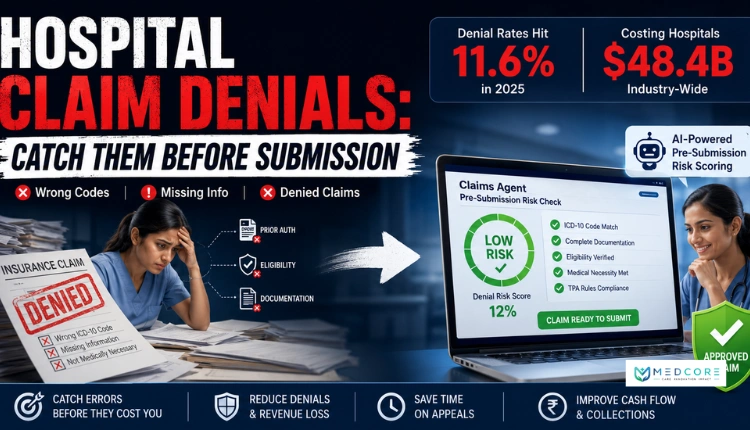
Hospital denial rates reached 11.6% in 2025, costing providers $48.4 billion collectively. Insurers also ramped up clinical-ground denials specifically, driving a 25% increase in net revenue leakage at hospitals year-over-year. Those are not rounding errors. And the standard response — more staff, faster appeals — is expensive, slow, and treats the symptom rather than the cause.
The smarter intervention is upstream: catch the denial before it leaves your system.
Listen To The Podcast Now!
Where Denials Actually Come From
Roughly 20% of all medical claims are denied, with prior authorization issues accounting for 25–30% of those rejections. Non-coverage and eligibility mismatches make up a large share of the rest.
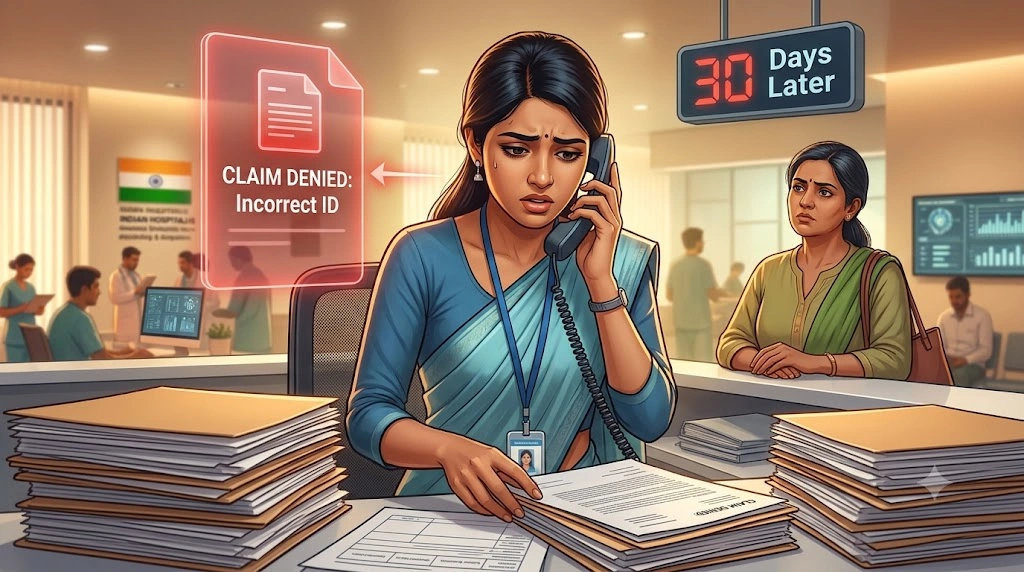
What does that mean at ward level? The problem mostly starts not with the insurer’s adjudicator but with clinical documentation and the intake desk. Wrong ICD-10 codes. SOAP notes that don’t support the billed procedure. Missing fields the TPA needs to confirm medical necessity. By the time the claim is drafted, the errors are baked in.
Reception staff aren’t the villains here. They’re working from discharge summaries written under time pressure, cross-referencing TPA schedules they barely had time to read. Front desk turnover is running at 30–40% annually in healthcare, which means the person filing your TPA claims today may have been hired three months ago. Institutional knowledge evaporates fast.
The Conventional Fix (and Why It Doesn’t Scale)
The typical response is a dedicated billing team that reviews claims before submission. That works — until volume grows, the team gets overwhelmed, and review becomes a rubber stamp rather than a real check. Mid-sized hospitals with 10–30 beds often have one or two billing staff responsible for drafting, reviewing, and chasing up dozens of claims per week. That’s not a process; it’s a bottleneck.
What’s missing isn’t headcount. It’s a system that flags likely denials at the point of drafting, before anyone submits anything.
What Pre-Submission Risk Scoring Changes
Here’s the mechanism worth understanding. When you know a claim carries high denial probability before sending it, you have options that vanish the moment it’s rejected. You can correct the documentation, ask the treating physician to strengthen the SOAP narrative while the consultation is still fresh. You can re-verify eligibility, or escalate for human review. Every one of those paths is faster and cheaper than an appeal filed three weeks later.
MedCore‘s Claims Agent is built around exactly this sequence. It auto-drafts TPA claims directly from the Ambient SOAP Scribe’s structured notes and maps them to ICD-10 codes. That reduces transcription errors significantly — because the SOAP is generated from the actual consultation recording with speaker tagging for DOCTOR, PATIENT, and ATTENDANT roles. The clinical narrative is grounded in what was actually said, not reconstructed from memory an hour later.
But the more consequential step is what happens before submission. The Claims Agent predicts denial risk on the draft claim and surfaces that score to the reception team for review. If risk is flagged, staff can intervene while the documentation is still fresh, the patient may still be on-premises, and the physician is reachable. That window matters enormously.
The Documentation Chain That Makes This Work

Pre-submission scoring is only as good as the data feeding it. A risk model working from a vague SOAP note will miss the same things a human reviewer would miss.
The Ambient SOAP Scribe captures the consultation in real time and structures it with speaker-tagged roles. The Claims Agent inherits that structured output directly — it isn’t re-reading a free-text discharge note. When the SOAP includes the relevant clinical detail (chief complaint, assessment, plan, any comorbidities affecting medical necessity), the ICD-10 mapping is more accurate, and the denial risk model has enough signal to work with.
This is the thing most hospitals miss when evaluating AI billing tools: the scribe and the claims tool are not separate products to be evaluated separately. The quality of one determines the ceiling of the other. A claims AI bolted onto weak documentation will produce slightly better-formatted wrong claims.
What Reception Actually Does With This
Let’s be concrete about the workflow, because “AI-assisted” can mean almost anything.
After a consultation is completed and the Scribe has generated the SOAP, the Claims Agent drafts the TPA claim — ICD-10 codes included — and assigns a denial risk score. That draft lands in the Agent Console for reception review. The Console shows the full transcript, the extracted SOAP, and the flagged risk factors. If risk is low, the staff member reviews briefly and submits. If risk is elevated, they can see exactly which fields or codes are driving the flag, correct them, and resubmit the draft — still before it leaves the building.
The key word is “before.” Not “after the TPA rejects it in 21 days.”
What This Doesn’t Solve
Pre-submission scoring doesn’t fix eligibility issues that exist because a patient’s coverage genuinely lapsed. It doesn’t replace the TPA relationship or the need to track payer-specific rules that change without notice. And it won’t help if the treating physician consistently documents in ways that undersell medical necessity — that requires a clinical culture change, not a software setting.
What it does remove is the class of denials that originate from avoidable errors: wrong codes, missing fields, SOAP notes that don’t support the billed procedure. That’s a meaningful slice of the 11.6% denial rate — not all of it, but a meaningful slice, and the slice you can act on today.
A Practical Starting Point for Mid-Sized Hospitals
If you’re evaluating whether pre-submission AI review makes sense, here’s the question to start with: what percentage of your current denials are being overturned on appeal? A high appeal success rate signals that the underlying errors are correctable. If they’re correctable after rejection, they were preventable before submission. That’s your baseline for the value of shifting intervention upstream.
The clinical documentation quality conversation and the revenue cycle conversation are the same conversation. Hospitals that treat them separately tend to solve neither cleanly.
MedCore’s Professional plan is priced at ₹24,999/month for up to 25 users across two branches, including the Claims Agent and patient mobile app. That’s sized for exactly the mid-tier hospitals where manual TPA review is becoming an operational ceiling. There’s also a 14-day free trial with no setup fee on self-serve tiers if you want to pressure-test the workflow before committing.
The claim denial problem isn’t going away. Automated claims management and AI-enabled tools are increasingly essential for providers trying to hold the line on reimbursement rates. Hospitals that figure out pre-submission intervention now will spend a lot less time on appeals two years from now.
Start your free MedCore trial and see the Claims Agent in action — before your next TPA rejection beats you to it.