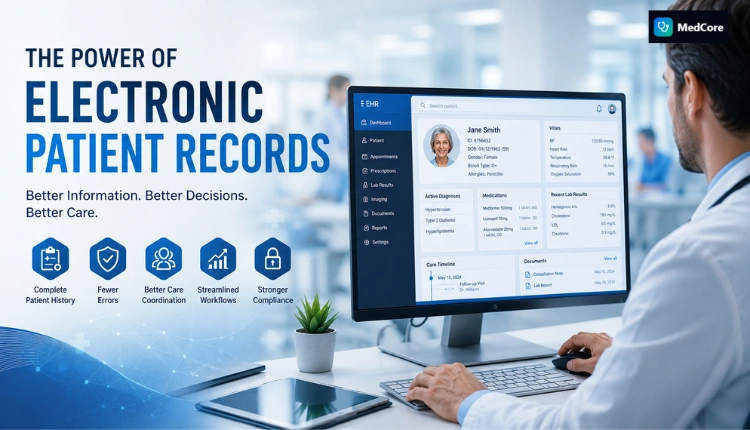

A patient walks into a busy outpatient department. They hand over an insurance card, then wait. Fifteen minutes later, a staff member is still searching for last year’s lab reports in a different system. This scene used to be normal. But in hospitals that have adopted connected digital tools, it barely happens anymore. The same visit now takes minutes. Not because patients changed their behaviour, but because the systems behind the scenes finally talk to each other.
This is what digital healthcare actually looks like in practice. It is not a general, futuristic idea. Instead, it is already reshaping how hospitals run and how patients experience care. This blog looks at what digital healthcare means, why hospitals of every size are adopting it, and how one platform, MedCore, is helping clinics and hospitals put it into practice.
What Does Digital Healthcare Really Mean?
Digital healthcare refers to the use of software, apps, and connected devices to manage clinical, operational, and financial tasks. It covers everything from electronic health records and e-prescriptions to online booking and remote consultations.
Instead of treating patient care and paperwork as separate problems, digital healthcare brings clinical data, billing, and communication into one connected system. For instance, even something as simple as a shared patient record across departments can eliminate repeated forms and duplicate tests. As a result, visits move faster and with fewer hiccups.
For hospitals, this means fewer manual errors and faster decisions. For patients, it means shorter waits, easier access to reports, and clearer communication with their care team. As more facilities adopt these tools, this approach is quickly becoming the standard rather than the exception. This is especially true in fast-growing healthcare markets, where patient demand keeps outpacing infrastructure. Because of this shift, smaller clinics that once struggled to keep up with larger hospital chains now have access to many of the same capabilities. Often, they get this access at a fraction of the cost and complexity that older systems used to demand.
Health Technology’s Growing Role and Why Trust Comes First
Voice-based receptionists, AI-assisted note-taking, and automated triage systems are no longer futuristic ideas. In fact, they already help busy facilities manage patient inflow without overwhelming staff. For example, radiology drafting tools highlight findings for a doctor to review. Meanwhile, predictive systems flag patients who might miss appointments so staff can follow up in time. Overall, these tools shift routine decisions away from guesswork and toward what the data can actually show.
What matters here is not the technology itself, but how it is applied. When systems are designed around real clinical workflows instead of generic templates, they reduce administrative burden rather than add to it. That is why many facilities now choose one connected system rather than juggling separate software for billing, records, and communication. This shift, in turn, keeps digital healthcare practical instead of overwhelming for smaller clinics.
Still, none of this works unless trust and safety come first. Patients need confidence that their data is secure. They also need to know their prescriptions are accurate and their reports reach the right hands. Compliance standards, audit trails, and secure data residency are no longer optional extras. Instead, they are the foundation that responsible care is built on. Without that foundation, even the most advanced tools will struggle to earn genuine adoption from patients and staff alike.
Hospitals that build this kind of trust tend to see real, measurable benefits. For example, patients return more often, refer friends and family, and engage more openly with their care team. In this sense, technology is not replacing the human side of medicine. Instead, it is reinforcing it, giving doctors more time to listen and less time spent on repetitive paperwork.
Key Benefits of Digital Healthcare for Hospitals and Patients
Digital healthcare offers measurable advantages for both sides of the care relationship. For hospitals, it reduces paperwork, speeds up billing, and lowers the chances of miscommunication between departments. For patients, meanwhile, it means more transparency and convenience throughout their treatment journey.
Some of the most noticeable benefits include:
- Shorter waiting times through real-time queue management
- Fewer billing errors with automated, tax-compliant invoicing
- Easier access to prescriptions, lab results, and medical history
- Better communication through appointment reminders and follow-ups
- Reduced administrative workload for doctors and front-desk staff
Altogether, these improvements add up to a smoother, more reliable experience for everyone involved in the care journey. That is also why even smaller clinics are now investing in better systems.
MedCore: A Platform Built for Real Hospitals
Consider a mid-sized multi-specialty clinic handling a few hundred outpatient visits a day. Before switching to a connected platform, front-desk staff manually cross-checked insurance details. Meanwhile, billing ran on a separate spreadsheet, and doctors’ notes lived in paper files that didn’t sync with the pharmacy. However, after moving to a single connected system, the same clinic could see patients faster and catch billing errors before they reached the patient. It also freed up staff time that used to go into manual data entry. This is the kind of shift MedCore is built to support.
If you are exploring a digital healthcare platform that brings all of this together, MedCore is worth a look. Built specifically for Indian hospitals and clinics, it combines clinical records, billing, staffing, and patient engagement into one connected system instead of several disconnected tools.
MedCore includes features such as:
- Real-time OPD queue with live token updates
- GST-aware billing with Razorpay and UPI payment support
- A patient mobile app for prescriptions, lab reports, and appointments
- AI-powered voice receptionist and outbound follow-up agents
- Ambient SOAP scribe and AI-assisted radiology drafting
- ABDM-ready compliance with FHIR R4 and HL7 v2 support
For hospitals that want to modernise without adding complexity, MedCore shows a connected system at work. Here, reception, doctors, and billing all work off the same data.
What the Future Holds
The next phase of digital healthcare will likely focus on personalization and prediction rather than just digitization. For example, hospitals are beginning to use data to anticipate patient needs, from forecasting pharmacy demand to identifying patients at risk of missing follow-up care. Additionally, multilingual support is becoming more common. This helps facilities serve diverse populations without language becoming a barrier to good care. Importantly, none of this requires patients to learn new habits. Instead, the improvements happen behind the scenes.
As adoption grows, these tools will likely become less visible to patients and more embedded into everyday interactions. Think of appointment confirmations, automated reminders, and instant report access that simply work in the background while doctors focus on treatment decisions. Because of this, smaller clinics and mid-sized hospitals stand to gain the most. After all, they have historically been left out of major technology investments, and these systems are now becoming easier to set up and more affordable to maintain.
Conclusion
Digital healthcare is no longer a future concept. Instead, it is already reshaping how hospitals operate and how patients experience care. By combining clinical, financial, and communication tools into one connected system, hospitals can reduce errors, save time, and give patients a smoother experience from booking to billing. As more facilities adopt these tools, hospitals that start early are likely to see the benefits compound over the next few years.
FAQs
What is digital healthcare? It is the use of technology, software, and connected devices to manage clinical, operational, and billing tasks in hospitals and clinics.
How does it help patients? It reduces wait times, simplifies access to reports and prescriptions, and improves communication between patients and their care team.
Is this only for large hospitals? No. Platforms like MedCore are built for clinics and mid-sized hospitals too, not just large corporate chains.
Is patient data safe on these platforms? Reputable platforms follow compliance standards like DPDP and ABDM, along with audit trails and secure data residency.