The Hidden Cost of Clinical Documentation
Doctors don’t go to medical school to spend hours writing notes. Yet somewhere between patient rounds and end-of-shift wrap-ups, documentation became one of the heaviest burdens in modern healthcare. Studies consistently show physicians spend nearly two hours on paperwork for every hour of direct patient care. That’s not just inefficient. It’s unsustainable.
Burnout, delayed records, rushed notes – these aren’t isolated complaints. They’re symptoms of a documentation system that hasn’t kept pace with clinical demands. Medical transcription exists to solve exactly this problem: turning spoken patient encounters into accurate, structured records without pulling clinicians away from what they do best.
Read Aloud!
Quick Answer: What Is Medical Transcription?
Medical transcription is the process of converting spoken medical information into written clinical documentation. A physician describes findings, diagnoses, or treatment plans – and that dictation becomes a structured record inside the patient’s file.
Modern medical transcription often combines AI, speech recognition, and healthcare workflow integration to create accurate patient records faster than traditional methods ever allowed.
Medical Transcription Has Changed: Then vs Now
Traditional Medical Transcription
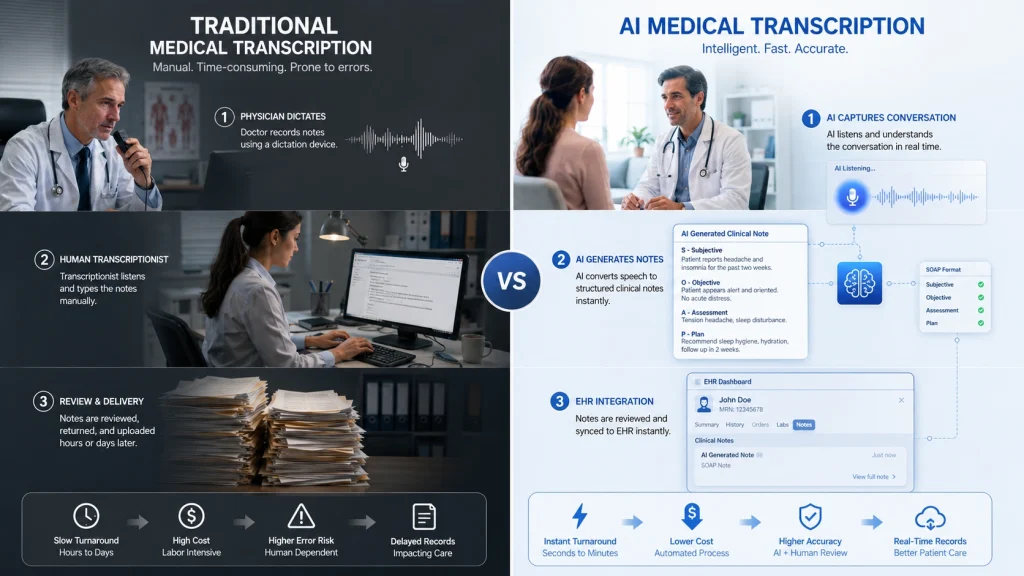
Not long ago, the process was straightforward but slow. A physician would dictate notes – either in person or over a phone line. A human transcriptionist would then listen, type, and return a draft for review. Final approval could take hours or days.
It worked, but it had real limits. Turnaround time created gaps in the patient record. Errors crept in when audio quality was poor or medical terminology was misheard. And the operational cost of employing transcriptionists at scale was significant.
Modern AI Medical Transcription
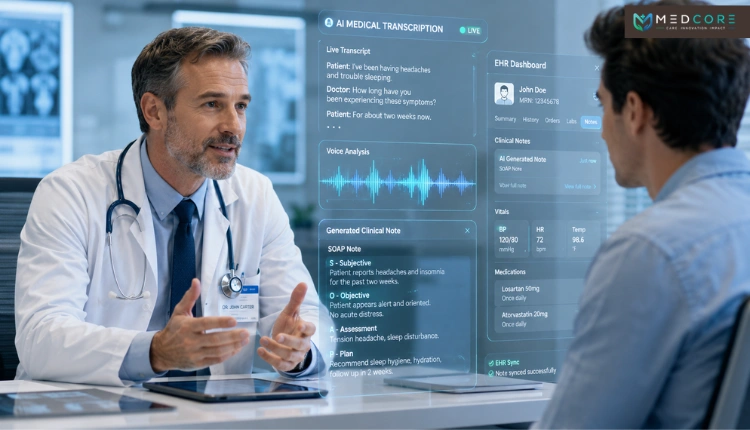
The shift started with speech recognition and accelerated rapidly with natural language processing. Today’s systems don’t just transcribe – they interpret. AI listens to a patient encounter, identifies clinical context, and generates structured notes in real time.
AI medical transcription can distinguish between a physician’s commentary and a patient’s response, organize output into SOAP format, and push completed notes directly into an EHR system. The transcriptionist role hasn’t vanished, but it has transformed into a review and quality function rather than a production one.
How Medical Transcription Works in Modern Healthcare
Step 1 – Capturing Clinical Conversations
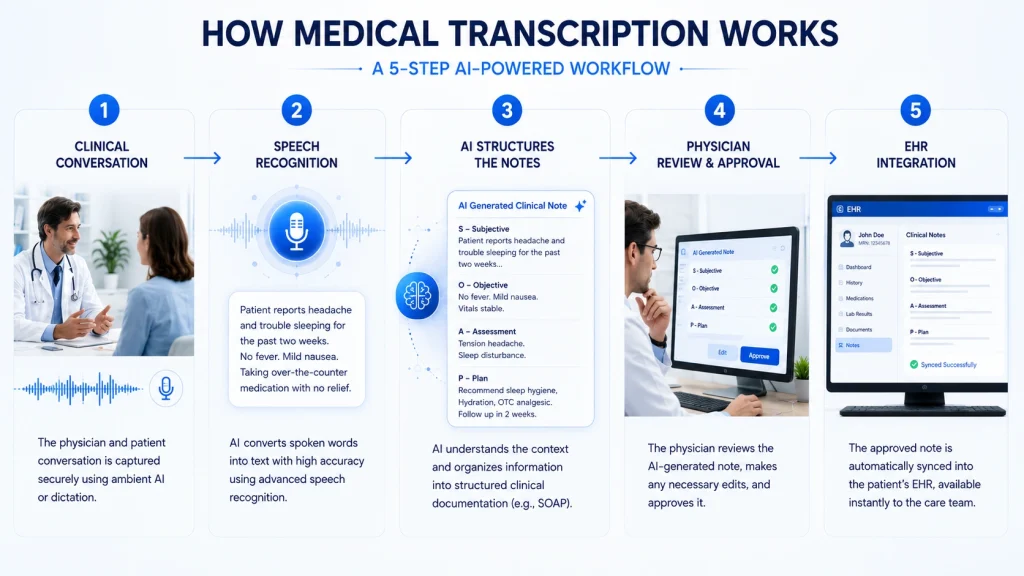
Everything starts with audio capture. Depending on the workflow, that might be a physician dictating into a mobile app after a visit, or an ambient AI microphone listening throughout the encounter itself. Ambient capture is becoming more common because it removes the dictation step entirely.
Step 2 – Converting Speech Into Text
Speech recognition software converts the audio into raw text. Accuracy here depends heavily on the system’s training data. Systems built on clinical language models outperform generic speech-to-text tools because they understand medical terminology, drug names, and procedural language without constant corrections.
Step 3 – Structuring Medical Documentation
Raw transcription is just words. Clinical documentation requires structure – chief complaint, history, assessment, plan. NLP layers interpret the content and organize it into the appropriate sections. This is where modern medical transcription goes beyond simple typing.
Step 4 – Quality Review and Approval
No AI-generated note goes straight into a permanent record without human sign-off. Physicians review the draft, make corrections, and approve the final version. This step is fast – often seconds – but it’s essential for accuracy and compliance.
Step 5 – EHR Integration
Approved notes sync automatically with the patient’s electronic health record. The goal is zero manual upload, no switching between systems, and a complete record that’s available to the care team immediately.
Why Medical Transcription Matters More Than Ever
More Time With Patients
Every minute a physician spends on documentation is a minute not spent in the exam room. Faster, more efficient transcription gives clinicians that time back – not in theory, but measurably. Practices using AI-powered documentation tools report reclaiming several hours per provider per week.
Better Documentation Accuracy
Rushed notes create gaps. Gaps create risk. A well-supported transcription workflow captures more clinical detail because providers can speak naturally instead of abbreviating everything to survive the charting queue.
Reduced Administrative Work
Front-office staff, coding teams, and billing departments all depend on clean documentation. When medical records are accurate and complete from the start, downstream administrative work shrinks considerably.
Faster Record Availability
In traditional workflows, a note from a morning visit might not appear in the record until late afternoon. Modern transcription closes that gap to minutes, which matters when another provider needs to make a decision based on that visit.
Improved Care Coordination
Specialists, hospitalists, and primary care teams operate better when records are complete and accessible. Fast, accurate documentation isn’t just an administrative win – it directly affects how well a care team functions together.
Medical Transcription Services vs AI Medical Transcription Software
| Factor | Human Transcription | AI Software |
| Turnaround Time | Hours to 24 hours | Minutes to real-time |
| Cost | Higher per-report cost | Lower ongoing cost |
| Scalability | Limited by staff capacity | Scales with volume easily |
| Accuracy | High, with context judgment | High, improving with use |
| Oversight Needed | Minimal | Physician review required |
| Best For | Complex dictation, specialty notes | High-volume, structured workflows |
When Human Transcription Still Makes Sense
Highly complex specialty dictation – legal depositions, psychiatric evaluations, pathology reports – sometimes benefits from a trained human ear. Nuance, context, and unusual phrasing can still trip up even sophisticated AI systems.
Where AI Excels
Routine clinical encounters, high-volume practices, and any workflow where turnaround time is critical are where AI-powered tools genuinely outperform the traditional model. Real-time note generation during a visit is something no human transcriptionist can match.
Which Option Is Right for Your Organization?
For most healthcare organizations in 2026, the answer isn’t purely one or the other. A hybrid model – AI-generated drafts with human review on complex cases – balances speed, cost, and accuracy. The organizations struggling most are those that haven’t evaluated their current workflow against what modern tools can offer.
Read More!
How To Choose The Best Ehr Systems For Your Hospital ?
Top 10 Benefits of Hospital Information Systems (HIS)
Real-World Use Cases Across Healthcare Settings
Hospitals
Large inpatient facilities generate massive documentation volume. AI-powered medical transcription handles daily discharge summaries, nursing handoffs, and attending notes far faster than any manual process could.
Private Practices
A solo physician or small group benefits from tools that reduce after-hours charting. Documentation that used to follow physicians’ homes now gets handled before they leave the clinic.
Telehealth Providers
Virtual visits already happen through software. Transcription integrates naturally here – the audio exists, the session is digital, and the note can be completed automatically without any additional workflow disruption.
Specialty Clinics
Orthopedics, dermatology, and oncology – each specialty has distinct documentation patterns. Systems trained on specialty-specific language produce significantly more useful drafts than generic tools.
Multi-Location Healthcare Networks
Consistency across locations is hard to maintain manually. AI-driven documentation creates standardized output regardless of which provider or site generated the note.
Choosing the Right Medical Transcription Solution
Evaluate Accuracy First
Ask vendors for specialty-specific accuracy benchmarks, not just general figures. A system claiming 99% accuracy on generic speech may perform very differently on cardiology or psychiatric dictation.
Check Healthcare Compliance Requirements
Any solution handling patient information must be HIPAA-compliant. That means encrypted transmission, secure storage, audit logging, and clear business associate agreements. Non-negotiable.
Look for EHR Compatibility
If a transcription tool doesn’t integrate with your existing EHR, the workflow breaks down. Confirm native integration or a reliable API connection before committing.
Consider Turnaround Time
For high-volume practices, real-time or near-real-time output matters. For lower-volume settings with complex notes, same-day delivery may be sufficient.
Measure Long-Term ROI
Don’t just compare licensing costs. Factor in time saved per provider, reduction in coding errors, and decreased after-hours charting. The full picture is usually more compelling than the line-item price.
Common Misconceptions About Medical Transcription
“AI Can Replace Human Oversight Completely”
Not yet. AI systems produce drafts – and good ones – but physician review remains a required step for accuracy, liability, and compliance reasons. The goal is to make that review fast, not to eliminate it.
“Medical Transcription Is Becoming Obsolete”
The opposite is true. As documentation demands grow, so does the need for efficient transcription workflows. The format is evolving, not disappearing.
“All Speech Recognition Tools Are the Same”
General-purpose voice recognition and clinical-grade medical transcription are fundamentally different products. Clinical systems are trained on medical language, handle specialty terminology, and integrate with healthcare infrastructure. Consumer tools aren’t built for this environment.
“Accuracy Isn’t a Major Concern”
A single transcription error in a medication dosage, allergy field, or diagnosis code can have real clinical consequences. Accuracy isn’t a nice-to-have – it’s the entire point.
How Medcore Supports Modern Medical Transcription Workflows
As clinical documentation becomes more complex, healthcare organizations need solutions that improve efficiency without adding friction to provider workflows. Medcore is built for the realities of modern healthcare, combining AI-powered documentation tools with seamless workflow integration to help clinicians spend less time on paperwork and more time with patients.
Key Features of Medcore:
- AI-Powered Medical Transcription for faster and more accurate documentation
- Structured Clinical Note Generation that automatically organizes encounter data into usable records
- Direct EHR Integration to streamline documentation and reduce manual entry
- Real-Time Ambient Documentation that captures patient-provider conversations as they happen
- Support for Dictation Workflows for providers who prefer voice-based documentation
- Reduced Administrative Burden by automating repetitive documentation tasks
- Consistent Clinical Records across teams, departments, and locations
Beyond Transcription: The Future of Clinical Documentation

Ambient AI Is Reshaping Documentation
Ambient AI systems listen passively during patient encounters and generate complete visit notes without any provider dictation. The physician finishes the appointment, and the note is already drafted. This is moving from pilot programs to mainstream adoption rapidly.
Real-Time Clinical Note Generation
Notes completing before the patient leaves the room isn’t a future concept – it’s available now. Real-time generation reduces documentation backlogs and keeps records current with minimal delay.
AI-Assisted Coding and Workflow Automation
Transcription is only the beginning. AI systems are now identifying billable codes from completed notes, flagging missing documentation for billing purposes, and connecting clinical records to downstream administrative workflows automatically.
Privacy-First Medical AI Systems
On-device AI processing – where data never leaves the local environment – is gaining traction among privacy-conscious healthcare organizations. As regulatory scrutiny of cloud-based health data increases, local processing models will become an important consideration for new deployments.
FAQ
Is medical transcription still relevant in 2026?
Absolutely. The volume of clinical documentation has only increased. What’s changed is how transcription gets done – faster, more automated, and directly integrated with EHR systems.
What is the difference between medical transcription and medical scribing?
Scribes typically work in real time, either in person or virtually, assisting during the encounter itself. Transcription happens after dictation – either immediately with AI or with some delay using human transcriptionists.
How accurate is AI medical transcription?
Leading clinical AI systems report accuracy rates above 95% for standard encounters, with performance varying by specialty and audio quality. Human review catches remaining errors before finalization.
Are medical transcription services HIPAA compliant?
Reputable services and software platforms are designed to be HIPAA compliant. Always verify through a formal business associate agreement and review the vendor’s security documentation.
Conclusion: Better Documentation Means Better Healthcare
A medical record isn’t just administrative paperwork. It’s the shared language of a care team – the document that connects a primary care visit to a specialist referral to a hospital admission. When that record is accurate, timely, and complete, clinical decisions improve.
AI is transforming medical transcription from a back-office function into a real-time clinical tool. The organizations that recognize this shift and act on it now will spend less time chasing documentation and more time delivering care. That’s the outcome good transcription has always been working toward.