Managing the financial side of a medical practice is rarely simple, and healthcare RCM (Revenue Cycle Management) sits right at the center of that complexity. From the moment a patient books an appointment to the final payment posting, every step affects whether a provider actually gets paid for the care delivered.
Yet many hospitals and clinics still struggle with denied claims, slow reimbursements, coding errors, and growing administrative overhead. These bottlenecks quietly drain revenue and stretch already-busy staff. The good news is that most of these problems are fixable with the right processes and technology.
In this blog, we’ll break down the most common Healthcare RCM challenges providers face today and share practical ways to solve each one, so your practice can protect its cash flow and focus on what matters most: patient care.
What Is RCM in Healthcare?
So, what is RCM in healthcare? Revenue cycle management is the end-to-end financial process providers use to track a patient’s care journey, from registration and scheduling all the way to the final balance payment. RCM in healthcare connects clinical and administrative data, including insurance verification, medical coding, claim submission, and collections, into one continuous workflow.
When this cycle runs smoothly, providers get reimbursed faster, and patients enjoy a clearer, more transparent billing experience. A strong healthcare RCM system reduces revenue leakage, improves accountability, and keeps the practice financially healthy. Understanding this foundation makes it far easier to spot exactly where things tend to break down, and that’s where the real challenges begin.
Key Stages of the Revenue Cycle:
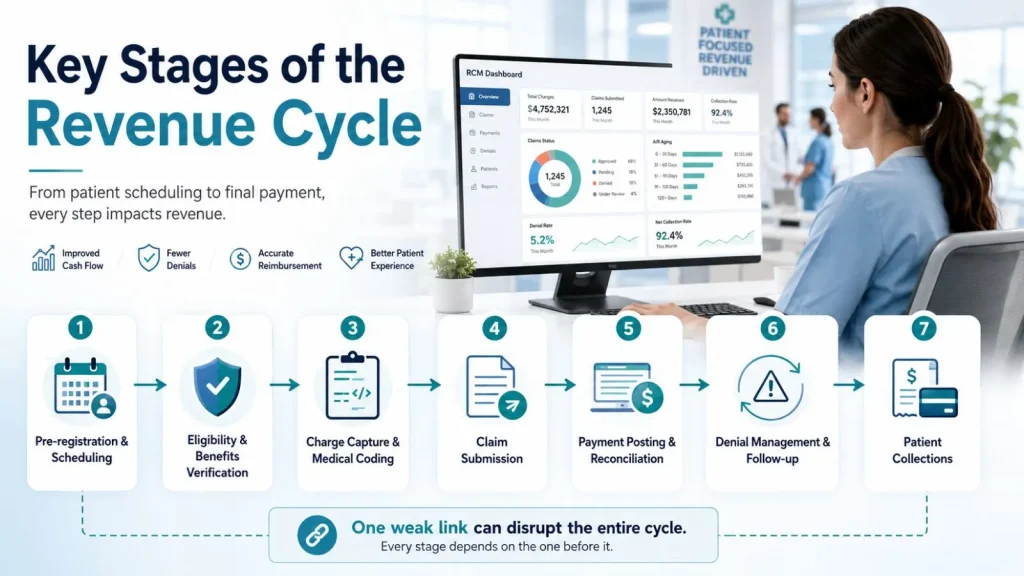
To understand where problems arise, it helps to know how the revenue cycle flows from start to finish:
- Pre-registration and scheduling: Capturing accurate patient and insurance information upfront.
- Eligibility and benefits verification: Confirming coverage before any services are rendered.
- Charge capture and medical coding: Translating clinical care into accurate billing codes.
- Claim submission: Sending clean, error-free claims to payers for reimbursement.
- Payment posting and reconciliation: Recording payments and matching them to the right claims.
- Denial management and follow-up: Reworking rejected claims and chasing outstanding balances.
- Patient collections: Collecting any remaining patient responsibility transparently.
Each stage depends on the one before it, which is why a single weak link can disrupt the entire cycle. For example, skipping eligibility verification almost always increases denials later down the line. By mapping out these stages clearly, practices can pinpoint exactly where revenue leaks occur and apply targeted fixes, whether that means better staff training, cleaner documentation, or smarter automation tools.
Common Healthcare RCM Challenges:
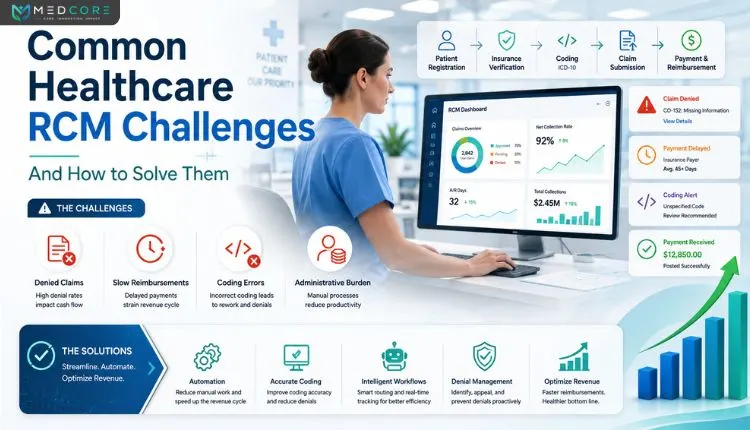
Even the best-run practices run into recurring roadblocks. Here are the most common healthcare RCM challenges:
- Claim denials and rejections: Incorrect coding, missing documentation, or eligibility errors lead to denied claims that delay payment.
- Inaccurate patient data: A single typo in insurance or demographic details can stall the entire reimbursement cycle.
- Coding and compliance errors: Frequent updates to ICD-10 and CPT codes make manual coding risky and error-prone.
- Slow reimbursements: Manual follow-ups with payers create long accounts receivable cycles and unpredictable cash flow.
- Lack of transparency: Without real-time dashboards, teams simply can’t see where revenue is getting stuck.
- Rising administrative burden: Staff spend hours on repetitive billing tasks instead of patient-facing work.
Each of these issues chips away at profitability. Left unchecked, they compound; a small data error becomes a denied claim, which eventually becomes a write-off. Recognizing these pain points early is the first real step toward building a more resilient healthcare RCM process.
How to Solve Common Healthcare RCM Challenges?
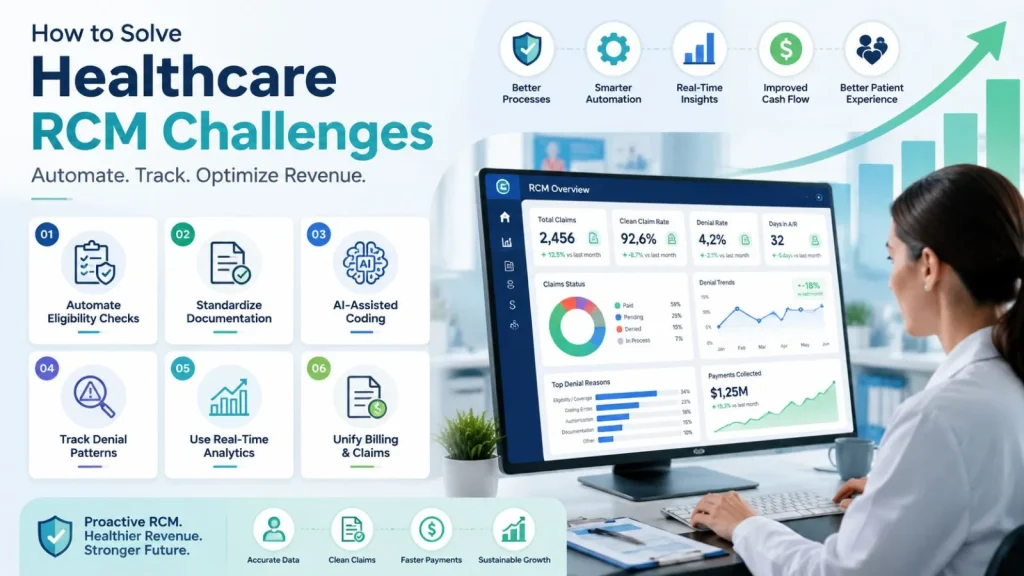
Solving these challenges takes a mix of smarter processes and dependable automation. Here’s how leading providers tackle them:
- Automate eligibility checks: Verify insurance coverage before the visit to prevent downstream denials.
- Standardize documentation: Use templates and structured notes, so coders have everything they need.
- Adopt AI-assisted coding: Automated tools reduce human error and keep pace with regulatory updates.
- Track denials systematically: Identify denial patterns and fix root causes instead of reworking claims one by one.
- Use real-time analytics: Dashboards reveal bottlenecks so teams can act before revenue slips away.
- Invest in the right technology: Modern healthcare RCM solutions unify billing, claims, and reporting in one place.
The most effective approach is proactive rather than reactive. Instead of chasing unpaid claims after the fact, a well-designed healthcare RCM workflow catches problems right at the source. Combining trained staff with dependable RCM Healthcare Services and automation turns the revenue cycle from a constant headache into a predictable, scalable system that supports long-term growth.
The Business Impact of Strong Healthcare RCM:
Investing in better healthcare RCM isn’t just about cleaner billing; it directly affects the survival and growth of a practice. When the revenue cycle is optimized, providers see measurable improvements:
- Higher collection rates: Fewer denied claims mean more of the revenue you earn actually reaches your account.
- Faster cash flow: Automated claim submission shortens the time between service and payment.
- Reduced operating costs: Less manual rework frees staff for higher-value tasks.
- Better patient experience: Transparent, accurate bills build trust and loyalty.
- Data-driven decisions: Clear reporting helps leadership forecast and plan with confidence.
A modern healthcare RCM strategy also future-proofs your practice against changing regulations and payer rules. As compliance requirements evolve, an automated, well-documented healthcare RCM system adapts far more easily than manual processes ever could. In short, strong healthcare RCM turns financial management from a reactive scramble into a genuine strategic advantage that supports both clinical excellence and sustainable growth.
Also Read:
How AI Is Revolutionizing Healthcare Scheduling?
Top Healthcare Trends Shaping the Future of Patient Care
How MedCore Simplifies Healthcare RCM?
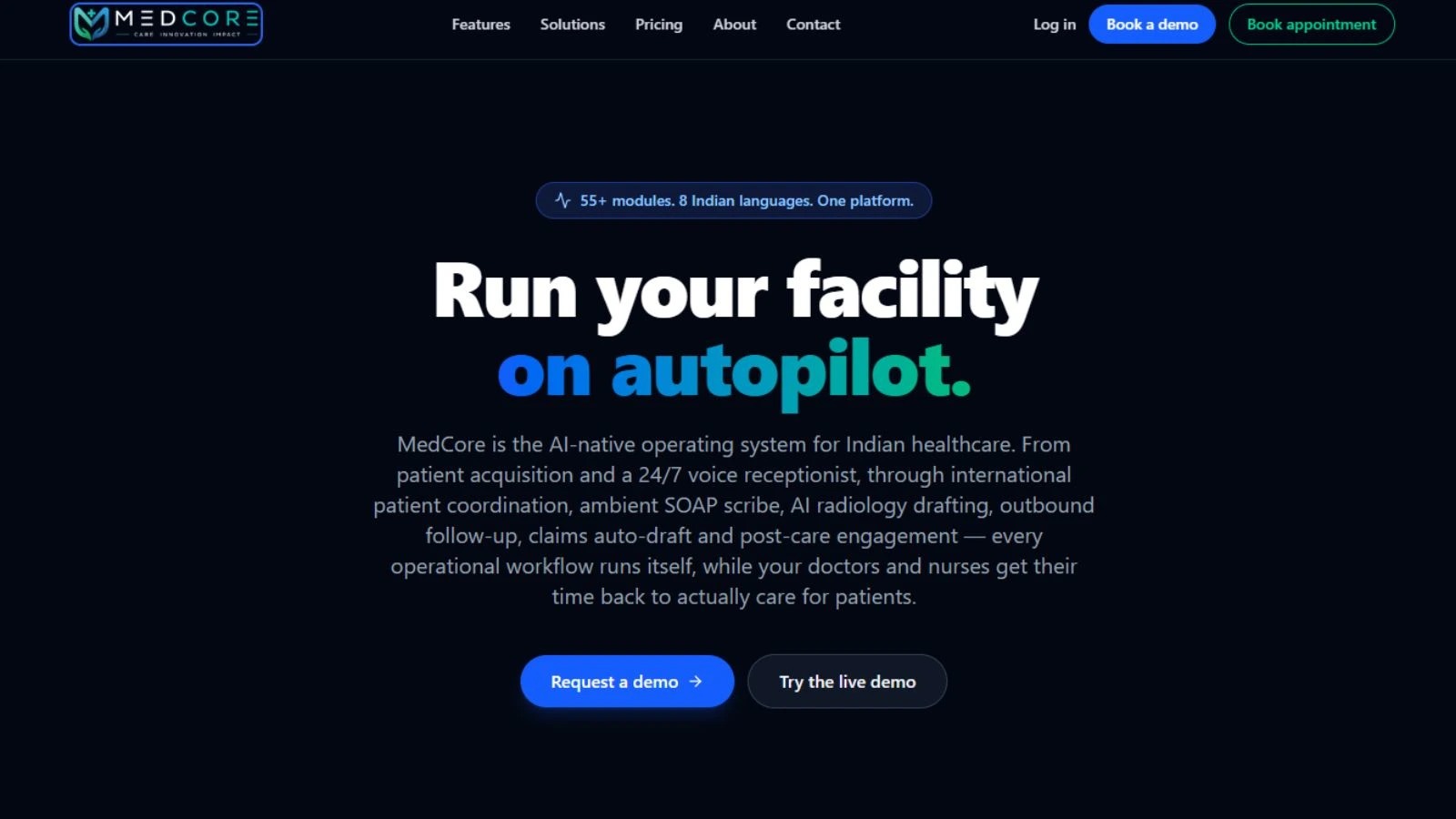
If manual billing is slowing you down, MedCore offers a powerful way to modernize your healthcare RCM. Built as an AI-native operating system for Indian hospitals and clinics, MedCore connects clinical, operational, and financial workflows so money moves the same day the care happens. Its standout features include:
Here’s a more detailed yet concise explanation of these MedCore features:
- Claims Auto-Draft from SOAP Notes
MedCore automatically converts clinical SOAP notes into claim-ready drafts by pre-filling relevant ICD-10 diagnosis codes and CPT procedure codes. This reduces manual data entry, minimizes coding errors, and allows front-desk teams to review and submit insurance claims in seconds. - GST-Aware Invoicing
Generate compliant invoices automatically with accurate CGST, SGST, or IGST calculations based on the patient’s location. MedCore also supports treatment packages, installment-based payment plans, discounts, and mixed payment methods, making billing flexible for both clinics and patients. - Razorpay & UPI Payments
Accept payments through UPI, credit/debit cards, net banking, and digital wallets directly within MedCore. Integrated payment tracking helps clinics reconcile collections faster while offering patients a seamless payment experience. - TPA Pre-Authorization & Claims Management
Simplify insurance workflows with centralized management of TPA approvals, pre-authorizations, claim submissions, and status tracking. Automated documentation and workflow tracking help reduce claim rejections and accelerate reimbursements. - Refunds with Fraud Protection & Audit Trails
Every refund request is logged with user actions, timestamps, and approval history. Built-in fraud safeguards prevent unauthorized transactions while maintaining a complete audit trail for compliance and financial transparency. - AI-Powered KPI Dashboards
Get real-time visibility into clinic revenue, collections, outstanding payments, claim performance, and patient billing trends. Interactive dashboards and CSV exports make it easy for administrators and finance teams to monitor performance and make data-driven decisions.
Together, these tools make MedCore one of the most practical healthcare RCM platforms for growing facilities.
Conclusion:
Healthcare RCM challenges like claim denials, coding errors, and slow reimbursements are common, but they’re far from unsolvable. With the right mix of streamlined processes, skilled staff, and automation, any provider can build a healthier revenue cycle. Tackling these issues head-on protects your cash flow and lets your team focus on patients. A reliable healthcare RCM partner like MedCore makes that transformation faster and far less stressful.
FAQs:
Q1: What is the main goal of healthcare RCM?
Ans: The goal is to manage a patient’s entire financial journey, from registration to final payment, so providers get reimbursed accurately and on time.
Q2: How can technology improve the revenue cycle?
Ans: Automation reduces coding errors, speeds up claim submission, flags denials early, and provides real-time analytics, making the whole cycle more efficient.
Q3: Is revenue cycle management only for large hospitals?
Ans: No. Clinics and mid-sized facilities benefit just as much, since efficient billing and fewer denials matter for practices of every size.