
Missed appointments drain 15–30% of OPD schedules in mid-size hospitals. You can cut that by 25–40% in 30 days with a structured WhatsApp reminder rollout. A patient engagement app with whatsapp reminders meets patients where they are, and it does so without asking your lean IT team to build from scratch.
In 2026, WhatsApp is the default channel for Indian patients.
Open rates exceed anything email or SMS can match, and patients already trade images, PDFs, and payment links on it every day. In my rollouts across 20+ facilities (50–200 beds), WhatsApp reminders reduced no-shows, kept OTs full, and made surgeons a lot less frustrated at 10 a.m.
However, this is not only an ops fix.
Clear, language-appropriate reminders and quick follow-ups lift patient trust.
That trust improves continuity of care, bill realization, and NPS. If you already track OPD flow, you’ve seen the pattern: as reminders improve, token queues smooth out, and billing peaks stop spiking.
For context on how reminders fit into broader patient communications, you might skim "patient engagement software". And if you want a clinic-scale walkthrough to compare with a hospital rollout, see How to Set Up WhatsApp Patient Reminders for Your Small Clinic in India.
Why WhatsApp Reminders Are Now Table Stakes for Mid-Size Hospitals
Mid-size hospitals carry enough volume that manual calling breaks. A 100-bed facility with 150+ OPD patients per day cannot rely on two receptionists to call and re-call every patient. As a result, gaps in the schedule lead to idle doctors, idle OTs, and deferred revenue that rarely returns.
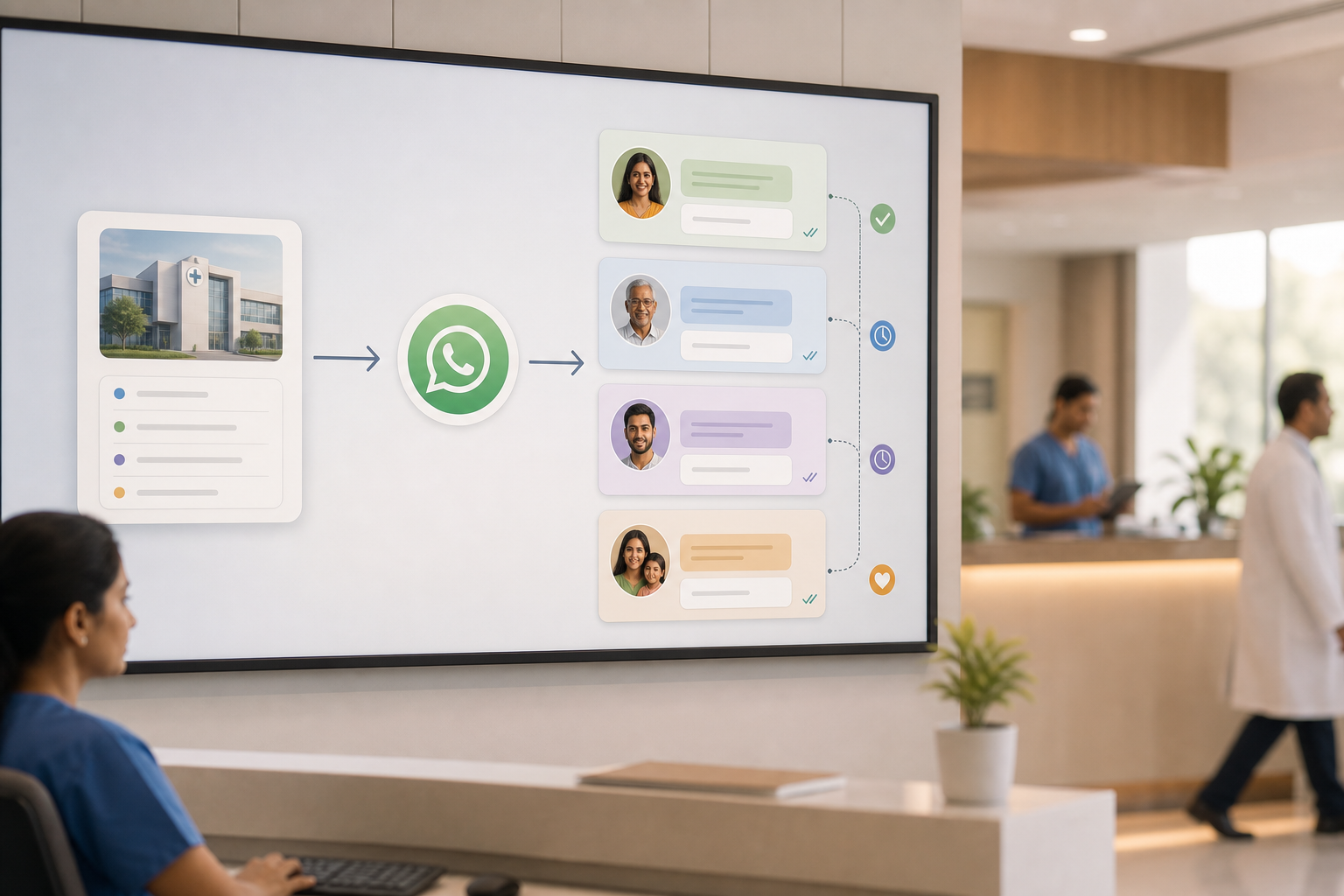
WhatsApp solves three issues in one shot.
- First, it’s where patients already live.
- Second, it drives read rates far above email or SMS.
- Third, it supports rich media, so you can send appointment cards, lab reports, maps, and payment links in one thread.
Because everything sits in a single chat, patients reply faster and show up prepared.
Results and market context
Moreover, hospitals that adopt WhatsApp reminders in a structured way see no-shows drop by 25–40% within the first month of steady use. In my projects, this improvement holds even with basic templates and two reminder touches per visit. The consistency, not bells and whistles, moves the needle.
Crucially, most of the Indian market is still underserved by tech built for corporate chains. Per market data shared with us, 75% of the market remains underserved, and 80% of facilities still run on fragmented workflows. If that sounds like you, the upside is real: bringing reminders into the same system that runs OPD queues and billing removes busywork and missed handoffs.
- Patient volume reality: 150+ OPD patients per day strains manual calls and ad-hoc WhatsApp messages.
- Experience upside: real-time notifications and quick feedback collection increase patient satisfaction.
- Operational relief: fewer gaps for doctors, better OT use, steadier pharmacy and lab flow.
For a quick primer on the app itself, see WhatsApp on Wikipedia for background on reach and features. The bottom line: WhatsApp is now a patient-experience differentiator, not just a notification channel. In 2026, mid-size hospitals that message where patients respond will win repeat visits.
“The patient mobile app reduced our front-desk calls by half in the first month.” — Shalini Kumar, Operations Head, Greenleaf Care
Also Read!
MedCore vs Practo for Mid-Size Hospitals: Which Is Better for Patient Engagement WhatsApp Reminders?
How to Set Up WhatsApp Patient Reminders for Multi-Specialty Hospital Chains
Step-by-Step: Setting Up WhatsApp Reminders That Actually Work
Here is the 7-step framework I use with 50–200 bed hospitals. Expect 30 days from kickoff to hospital-wide go-live, with the first department live in 10–14 days.
Step 1: Get WhatsApp Business API Access
The free WhatsApp Business app is for small shops. It does not scale and offers no automation. The official WhatsApp Business API supports automation, approved templates, reporting, and enterprise controls. In healthcare, you also need verification for your hospital’s name and brand. Plan 3–7 business days for Meta verification via your provider.
- Do: Provision a dedicated hospital number for the API.
- Don’t: Use a personal number; Meta can ban it for policy violations.
Step 2: Register DLT-Compliant Templates
In India, commercial messaging must pass DLT (Distributed Ledger Technology) checks with your telecom provider. You will submit message templates for approval. Expect 7–14 days. Prepare both English and Hindi versions in advance to avoid rework.
- Pro tip: Keep variable fields clear (e.g., {{patient_name}}, {{date}}, {{doctor_name}}). Avoid promotional language in reminder templates.
Step 3: Map Your Reminder Workflow
Map your end-to-end touchpoints. You need automation, not ad-hoc sending.
- Appointment confirmation: immediate on booking
- Reminder: 24 hours before
- Day-of nudge: 2 hours before
- Post-visit follow-up: 24–48 hours after
- Lab-report-ready: when a result is posted
- Payment reminder: on pending dues before discharge or 48 hours post-visit
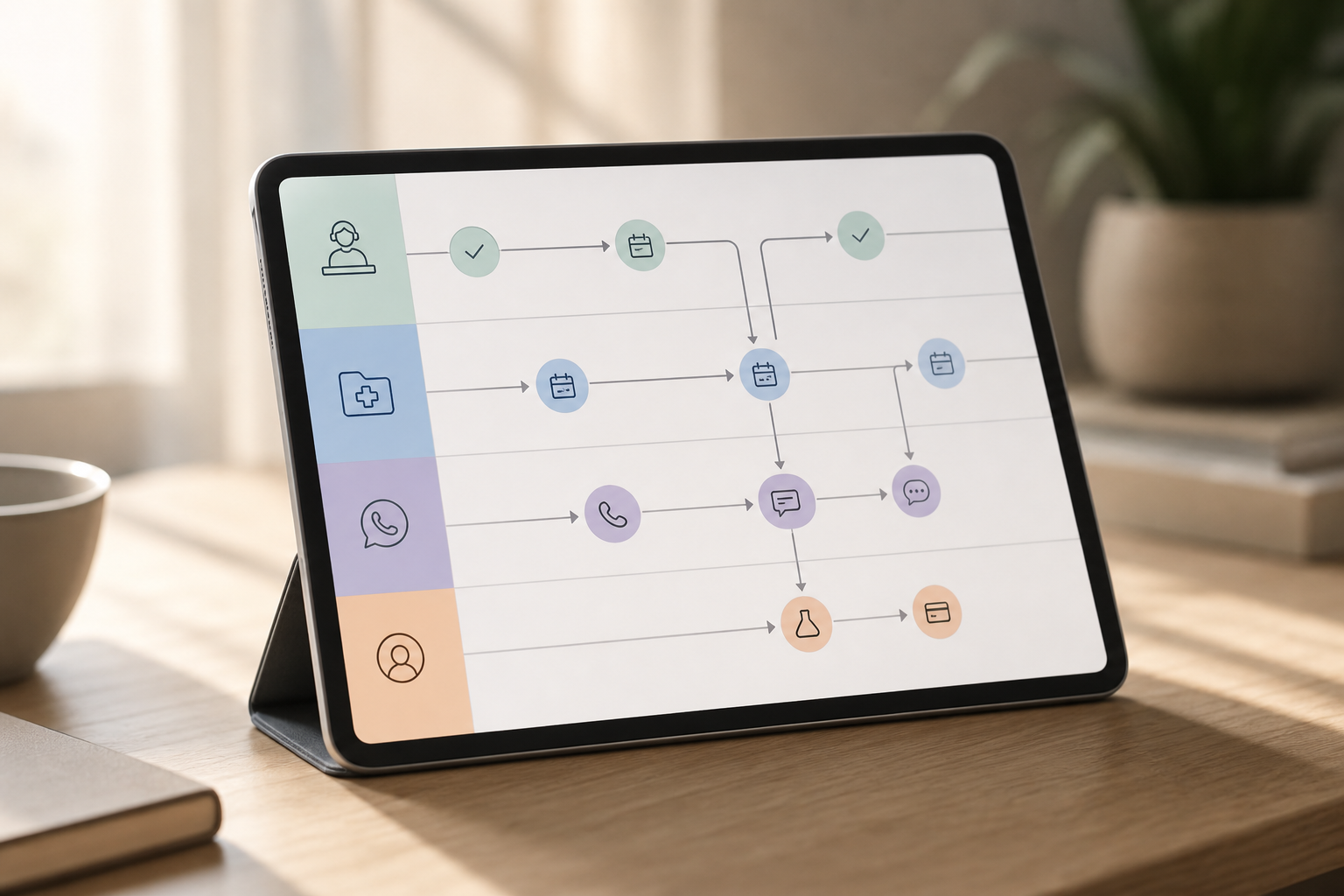
Flowchart description: HMS/EHR creates or updates an appointment → triggers the WhatsApp API with the correct template and language → patient replies with confirm/reschedule options → HMS updates status → follow-up templates send based on outcomes and lab/billing events.
Step 4: Integrate With Your HMS/EHR
Your reminder engine must read live schedules from your HMS/EHR.
- API-based native integration: best if your HMS supports webhooks and REST APIs.
- Middleware connector: works when you lack APIs, but adds a layer to maintain.
For stability, push minimal PHI and store audit trails. Also, mirror appointment status back into the HMS so front-desk staff see the same truth patients see.
Step 5: Set Up Multilingual Templates
At a minimum, prepare English and Hindi. Ideally, add 1–2 regional languages based on your catchment. Store a language preference on the patient profile and route the correct template. Keep each message under 160 words. Shorter is better.
Step 6: Build Opt-In and Opt-Out
The DPDP Act 2023 requires explicit consent for messaging. Add consent capture to registration (paper or digital), and store a time-stamped record in your HMS. Provide a simple opt-out, such as “Reply STOP to opt out.” For ABDM/ABHA-linked patients, respect the consent framework across visits and departments.
Step 7: Pilot, Then Expand
Start with your highest-volume OPD for two weeks.
- Delivery rate
- Read rate
- No-show rate before
- Opt-out rate
Aim for 25–40% no-show reduction in the pilot. Once stable, roll out to the next department every 1–2 weeks.
Moreover, plan capacity. Some platforms offer message tiers (for example, 1,000 or 10,000 messages per month). If your OPD runs 150+ patients per day across five departments, budget at least 12,000–15,000 outbound messages per month for confirmations, reminders, and follow-ups.
5 Mistakes Mid-Size Hospitals Make with WhatsApp Patient Engagement
Avoid these five traps I see in 8 of 10 first-time rollouts. Each has a simple fix.
Mistake 1: Using Personal Numbers
Using staff or personal WhatsApp numbers violates policy and gets numbers banned. It also blocks automation and audit trails. Fix it by provisioning a verified WhatsApp Business API number for the hospital, with role-based access.
Mistake 2: Skipping DLT Registration
Sending without DLT approval leads to blocks and fines. Hospitals miss this because they think “WhatsApp isn’t SMS.” Fix it by submitting each template for DLT clearance and keeping an internal tracker for template IDs and validity dates.
Mistake 3: Over-Messaging Patients
Five or more messages per appointment drives opt-outs. The sweet spot is 2–3 messages per visit cycle. Fix it by standardizing on confirmation, 24-hour reminder, and 2-hour nudge. Add post-visit only for specific care plans.
Mistake 4: Ignoring Language Preferences
Sending English-only messages to Hindi-first patients hurts response rates. Fix it by storing language on the patient profile and routing templates by preference. For triage or chat, use agents that support 8 Indian languages where possible.
Mistake 5: No Feedback Loop
Hospitals switch on reminders and forget to measure results.
- Delivery and read rates
- No-show change
- Opt-out rate by department
- Average response time to “Reschedule?
“Our OPD wait time dropped from 40 minutes to 12. The live token display alone was worth the switch.” — Dr. Meera Rao, Medical Director, Asha Hospital
Furthermore, keep compliance in view. Store consent (DPDP Act 2023) with the patient record and ensure data stays within India data residency requirements when you choose vendors.
Also Read!
Small Clinic’s Guide to Hospital Billing, Insurance Claims, and GST in India
Tools and Platforms for Hospital WhatsApp Reminders
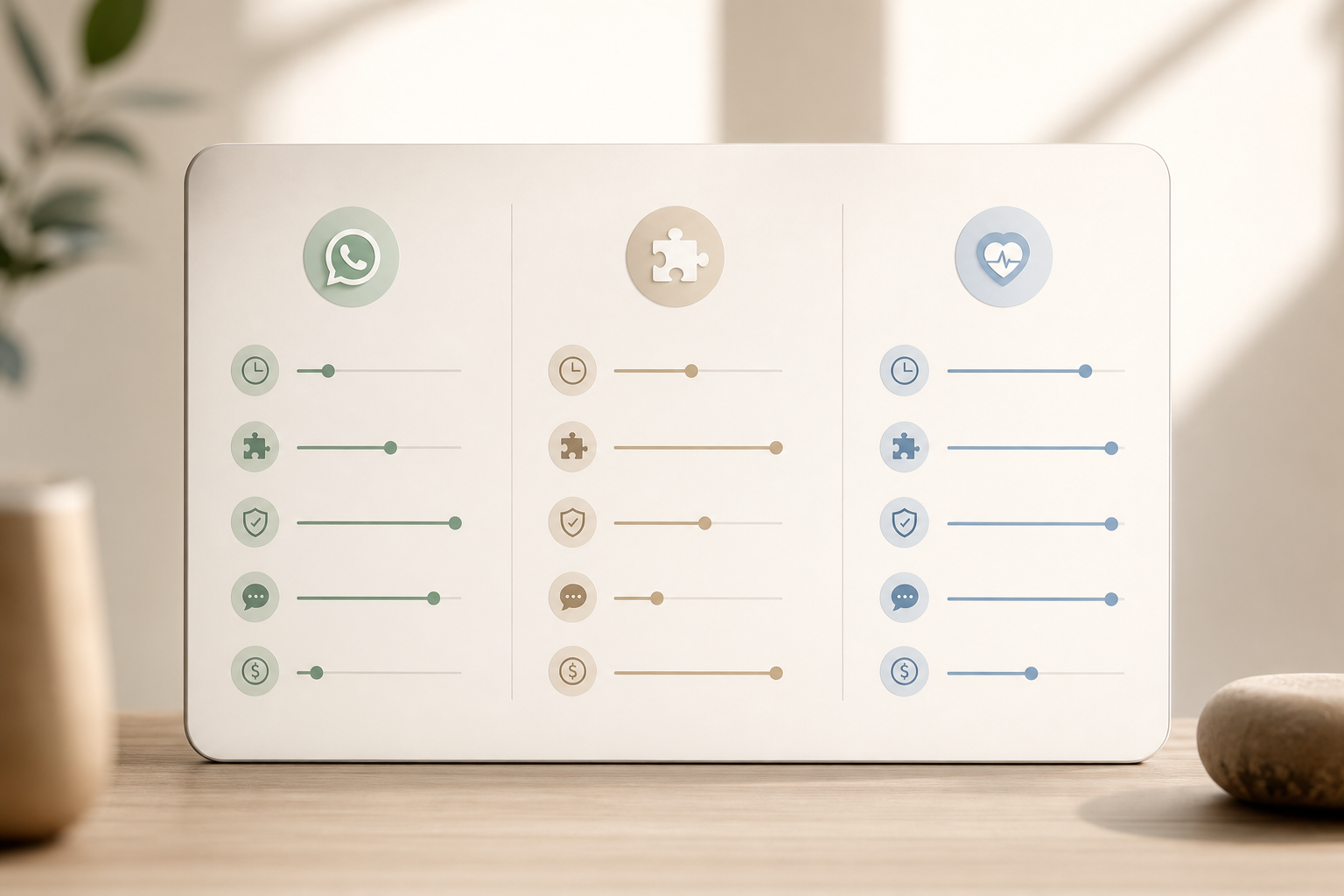
You have three practical choices. Pick based on your IT bandwidth and where your appointments live today.
Category 1: Standalone WhatsApp API Providers
Vendors like Gupshup, Wati, or Interakt excel at sending and receiving WhatsApp messages. They give you an API, template handling, and basic automation. However, you must build healthcare logic, appointment-aware triggers, language routing, DLT submissions, and integrate with your HMS. If you already have developers or a systems integrator, this is flexible.
Category 2: Generic CRMs With WhatsApp Plugins
Tools such as HubSpot or Zoho offer strong automation and reporting. With plugins, you can send WhatsApp messages and log replies. Still, they are not healthcare-first. You will spend weeks configuring schedule-aware triggers and writing middleware to keep the HMS, CRM, and WhatsApp in sync. Compliance (DLT, DPDP) is not out-of-the-box.
Category 3: Healthcare Management Systems With Built-In WhatsApp
Platforms like MedCore bundle DLT-compliant WhatsApp reminders into the same system that runs OPD queues, billing, lab, pharmacy, and the EHR. Reminders trigger from live appointments. Multilingual routing uses the patient’s stored preference. For teams without a dedicated IT bench, this path delivers the fastest time-to-value. Pricing for mid-size hospitals starts from ₹24,999/mo, with flat per-month pricing (no per-bed or per-user fees). MedCore also offers DPDP Act 2023 compliance, India data residency, and a self-serve onboarding wizard that goes live in days.
| Category | Setup Time | Integration Effort | DLT Built-In | Multilingual Support | Approx. Monthly Cost |
|---|---|---|---|---|---|
| Standalone API Providers | 2–4 weeks | High (HMS + middleware) | Partial (via provider) | Yes (via templates) | Vendor-dependent |
| Generic CRM + Plugin | 4–8 weeks | High (CRM + HMS sync) | No (custom process) | Yes (custom routing) | Vendor-dependent |
| Healthcare HMS With WhatsApp | 5–10 days | Low (native) | Yes | Yes (stored preference) | From ₹24,999/mo (MedCore) |
For a small-facility take on trade-offs, this clinic-focused comparison may help: Best Patient Engagement WhatsApp Reminders for Small Clinics in India, 2026.
What to Do This Week: Your WhatsApp Reminder Launch Checklist
Turn the guide into action. Block two hours per day for five days. Appoint one owner, your front-desk lead or IT coordinator.
- Day 1.
- Pull the last 30 days from your HMS (or registers if needed).
- Record total bookings, attended, and no-shows for each OPD.
- Set a baseline you’ll compare against in 30 days.
- Day 2.
- Apply for WhatsApp Business API verification with your chosen vendor.
- Submit 3–5 DLT templates (English and Hindi) for approval.
- Start a tracker with template names, languages, and IDs.
- Day 3.
- Appointment confirmation, 24-hour reminder, and 24–48 hour post-visit follow-up.
- Keep each under 160 words, bilingual (English/Hindi).
- Add variables: patient name, date/time, doctor, department, location/map link.
- Day 4.
- Check if your HMS supports native WhatsApp integration or needs a connector.
- Shortlist two vendors and request demos—prefer those with DLT and DPDP built-in.
- If you want more vendor-side detail, skim MedCore vs Practo for Small Clinics in India: Which Is Better for Patient Engagement WhatsApp Reminders? for configuration angles, then extrapolate to hospital scale.
- Day 5.
- Target go-live: 30 days from today.
- Pick the highest-volume OPD for the pilot (two weeks).
- Define weekly KPIs: delivery, read, no-show delta, and opt-out.
As a mindset check, treat WhatsApp reminders as a patient experience project. If you speak on the patient’s preferred channel and in their preferred language, you earn their trust, and their next visit.
**See pricing, flat monthly →
Key Takeaways
- A structured WhatsApp rollout cuts no-shows by 25–40% within the first month and smooths OPD flow.
- Map six core touchpoints—confirmation, 24-hour reminder, 2-hour nudge, post-visit, lab-ready, and payment—to your HMS events.
- DLT approval and DPDP Act 2023 consent are non-negotiable. Store language preference and consent in the patient record.
- Keep to 2–3 messages per visit cycle to avoid opt-outs, and track delivery/read/no-show weekly for 12 weeks.
- For teams without deep IT, a healthcare HMS with built-in WhatsApp and DLT (e.g., tools like MedCore) delivers the fastest time-to-value.
What to do next: pick one high-volume OPD, finalize three bilingual templates, and schedule your 30-day pilot. A patient engagement app with whatsapp reminders is now table stakes; use it to raise standards, not just fill slots.