Most hospitals and clinics face a common challenge: patients missing appointments, forgetting medications, or leaving without fully understanding their care plans. These communication gaps affect both patient outcomes and operational efficiency, making consistent patient engagement more important than ever.
This is where patient engagement software plays a crucial role. It helps healthcare providers improve communication through automated reminders, digital updates, follow-ups, and personalized interactions that keep patients informed throughout their care journey. Instead of relying only on phone calls and paper-based processes, healthcare organizations can create a faster, more connected, and patient-friendly experience.
As patient expectations continue to evolve, healthcare providers need systems that support digital, instant, and personalized communication. In this blog, we explore why patient engagement software is becoming an essential part of modern healthcare operations.
What Is Patient Engagement Software, And Why Does It Matter?
Some of the digital tools that help hospitals and clinics communicate, manage, and build relationships with patients before, during, and after a visit. It handles appointment reminders, lab reports, feedback collection, and multi-channel messaging, all from one platform.
When a patient feels involved in their own care, they are more likely to follow through with treatment. The patient engagement software solutions make this possible at scale without burdening your staff.
In short, it is not just a communication tool. It is a care improvement tool that directly affects health outcomes, patient satisfaction, and hospital reputation.
The Real Points Hospitals Face Without it.
The same frustrations are still in many hospitals year after year because missed appointment times, unanswered calls, and confused patients are a daily reality. Without patient engagement software, your team wastes hours on tasks that a system can handle in seconds. Here is what poor engagement actually costs:
- No-shows disrupt schedules and reduce revenue, sometimes by 10–15% of total appointments
- Staff spend hours calling patients manually instead of focusing on care
- Patients leave without understanding their discharge instructions, leading to readmissions
- Negative reviews and poor NPS scores damage the hospital’s online reputation
- Paper-based feedback is slow, inaccurate, and rarely actionable
These are not small inconveniences. They are systemic failures that software directly solves. The longer a hospital waits to adopt it, the more patients it quietly loses.
How to improve hospital operations

Patient engagement software does not just improve patient experience. It makes your entire operation run better. When communication is automated and data-driven, staff can focus on what they do best: delivering care. Here is how it helps operationally:
- Automated WhatsApp, SMS, and email reminders reduce no-shows significantly
- Real-time OPD queue updates reduce front-desk congestion and patient anxiety
- Feedback and NPS tools help management identify service gaps quickly
- Complaints with unresolved SLA breaches are auto-assigned to the right team
- Digital patient engagement software eliminates paper forms and manual data entry
- Consistent communication builds patient loyalty and repeat visits
Each of these improvements has a direct impact on revenue, staff morale, and clinical quality. The return on investment from patient software is measurable and fast.
Key features
Not all engagement tools are built equally. When choosing software for your hospital or clinic, look for these core features. Each one addresses a specific pain point and delivers measurable value to both patients and staff.
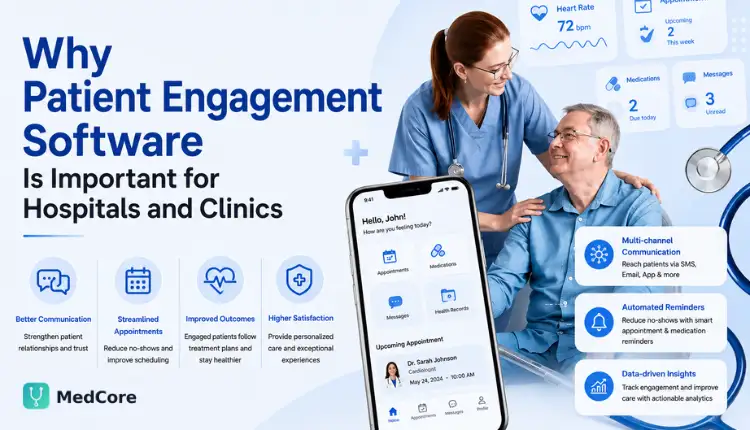
- Multi-channel messaging: WhatsApp, SMS, email, and push notifications in one place.
- Real-time OPD queue display with live token updates for patients on the mobile app
- Patient feedback collection with NPS scoring and automated complaint escalation
- Lab report delivery and prescription QR codes directly to the patient’s phone
- Appointment reminders with auto-scheduling and confirmation workflows
- Multi-language support so patients receive communications in their preferred language
- DPDP-compliant data handling to ensure patient privacy and legal compliance
- AI-powered no-show predictions to help staff proactively fill empty slots
When patient engagement software includes all these features, it becomes the backbone of a well-functioning, patient-centred hospital.
How MedCore’s patient engagement software helps hospitals in India
If you are looking for a platform that truly understands Indian healthcare, MedCore is built exactly for that. It is not a generic international tool upgrade for India. It is engineered from the ground up for Indian hospitals, clinics, and multi-specialty centres. MedCore’s patient engagement software is a fully integrated module inside a 55+ module hospital management platform. Here is what makes it different:
- WhatsApp + SMS + email + push all channels managed from a single dashboard
- Patients see their live OPD token, lab reports, and prescription QR on the branded mobile app
- NPS and feedback tools with auto-escalation after a 48-hour SLA breach
- Complaints are auto-assigned, so nothing falls through the cracks
- Supports 8 Indian languages, including Hindi, Tamil, Telugu, Bengali, and more
- AI-powered no-show predictions so your team can fill slots before they go empty
- Seamless integration with billing, pharmacy, lab, and EHR, no data silos
MedCore’s digital software has already helped hospitals reduce OPD wait times from 40 minutes to 12, cut front-desk calls by 50%, and dramatically improve patient NPS scores. It is trusted by growing hospitals across India, and it is ready to work for yours.
The impact on patient outcomes and clinical quality
Patient engagement software is not just an administrative tool. Its impact reaches directly into clinical outcomes. Engaged patients are healthier patients. When people receive timely reminders, clear instructions, and easy access to their records, they are far more likely to follow their treatment plans.
Studies consistently show that better engagement leads to fewer hospital readmissions, lower rates of medication non-adherence, and improved management of chronic conditions like diabetes and hypertension.
For hospitals, this means fewer emergency admissions and lower care costs per patient. For patients, it means a better quality of life. Patient engagement software solutions close the loop between a clinical visit and the patient’s home, which is where most health decisions are actually made.
Why small clinics need it just as much as large hospitals
There is a common people’s belief that only for large hospital chains & costly. Small clinics and single-specialty centres have even more to gain. With smaller teams and tighter budgets, manual follow-up and communication become unsustainable fast.
A clinic with two doctors cannot afford to have a receptionist spend three hours a day calling patients. It also helps small clinics look professional and modern, which builds patient confidence. When a patient receives a WhatsApp reminder with a QR-code prescription link, they trust that clinic more. It levels the playing field, giving small clinics the same communication power as large hospital groups, at a fraction of the cost.
Choosing the right patient engagement software for your facility
Selecting the right software requires more than comparing feature lists. You need a solution that fits your workflow, integrates with your existing systems, and scales as your patient volume grows.
A good software should reduce your team’s workload on day one. If it requires months of setup and constant IT support, it is the wrong choice.
Here are the key questions to ask before you decide:
- Does it integrate with your EHR, billing, and lab systems without manual exports?
- Does it support the languages your patients actually speak?
- Is the data stored in compliance with local privacy laws (DPDP in India)?
- Can it handle multi-channel communication from a single dashboard?
- Does it provide actionable analytics, not just data dumps?
- Is the mobile app branded for your hospital or generic?
Conclusion
Patient engagement software is no longer a luxury feature reserved for elite hospitals. It is a fundamental requirement for any healthcare facility that wants to deliver better care, reduce operational waste, and build lasting patient relationships.
From automated reminders and multi-language messaging to real-time queue updates and NPS tracking, the right platform changes how patients experience your hospital and how your staff operates every single day.
The cost of not having it is far greater than the cost of adopting it. Missed appointments, poor reviews, overwhelmed front desks, and disengaged patients are all symptoms of the same problem. Start with a platform built for your market, your language, and your patients.
Frequently asked questions (FAQ)
Q1. Can patient engagement software reduce hospital readmissions?
A: Yes, and this is one of its most underappreciated benefits. When patients receive clear post-discharge instructions, medication reminders, and follow-up appointment nudges through patient engagement software, they are significantly less likely to return to the hospital for an avoidable issue. Studies in both public and private hospital settings show readmission rates can drop by up to 20% with structured digital engagement. The key is continuity; the software maintains the patient relationship even after they leave the building.
Q2. Does software work for multi-location hospital groups?
A: Modern patient engagement software platforms, including those with multi-tenant architecture, are specifically designed for hospital groups running multiple branches. Each location can have its own workflows, branded communications, and staff roles while senior management gets a consolidated view of NPS scores, complaint volumes, and engagement metrics across all sites. This is especially critical for chains expanding across cities, where an inconsistent patient experience at one branch can damage the reputation of all others.
Q3. How does patient engagement software handle data privacy under India’s DPDP Act 2023?
A: This is a question many hospital administrators overlook until there is a problem. Under India’s Digital Personal Data Protection Act 2023, hospitals are classified as significant data fiduciaries, meaning they carry legal obligations around patient consent, data storage, and the right to portability. Compliant patient engagement software must store data within India, provide patients with a self-serve data export option, log every data access event, and ensure that consent is collected and recorded before any communication is sent. Failure to comply carries financial penalties and reputational risk.