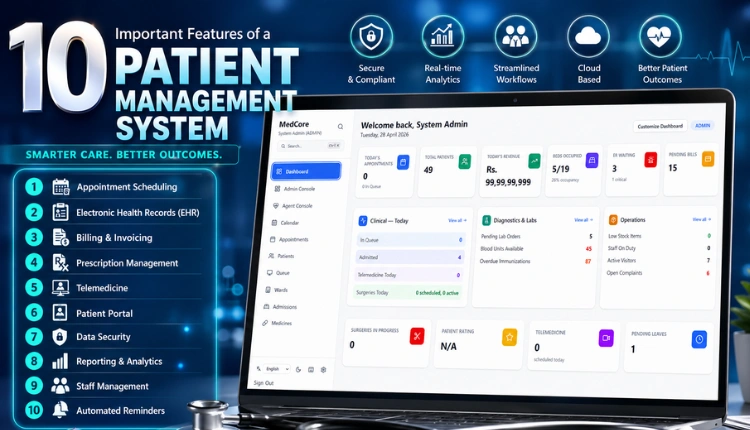
Healthcare in 2026 is moving faster than ever, and hospitals can no longer rely on paperwork, fragmented records, or outdated systems to manage patient care effectively. From appointment scheduling and billing to diagnostics and real-time communication, every process needs to work seamlessly. That is exactly why understanding the 10 Important Features of a Patient Management System is crucial for modern clinics, hospitals, and healthcare providers.
A powerful patient management system is more than just software — it is the operational backbone that keeps every department connected while improving efficiency, reducing human error, and enhancing patient satisfaction. Whether you are running a small practice or a large multi-specialty hospital, choosing the right patient record management system can directly impact revenue, care quality, and long-term growth.
The best platforms simplify daily operations, automate repetitive tasks, and ensure secure access to critical patient data across teams. In this blog, we will break down the 10 Important Features of a Patient Management System that every healthcare facility should prioritize to stay competitive, compliant, and future-ready. If you want smarter workflows and better patient outcomes, these are the features that truly matter.
In a hurry? Listen to the blog instead!
What Is A Patient Management System?
A Patient Management System (PMS) is the digital engine that powers a modern healthcare facility. It handles everything — from the moment a patient walks through the door to when the final bill is paid and the follow-up reminder is sent.
Without a proper patient data management system, hospitals lose hours daily to paperwork, missed appointments, billing errors, and poor coordination between departments. The right PMS eliminates all of this. It does not just store data — it transforms your entire workflow.
10 Features That Define a Great Patient Management System
Not all systems are built equal. Here are the 10 features that separate a good PMS from a great one — and why each of them matters to your practice.
Feature 01
Patient Registration and Appointment Scheduling
The first touchpoint with any patient should be smooth. A good hospital patient management system lets patients self-register through an app or web portal — no paper forms, no queue at the reception desk.
- Online and walk-in registration with digital forms
- Automated appointment booking, rescheduling, and cancellations
- Real-time slot availability visible to both staff and patients
- Automated SMS, email, and app reminders to reduce no-shows
- Queue management with live token displays for OPD counters
Feature 02
Electronic Health Records (EHR) Integration
A reliable patient record management system is built on strong EHR integration. Every doctor needs a complete picture of the patient — not fragmented notes scattered across registers and files.
- Unified patient profiles with full medical history, lab reports, and imaging
- Real-time updates accessible by any authorised doctor or nurse
- Seamless data sharing between departments — pharmacy, lab, radiology
- Compliance with HL7 and FHIR R4 interoperability standards
Feature 03
Billing, GST, and Insurance Processing
Financial leakage is one of the biggest problems in hospital management. Manual billing leads to errors, disputes, and delays. A modern PMS automates the entire billing cycle — from generating invoices to processing insurance claims.
- Auto-generated bills with GST split (CGST / SGST / IGST)
- Package billing, payment plans, and multi-mode payment support (UPI, cards, wallets)
- Insurance and TPA claim auto-drafting with ICD-10 code pre-fill
- Real-time financial reports and revenue dashboards
Feature 04
Prescription and Medication Management
Prescription errors cause real harm. A strong doctor patient management system replaces handwritten prescriptions with e-prescriptions that are accurate, traceable, and shareable — directly with pharmacies.
- Digital e-prescriptions with QR codes for easy pharmacy fulfilment
- Built-in drug-safety checks and interaction warnings
- Controlled-substance register with audit trail
- Automated medication reminders sent directly to the patient
Feature 05
Lab and Diagnostic Test Management
Waiting for lab reports delays diagnosis. And when reports are mis-filed or delivered to the wrong doctor, patient safety is at risk. A PMS integrates with your lab systems to close these gaps.
- Direct lab orders from the doctor’s desk — no manual request forms
- Auto-update of test results in the patient’s electronic record
- Levey-Jennings quality control charts for lab accuracy monitoring
- Patients can access their reports via mobile app or patient portal
Feature 06
Telehealth and Remote Patient Monitoring
Telehealth is no longer a luxury. It is an expectation — especially for follow-up consultations, chronic disease management, and patients in rural areas. Your PMS should make virtual care as easy as in-person care.
- Integrated video consultation with secure doctor-patient messaging
- IoT wearable device integration for real-time vitals tracking
- Remote monitoring for chronic conditions like diabetes and hypertension
- AI-powered symptom triage before the consultation even begins
Feature 07
AI-Powered Triage and Clinical Decision Support
AI in healthcare is not science fiction anymore. Leading patient data management systems now use machine learning to flag at-risk patients, predict readmissions, and support doctors in making faster, more accurate clinical decisions.
- AI triage that assesses symptoms before the patient sees a doctor
- Ambient SOAP note scribe — AI listens and auto-writes clinical notes
- Predictive analytics for no-show rates, ER severity, and readmission risk
- Clinical decision support with evidence-based treatment suggestions
Feature 08
Patient Communication and Engagement Tools
Patients who feel engaged with their healthcare provider are more likely to show up, follow treatment plans, and return for follow-ups. A PMS bridges the communication gap between doctor and patient.
- Multi-channel notifications — WhatsApp, SMS, email, and push alerts
- Patient portal with access to records, reports, and billing history
- AI chatbots for 24/7 query resolution and health guidance
- Feedback, NPS surveys, and complaint tracking with SLA management
Feature 09
Workflow Automation and Operations Management
For a large hospital, coordinating admissions, discharges, OT scheduling, and staff shifts manually is a nightmare. Workflow automation keeps everything moving without constant human intervention.
- Bed management, admissions, and discharge workflows in one view
- OT and surgery scheduling with auto-cancellation of stale cases
- Blood bank management with ABO compatibility checks
- HR tools — shift roster, leave calendar, and payroll in one system
Feature 10
Data Analytics, Reporting, and Compliance
You cannot improve what you do not measure. A data-driven PMS gives hospital administrators and owners a live view of what is working and what is not — from OPD patient flow to revenue performance.
- AI-powered KPI dashboards with export and per-department filtering
- ABDM / ABHA linking for national health stack compliance
- FHIR R4 data export and DPDP Act 2023 patient data portability
- Full audit trails with archival, role-based access, and data residency controls
Meet MedCore: One Platform. Every Department. Built for India.
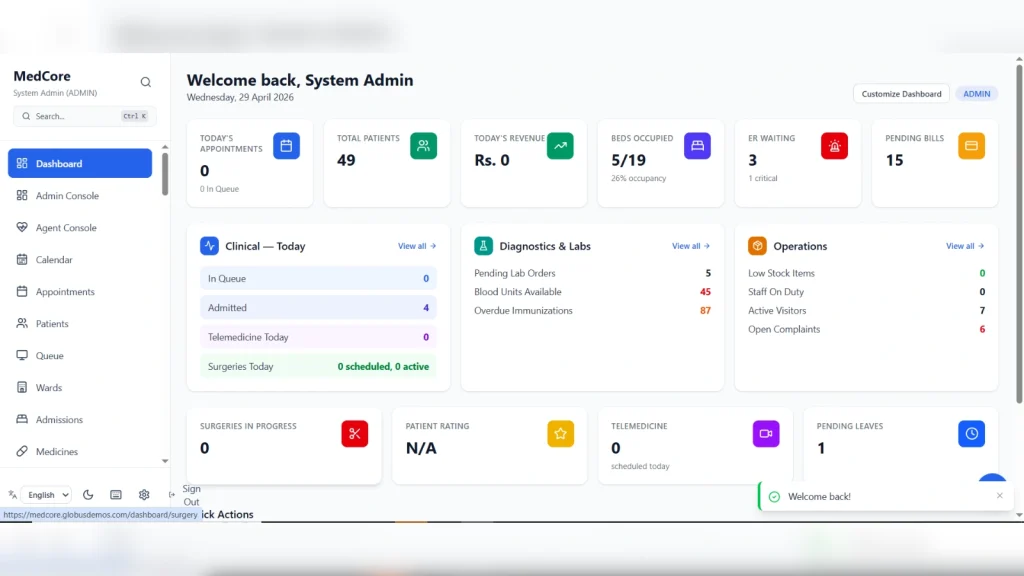
If you are a hospital owner or clinic administrator in India, you already know the challenges — GST billing, ABDM compliance, DLT-compliant SMS, multi-language patients, and TPA insurance claims. Most global PMS platforms were not built for this. MedCore was.
MedCore is a complete hospital patient management system with 55+ modules, AI triage in 8 Indian languages, an ambient SOAP scribe, AI radiology drafting, and a patient mobile app — all in one platform. Hospitals using MedCore have cut OPD wait times from 40 minutes to 12, reduced front-desk calls by half, and replaced three separate tools with one.
AI Triage8 Indian languages including Hindi, Tamil, Telugu & Marathi
GST Billing: Auto CGST/SGST/IGST split with UPI and Razorpay
ABDM Ready: ABHA linking, FHIR R4 export, DPDP compliance
Patient App: Live token, lab reports, QR prescriptions on mobile
Ambient Scribe: AI writes SOAP notes during the consultation
55+ Modules: OPD, pharmacy, lab, HR, payroll — all connected
Book a free demo Try the live demo →
How to Choose the Right Patient Management System
With dozens of options in the market, choosing the right PMS comes down to a few non-negotiable factors.
- Deployment model — Cloud-based is best for clinics needing low upfront cost and remote access. On-premise suits large hospitals with strict data control needs.
- Compliance readiness — In India, your PMS must support ABDM, ABHA, DPDP Act 2023, and GST billing. Globally, look for HIPAA and GDPR compliance.
- Integration capability — Does it connect with your existing lab systems, pharmacy software, and EHR? Look for HL7 v2 and FHIR R4 support.
- Ease of adoption — A PMS only works if your staff actually use it. Look for role-based access, mobile support, and a short onboarding curve.
- Vendor support — 24/7 support, regular updates, and a reliable SLA are non-negotiable for a system this critical to operations.
The Future of Patient Management Systems
Healthcare technology is evolving faster than ever. Here is where patient management is headed.
The shift towards value-based care is pushing hospitals to move beyond just recording what happened to predicting what will happen. AI and machine learning are central to this. Systems will soon flag a deteriorating patient before a nurse notices, auto-order a test before the doctor asks, and send a follow-up reminder before the patient even remembers the appointment.
Interoperability will become the defining challenge and opportunity. As more hospitals and diagnostic labs join national health networks, the ability for a patient’s records to flow securely between providers — with full consent and audit trails — will define the quality of care they receive.
Voice-activated charting, IoT wearables, AR-assisted diagnostics, and blockchain-secured records are no longer experiments; they are roadmap items for leading PMS platforms worldwide. The hospitals that invest in the right foundation today will find it much easier to adopt these capabilities tomorrow.
Conclusion
In today’s rapidly evolving healthcare landscape, investing in the right patient management system is no longer optional — it is essential for delivering efficient, accurate, and patient-focused care. From streamlining appointments and billing to enabling AI-powered diagnostics and seamless communication, the right platform transforms how hospitals and clinics operate at every level.
By understanding these 10 Important Features of a Patient Management System, healthcare providers can make smarter technology decisions that improve workflows, reduce operational challenges, and enhance patient experiences. A robust patient record management system not only supports daily administrative needs but also prepares your facility for future healthcare innovations.
Whether you manage a growing clinic or a large multi-specialty hospital, choosing a scalable and intelligent system can directly impact care quality, staff productivity, and long-term growth. The future of healthcare belongs to providers who embrace smarter systems today — because better technology leads to better outcomes for both patients and providers.
Frequently Asked Questions
1. Can a patient management system help reduce hospital operational costs?
Yes, an advanced patient management system automates repetitive administrative tasks, reduces billing mistakes, improves resource allocation, and minimizes paperwork, helping hospitals significantly lower operational expenses over time.
2. How does a doctor patient management system improve coordination between departments?
It connects departments like pharmacy, diagnostics, admissions, and billing through a unified platform, allowing real-time data sharing and smoother communication for faster patient care delivery.
3. Are patient management systems suitable for small clinics as well as large hospitals?
Absolutely. Modern systems are scalable, making them ideal for small practices, specialty clinics, and large hospitals by offering customizable modules based on facility size and requirements.
4. What role does automation play in modern patient data management systems?
Automation handles appointment reminders, billing processes, patient follow-ups, staff scheduling, and report generation, improving productivity while reducing human error.
5. Can patient management systems support future healthcare technologies?
Yes, leading platforms are designed to integrate with AI tools, telemedicine, wearable devices, and national healthcare networks, ensuring healthcare providers stay future-ready as technology evolves.