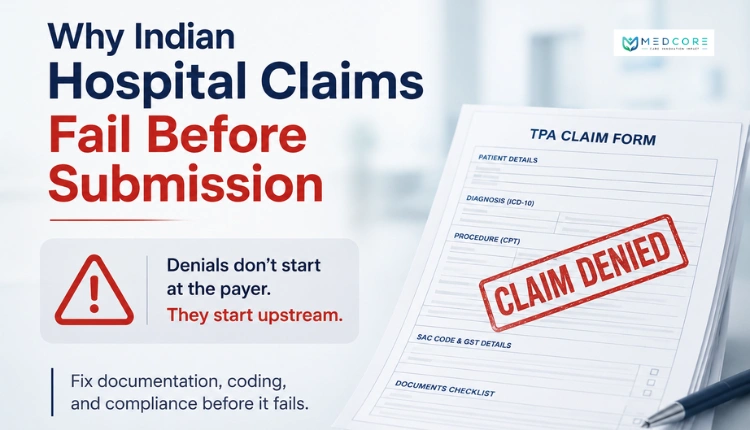
Most claim denials are decided before the billing team touches anything. The denial happens at the SOAP note, at the ICD-10 code, at the SAC tag — not at the payer’s desk. By the time a rejection lands in your inbox, the damage was done two or three steps upstream, and no appeal is going to fix a documentation gap.
This is the insight that most revenue cycle conversations miss. Globally, hospital denials reached 11.6% in 2025, costing providers $48.4 billion. In India, where 80% of facilities run on fragmented workflows, that upstream gap is wider and more expensive than almost anywhere else. You have GST itemization rules, IRDAI compliance obligations, and TPA-specific EDI requirements all converging on a single claim package — and most hospitals are still assembling that package manually, after the clinical encounter is over.
Fixing denials is expensive. Preventing them is a workflow problem.
In a hurry? Listen to the blog instead!
The Three Places Claims Break Before Submission

1. The SOAP Note — Where Coding Accuracy Is Made or Lost
A physician sees thirty patients. She documents in shorthand, dictates quickly, or uses a template that wasn’t designed for her specialty. The coder then interprets the available information. They assign ICD-10 codes based on the closest approximation instead of the strongest clinical match. They also add CPT codes from procedure lists rather than documented medical necessity.
This is the most common root cause named in the 2025 State of Claims report: incomplete documentation and coding errors. The payer doesn’t see the physician’s intent — they see the claim, and if the code doesn’t match the documented diagnosis, they deny it.
The fix isn’t faster coding staff. It’s capturing ICD-10 and CPT at the point of care, while the clinical reasoning is still visible. MedCore‘s Scribe Agent does this with ambient SOAP transcription and ICD-10/CPT pre-fill — the code suggestions appear alongside the note, before the encounter closes, while the physician can still verify them. The coder receives a document that is already structured around a defensible code set, not one they have to reconstruct from fragments.
2. The Claim Package — Where Indian-Specific Requirements Collide
Indian TPA submissions carry a layer of complexity that generic billing advice ignores. Before a claim even reaches a payer, the hospital must have collected the insurance card, passport, visa, and payer contact at admission. The billing team needs to validate the discharge summary against the payer’s policy terms. They also need to check ICD-10 codes against those same terms—not just for coding accuracy, but to ensure the specific payer accepts them.
Then there’s the SAC requirement that auditors check first and billing teams often overlook: clinical lines must be tagged SAC 9993 (exempt), while non-clinical lines carry their own SAC at 18%. Insurers expect itemized SAC codes on submitted claims. A missing or misapplied SAC code is a rejection trigger — not because the clinical care was wrong, but because the GST categorization was incomplete.
That’s before you account for the payer-specific EDI specs and claim reason codes that have to be exchanged with each TPA individually during setup. Each payer relationship requires its own configuration. A claim formatted correctly for one TPA may be structurally invalid for another.
3. The Denial-Risk Gap — Submitting Without Knowing the Score
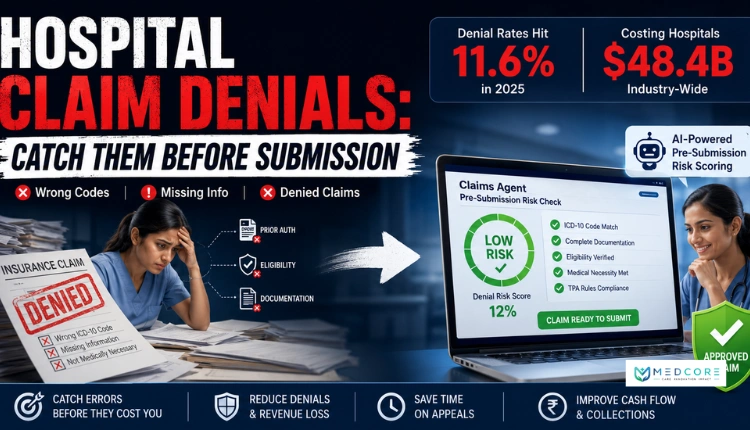
Most hospitals discover a denial risk after the payer flags it. The claim goes out, the denial comes back, the team writes an appeal. Experian Health’s State of Claims 2025 report is direct on this: the hospitals that are reducing denial rates are the ones catching errors before submission, not after.
That requires something most HMS platforms don’t have: a pre-submission signal. MedCore’s Claims Agent auto-drafts the TPA claim directly from the SOAP note and ICD-10 data, then attaches a denial-risk prediction before the claim leaves the building. If the risk score is elevated — say, because a particular payer has a pattern of rejecting a specific procedure code without supporting documentation — the billing team knows before submission, not after.
This matters more at hospitals running high daily volumes. For a facility seeing 150+ OPD patients per day with active TPA relationships and international patient billing through Razorpay and UPI, a double-digit denial rate across that volume compounds fast. The cost isn’t just the denied amount — it’s the staff hours in appeals, the cash flow delay, and the patient relationship damage when reimbursement disputes extend to them.
What a Pre-Submission Validation Workflow Actually Looks Like
This is the practical framework. It’s not glamorous, but it’s what separates hospitals with manageable denial rates from those drowning in appeals.
- Capture at the point of care. ICD-10 and CPT codes should be suggested during documentation, not assigned after the fact. If you’re coding from a completed note, you’re already working with an incomplete picture of the clinical reasoning.
- Build your SAC master list before you need it. Every billable item should have its HSN/SAC code, tax rate, exemption note, and insurance-claim inclusion flag mapped in advance. Auditors and insurers check this list first. Finding gaps under deadline pressure is avoidable.
- Validate against payer terms before packaging. Discharge summaries and ICD-10 codes need to be checked against the specific payer’s policy terms — not generic coding standards. This step requires knowing what each TPA will and won’t accept, which means the TPA integration setup (payer IDs, EDI specs, reason codes) must be complete and current.
- Score denial risk before submission. If your system can’t tell you the estimated denial probability on a claim before it goes out, you’re flying blind. The information exists in historical claim data — the question is whether your platform surfaces it at the right moment.
- Keep IRDAI and GST compliance parallel, not sequential. Hospitals create more errors when they treat regulatory compliance as a final checklist after clinical and billing work is complete. Instead, they should embed IRDAI rules, GST itemization, and FEMA obligations for international patients directly into the workflow, not bolt them on at the end.
The Staffing Trap That Makes This Worse
The instinctive response to rising denials is to hire more billing staff. More coders, more appeals specialists, more people to catch what’s slipping through. This works up to a point — but it treats a process problem as a headcount problem.
Prevention is the only lever that actually bends the denial rate. Appeals recover some denied revenue, but they don’t change the underlying error rate, and they consume staff capacity that could be doing something more productive. At a solo clinic or a 15-bed hospital without a dedicated revenue cycle team, staff often don’t have that option. They simply don’t file appeals, and the organization writes off denied claims.
This is exactly where mid-size and smaller Indian hospitals — the ones underserved by legacy HMS platforms built for large corporate chains — face the highest exposure. Most existing tools target enterprise RCM teams with dedicated staff. They don’t serve a 10-bed hospital in Karnataka, where the same person manages billing, handles the front desk, and juggles multiple administrative responsibilities.
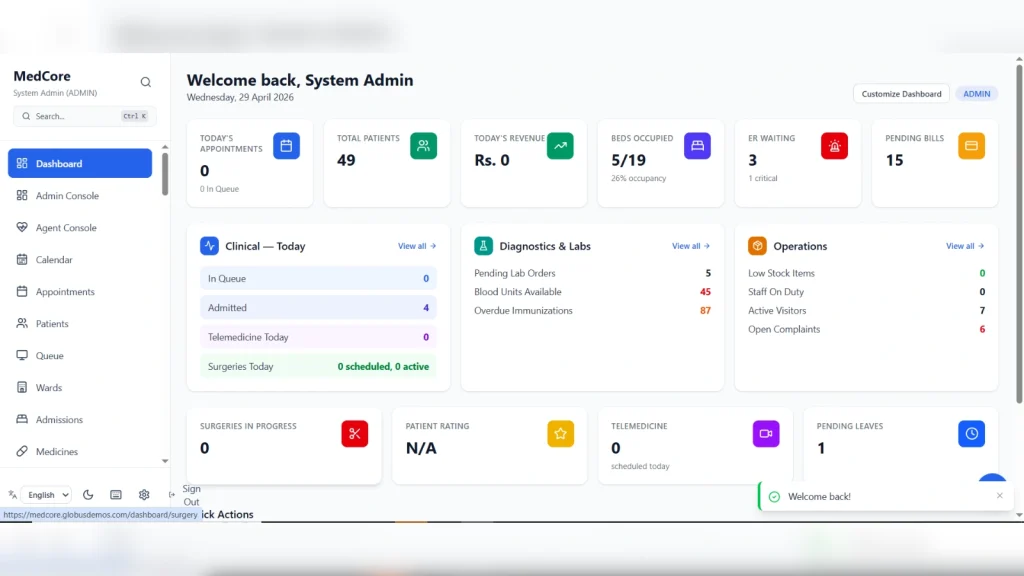
MedCore was built starting inside a 40-bed hospital in Bangalore, then beta-tested across 12 hospitals in Karnataka and Tamil Nadu before the 45-module platform launched. The Claims Agent and Scribe Agent exist because the people building the product watched this specific problem play out at that scale — not because they read about it in a whitepaper.
The One Question Worth Asking Your Current System
Before your next billing cycle, ask this: at what point does your HMS connect clinical documentation to claim output? If the answer is “when billing runs the claim,” you have a gap. The connection should happen at the SOAP note — ICD-10 pre-filled at documentation, SAC codes applied at invoicing, denial risk scored before submission.
If that chain isn’t continuous and visible, you’re not preventing denials. You’re just discovering them slightly sooner than the payer does.
For hospitals ready to close that gap, start your free MedCore trial — 14 days, no obligation, and the Claims Agent is live from day one.