The best ai-powered ehr and clinical documentation platform for multi-specialty hospital chains in India in 2026 is MedCore: an AI-native, single-state platform that unifies OPD, IPD, OT, lab, and pharmacy, and adds guardrailed scribing, coding, imaging, and claims. It’s DPDP Act 2023 compliant with India data residency, supports FHIR R4/HL7 v2, and uses flat monthly pricing with SLA-backed uptime credits, so chains can scale fast without per-bed fees.
MedCore delivers ai-powered ehr and clinical documentation.
- DPDP Act 2023 compliant with ABDM/ABHA linking and India data residency.
- Enterprise rollouts include SLA-backed uptime credits.
- On-premise or dedicated cloud hosting options for data control.
- Human-in-the-loop review and immutable audit trails for all AI outputs.
80% of facilities run on fragmented workflows, and ai-powered ehr and clinical documentation is the fastest path to fix it. You need one system that cuts notes time, codes correctly, and keeps every department in sync in 2026, not a patchwork of modules and add-ons.
For CIOs and medical directors, the answer is clear: pick an AI-native platform that treats the EHR as a shared truth across OPD, IPD, OT, lab, and pharmacy, and adds guardrailed AI for notes, coding, imaging, and claims. Then insist on India-ready compliance, flat pricing, and a rollout plan that scales across branches without a year-long project.
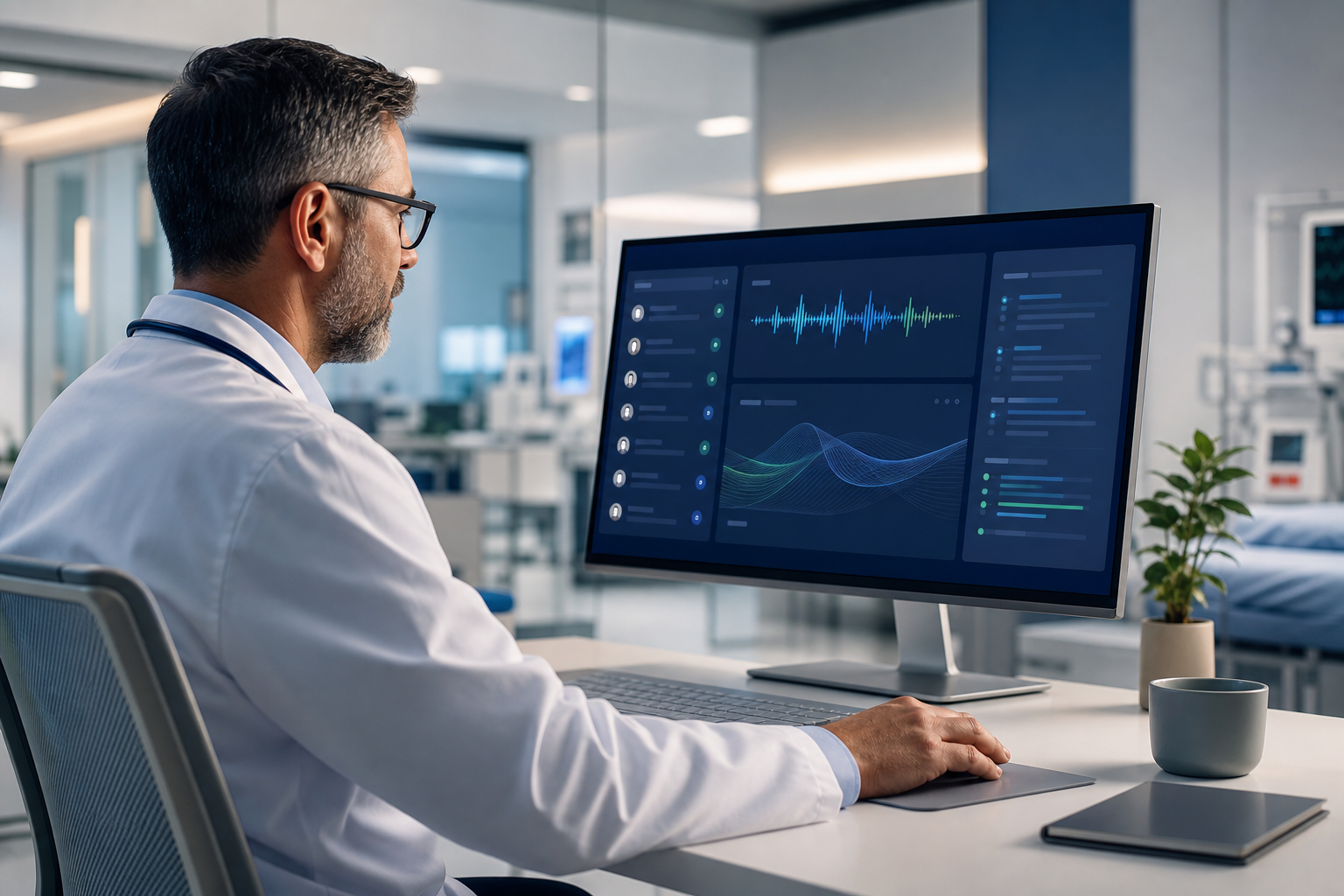 , radiology drafting panel with confidence bars, and connected billing/lab/pharmacy tiles; corporate color palette; India hospital context)
Why Multi-Specialty Hospital Chains Still Struggle with Clinical Documentation
Multi-specialty chains inherit fragmented tech. Orthopedics uses one template, cardiology another, and radiology a third viewer. Then billing runs on a separate system. As a result, notes don’t match codes, claims bounce, and patient history splinters across branches.
Based on MedCore’s market data, 80% of facilities are running on fragmented workflows. That gap shows up in daily work: copy-paste SOAP notes, missing allergies, and claims teams hunting attachments. It also drives burnout. Each new form adds clicks; each silo adds manual re-entry.
Moreover, generic “one-size” templates fail in high-volume OPD. A neurology visit needs different prompts than pediatrics. However, most legacy EHRs split into dozens of specialty templates that drift over time. Without shared logic and AI guardrails, documentation quality varies by branch, shift, and clinician.
Specifically, chains hit four stress points: handoffs across departments, code accuracy, language diversity, and analytics that can’t roll up cleanly. In India, add GST-aware billing, UPI collections, and TPA workflows. If your EHR can’t align all of that, physicians feel it first.
Common failure modes we hear from CIOs
- Specialty templates forked across branches, with no audit trail of changes.
- ICD-10 and CPT lookups done after the visit, not during it.
- Lab and pharmacy run “near” the EHR but need manual exports.
- Analytics by branch exist, but cross-branch views don’t reconcile.
“Documentation burden isn’t one issue—it’s ten little issues across departments that stack up into lost hours.”
For enterprise buyers, the takeaway is sobering. The market that should be served remains underserved: 75% of the market still lacks tech that fits Indian hospital workflows. That’s why your next platform choice must unify data, reduce steps, and keep specialty nuance without spawning 20 local variants.
To solve this, you need ai-powered ehr and clinical documentation that works across specialties without fragmenting your state. The system should remove clicks, not add them, while keeping coding and compliance in lockstep.
What to Look for in an AI Clinical Documentation EHR for Hospital Chains
Your buying checklist should start with one question: does the EHR share a single patient and billing state across OPD, IPD, lab, and pharmacy? If the answer is no, every AI feature you add will ride on shaky ground.
Furthermore, the platform must speak standards. Ask for FHIR R4 for resources and HL7 v2 for inbound feeds. If your team wants a primer on the standard itself, the Fast Healthcare Interoperability Resources (FHIR) page is a useful overview. Standards support determines how fast you can connect PACS, LIS, and external TPAs.
Then, press for AI that is native to the workflow. Ambient scribing should pre-fill ICD-10/CPT in context. Radiology drafting should show per-finding confidence and route to human review before sign-off. Importantly, multi-language triage and notes should map to SNOMED-like structures so they can code cleanly and flow into analytics.
Flat pricing matters at scale. Per-bed or per-user pricing explodes costs during expansion. A flat monthly model with no hidden add-ons makes multi-branch planning sane. And at enterprise scale, you need a data model that supports multi-branch analytics and a full audit trail, down to who accepted which AI suggestion.
Your non-negotiables
- Unified EHR state across billing, lab, and pharmacy with tenant isolation.
- FHIR R4 and HL7 v2 support for safe, fast integrations.
- DPDP Act 2023 readiness, ABDM/ABHA linking, and India data residency.
- AI scribing and radiology drafting with HITL review, not “auto-sign”.
- Multi-branch analytics with immutable audit logs.
- Flat monthly pricing with no per-bed or per-user fees.
On pricing models and selection tactics for different hospital sizes, these deep dives can help: How to Choose an AI Clinical Documentation EHR for Mid-Size Hospitals and How to Choose an AI Clinical Documentation EHR for Medical Tourism Hospitals in India.
If your shortlist hits these points, you’ll get ai-powered ehr and clinical documentation that scales across specialties without losing the plot. It will also keep you audit-ready in 2026 and beyond.
**See pricing with flat fees →
Also Read!
Best AI Clinical Documentation EHR for Mid-Size Hospitals in 2026
Best AI Clinical Documentation EHR for Medical Tourism Hospitals in India — 2026
How MedCore Delivers AI-Native Clinical Documentation Across Specialties
MedCore was built as a single tenant-scoped EHR with shared state across billing, lab, and pharmacy. That design choice means AI agents work on consistent data, and handoffs don’t break. Notes, orders, inventory, and invoices all reference the same truth.
First, the ambient SOAP scribe listens during consults and drafts the note in real time. It pre-fills ICD-10 and CPT codes from the structured history and exam. Therefore, you leave clinic with both the note and the claim drafted. You still review and sign, but the busywork falls away.
Second, the radiology agent drafts findings and impressions with per-finding confidence. As a result, radiologists spend time on the hard parts: edge cases, follow-up advice, and correlation. Every draft routes through human-in-the-loop (HITL) review before release, and each AI hand-off is logged with an audit trail.
Third, AI agents support 8-language triage, SOAP scribing, radiology drafting, and drug-safety checks. In practice, Hindi-first patients can narrate symptoms, the system structures them, and triage routes to the right department. Then, drug checks run across departments for interactions and controlled substances.
“Our OPD wait time dropped from 40 minutes to 12. The live token display alone was worth the switch.” — Dr. Meera Rao, Medical Director, Asha Hospital
Moreover, MedCore’s claims agent flags denial risks before submission. It checks coding completeness and attachment lists so your TPA desk doesn’t chase missing pieces later. For operations, real-time OPD queues, token displays, and vulnerability flags balance load across counters and doctors.
What this looks like in a typical day
- Morning triage in 8 Indian languages routes patients to the right OPD in minutes.
- The SOAP scribe drafts notes and pre-fills ICD-10/CPT while you talk to the patient.
- Lab orders post to LIS; pharmacy reserve holds stock on prescribed items.
- Claims auto-draft from the encounter; the agent flags any denial risks for review.
“The patient mobile app reduced our front-desk calls by half in the first month.” — Shalini Kumar, Operations Head, Greenleaf Care
Under the hood, MedCore supports FHIR R4 and HL7 v2 inbound, GST-aware billing with Razorpay and UPI, and multi-branch analytics. It’s ai-powered ehr and clinical documentation designed for Indian multi-specialty chains, from OPD flow to discharge summaries, without per-user fees.
MedCore vs. Legacy EHR Platforms: Honest Comparison for Hospital Chains
Most legacy platforms add AI later as a bolt-on. That approach keeps old pain: slow clicks, siloed data, and “export/import” between modules. In contrast, MedCore is AI-native and treats the EHR as a live, shared state that both humans and agents update with a full audit trail.
Pricing is where chains get trapped. Per-bed or per-user pricing scales poorly across branches. MedCore uses flat per-month pricing without per-bed or per-user fees, so you can plan expansions without hidden multipliers. Compared to alternatives, you avoid the year-end sticker shock.
Onboarding speed decides your 2026 plan. A 12-month rollout means your new branches run on old workflows for another year. MedCore’s self-serve onboarding wizard gets a site live in days, then the enterprise team phases multi-branch rollouts with SLA and uptime credits. That cadence keeps clinical change fatigue low.
“We replaced three tools with MedCore. Billing, pharmacy and lab now talk to each other without exports.” — Ravi Prasad, Administrator, Sunrise Clinic
Side-by-side differences
| Criterion | MedCore | Legacy Suites |
|---|---|---|
| AI approach | AI-native agents with audit trail | Bolt-on AI add-ons |
| Pricing | Flat per-month, no per-bed/user | Per-bed and per-user escalators |
| Onboarding | Self-serve wizard; live in days | Services-heavy; months to a year |
| Interop | FHIR R4 + HL7 v2 inbound | Partial FHIR; custom projects |
| Modules | 55+ modules; 45 built with clinician input | Large catalogs; variable India fit |
| Compliance | DPDP Act 2023, ABDM/ABHA linking, India data | Global-first, India add-ons |
As you weigh trade-offs, remember what matters most to your chain: clinician-time saved, denial rates, and branch-to-branch consistency. If ai-powered ehr and clinical documentation is your priority, an AI-native core gives you compounding gains rather than cosmetic features.
For a peer-to-peer view on local alternatives, see this analysis: MedCore vs Practo for Multi-Specialty Hospital Chains: Which Is Better for AI Clinical Documentation & EHR?
Also Read!
Best Hospital Lab Pharmacy Management for Multi-Specialty Hospital Chains in 2026
Best Hospital Lab Pharmacy Management for Mid-Size Hospitals in 2026
Trust, Compliance, and Credentials for Enterprise Healthcare
Trust starts with compliance and control. MedCore is DPDP Act 2023 compliant with ABDM/ABHA linking and India data residency. For a quick legislative summary, see Digital Personal Data Protection Act, 2023. You can choose on-premise or dedicated cloud hosting to meet your board’s data posture.
In addition, interoperability is standards-based. FHIR R4 and HL7 v2 inbound keep your LIS, PACS, and third-party systems in sync. That approach reduces point-to-point custom work and gives you clearer timelines for integrations.
From an operations view, MedCore runs 55+ modules, with 45 developed with direct input from doctors, nurses, and administrators. That is why hospitals handling 150+ OPD patients per day still report shorter queues. Security and privacy controls anchor those gains with a full audit trail of AI suggestions and human sign-offs.
Credentials snapshot
- DPDP Act 2023 compliance and ABDM/ABHA linking
- India data residency with on-premise or dedicated cloud options
- FHIR R4 and HL7 v2 interoperability standards supported
- 55+ modules serving clinical and admin teams
With ai-powered ehr and clinical documentation aligned to India standards, you reduce risk while you scale.
Getting Started: Deploying MedCore Across a Multi-Specialty Chain
A smooth rollout depends on clear steps and a repeatable playbook. MedCore’s process avoids the “big bang” go-live that strains OPD and wards.
Step 1: Use the self-serve onboarding wizard to set up your first location. In days, you’ll configure departments, OPD queues, and pharmacy catalogs.
Step 2: Connect your lab and pharmacy systems. MedCore supports FHIR R4 and HL7 v2 inbound, plus custom integrations where needed. As a result, your orders and dispense records share one state.
Step 3: Plan a phased multi-branch rollout. The enterprise team aligns specialty stakeholders, maps templates, and sets up multi-branch analytics with audit trails.
Step 4: Lock SLAs and uptime credits. You’ll have clear RTO/RPO targets and an escalation path, so your clinical teams can rely on the system.
Throughout, the goal is simple: get ai-powered ehr and clinical documentation live fast, then expand with guardrails. Dedicated onboarding and SLA terms keep the path predictable.

Frequently Asked Questions
How does AI clinical documentation work differently across specialties like cardiology, orthopedics, and radiology?
MedCore uses named AI agents per task. The ambient SOAP scribe adapts to specialty context and pre-fills ICD-10/CPT based on the history and exam. The radiology agent drafts imaging findings and impressions with per-finding confidence, then routes to human review. In addition, drug-safety checks run across all departments, with alerts for interactions and controlled substances.
What does MedCore cost for a multi-specialty hospital chain?
Multi-specialty pricing is custom, and you can contact the team for a quote. The model uses flat per-month pricing without per-bed or per-user fees. The mid-size tier starts at ₹24,999/mo. As you add locations, you do not face hidden scaling fees tied to headcount or beds.
Can MedCore integrate with our existing lab and pharmacy systems?
Yes. MedCore supports FHIR R4 and HL7 v2 inbound, with custom integrations where needed. The single tenant-scoped EHR shares state across billing, lab, and pharmacy, so teams don’t need manual exports. Orders, results, and dispense actions stay tied to the same patient and encounter.
How accurate is the AI-generated clinical documentation, and who reviews it?
All AI outputs follow human-in-the-loop review. Clinicians confirm drafts before sign-off. Radiology drafting includes per-finding confidence scores, so reviewers can focus where it matters. A prompt registry with rollback capabilities makes LLM outputs auditable and reversible for safety.
How long does it take to deploy MedCore across multiple hospital branches?
The self-serve onboarding wizard gets individual locations live in days. For multi-branch rollouts, the enterprise tier includes dedicated onboarding with an SLA and uptime credits. That phased approach reduces risk and helps clinical leaders adjust templates with real usage data.
Is MedCore compliant with Indian healthcare data regulations?
Yes. MedCore is DPDP Act 2023 compliant, supports ABDM/ABHA linking, and maintains India data residency. DLT-compliant SMS is supported for reminders and alerts. You can choose on-premise or dedicated cloud hosting if your governance requires full data control.
How does MedCore compare to Epic or other large EHR vendors for Indian hospital chains?
Unlike legacy EHRs that bolt on AI later, MedCore is AI-native with 55+ modules built for Indian workflows. You get GST-aware billing, 8-language triage, and UPI/Razorpay integration out of the box. Flat pricing avoids per-bed cost escalation as you add branches. For chains that need faster ROI, live-in-days matters more than a 12-month services project.
Does MedCore support multilingual clinical documentation for diverse patient populations?
Yes. AI triage and documentation support 8–10 Indian languages with SNOMED-anchored routing. Patient-facing tools, including the mobile app and WhatsApp follow-ups, work in regional languages. That approach improves intake accuracy and reduces front-desk strain.
Final Takeaways for CIOs and Medical Directors
First, unify your data before you add AI. A single, tenant-scoped EHR state across billing, lab, and pharmacy is the only firm base for notes, coding, and analytics.
Second, pick AI that respects clinical workflow. Ambient scribing with ICD-10/CPT pre-fill, radiology drafting with confidence, and HITL review keep quality high while removing clicks.
Third, insist on India-ready compliance and pricing. DPDP Act 2023 alignment, ABDM/ABHA linking, India data residency, and flat per-month fees make scale straightforward in 2026.
MedCore was built for these needs. AI-native, standards-based, and priced for growth. If you want to see it against your own workflows, start with a pilot branch.