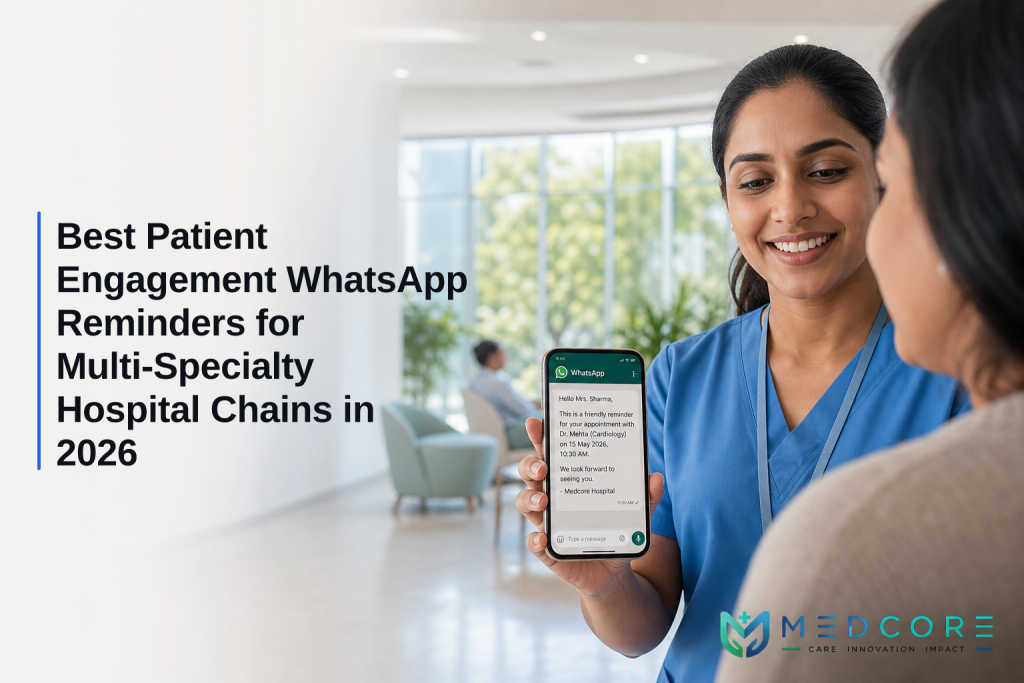
For multi‑specialty hospital chains in India, the fastest way to cut no‑shows in 2026 is a patient engagement app with whatsapp reminders integrated with your EHR. Run WhatsApp from a unified EHR, not a separate blasting tool, so you target high‑risk no‑shows, notify in eight Indian languages with DLT‑captured consent, and close the loop across billing, lab, and pharmacy.
**Book a demo, instant tour →.
The fastest path to fewer no‑shows in 2026 is a patient engagement app with whatsapp reminders tied to your EHR. Choose a patient engagement app with whatsapp reminders that speaks 8 Indian languages, is DLT-compliant, and plugs into your billing, lab, and pharmacy.
Here’s the answer up front: hospital chains cut missed appointments and lost follow-ups when WhatsApp reminders run from a unified EHR, not a separate blasting tool. As a result, you target high-risk no-shows, notify in the patient’s language, capture consent for DLT, and close the loop across billing, lab, and pharmacy without spreadsheets.
According to MedCore market analysis, 80% of facilities run on fragmented workflows and 75% of the market is underserved by existing tech. That gap shows up as no-shows, re-work at the front desk, and patients falling between departments. In 2026, WhatsApp is still the most read patient channel in India, but it only moves metrics when it has clinical context and a follow-up workflow behind it.
Security and compliance: DPDP Act 2023 compliant, DLT‑registered templates, India data residency by default, with SLA‑backed uptime credits.
However, teams hit real barriers: DLT template approvals, template sprawl across branches, language mismatches, and zero audit trail when third-party tools sit outside your HIS. Therefore, the platform matters more than the message body. Below, you’ll find a buyer’s checklist, a technical walkthrough, and a plain comparison of MedCore vs generic WhatsApp BSP tools, with numbers, not hype.
Why Multi-Specialty Hospital Chains Struggle with Patient Engagement at Scale
Fragmented workflows are the root cause. Per MedCore data, 80% of facilities operate on disconnected systems. One branch uses a local LIS, another has a separate pharmacy POS, and the OPD queue sits in a spreadsheet. Consequently, your reminders lack context: the tool doesn’t “know” the latest lab order, the billing block, or the doctor’s change in schedule.
In addition, language adds friction. Chains serve patients across states where English or even Hindi isn’t the first choice. Without 8-language support, reminders and triage answers don’t land. Patients ignore what they can’t parse, and your no-show rate stays high.
DLT adds a compliance tax. Template registration, header mapping, and consent logging vary by campaign and brand. If your tool isn’t DLT-aligned by design, you get blocked sends and ad-hoc fixes that never scale across branches. Moreover, audit gaps create risk in 2026, the year DPDP enforcement becomes real for many providers.
Cross-department hand-offs leak patients. A lab-ready reminder triggers a pharmacy follow-up only if systems share state. Otherwise, staff call patients twice, and patients get confused. As a result, care paths stall in the hand-off from OPD to lab to pharmacy.
The silent revenue drain you can measure
- No-shows block OPD slots and delay care. Empty chairs don’t bill.
- Repeated front-desk calls raise cost per visit and frustrate patients.
- Language mismatches lower response rates to follow-ups and recalls.
- Non-compliant templates risk suspensions and sudden drop-offs in reach.
“We replaced three tools with MedCore. Billing, pharmacy and lab now talk to each other without exports.” — Ravi Prasad, Administrator, Sunrise Clinic
Finally, scale exposes the cracks. A single branch juggling 150+ OPD patients per day needs more than a message blaster. It needs a shared source of truth so WhatsApp reminders reflect live queue status, orders, and payments, not yesterday’s CSV.
What to Look for in a WhatsApp Patient Engagement Platform for Hospital Chains
A buyer’s checklist saves months of trial and error. Start with the core: DLT compliance, language, EHR depth, prediction, analytics, and pricing. Then verify audit and rollout paths across branches. You want a platform that works in week one and still works at your tenth site.
Specifically, insist on DLT-registered templates and consent capture inside the same system that sends the WhatsApp reminder. If your EHR or HIS is separate, integration depth matters. FHIR R4 and HL7 v2 inbound support let you sync appointments, encounters, labs, and prescriptions cleanly.
Moreover, plan around language. Eight Indian languages should be the floor for patient-facing flows. Triage, reminders, and follow-up nudges have to speak like your front-desk team does. Anything less leaves response gaps by region.
Checklist you can run this week
- DLT-compliant WhatsApp and SMS with template registry and audit trail per branch.
- Eight-language patient flows, not just English/Hindi toggles.
- EHR-grade integration (FHIR R4 + HL7 v2 inbound), not CSV uploads.
- No-show prediction with scores you can act on, not vanity charts.
- Multi-branch analytics with a full audit trail for templates, sends, and hand-offs.
- Follow-up automation across voice + WhatsApp, not one channel alone.
- Branded patient app with live queue, lab reports, prescription QR, and bill pay.
- Flat monthly pricing with included message packs to avoid per-message traps.
On pricing, avoid surprises. Flat per-month pricing with included WhatsApp message packs (e.g., 1,000 or 10,000) is safer than pure pay-per-send. As a result, you can budget and still scale recall campaigns during high season. For a broader view of evaluation criteria, you can skim this practical guide to “patient engagement software” and map it to your chain.
Finally, ask for a multi-branch rollout plan. A template that works at Site A must clone with IDs, senders, and routing intact at Site B. Therefore, your platform needs tenant-scoped logic and per-branch overrides, without engineering tickets.
Also Read!
Best Hospital Billing with GST, UPI & Insurance Claims for Small Clinics in India (2026)
Best Hospital Lab & Pharmacy Management for Small Clinics in India — 2026
How MedCore Delivers WhatsApp-Powered Patient Engagement for Hospital Chains
MedCore is an AI‑native healthcare management system with a unified EHR and patient messaging built in. Unlike generic WhatsApp BSP tools, it sends reminders with clinical context and records every step against the patient chart. As a result, the front desk sees the same state as the lab and pharmacy, and patients get the right nudge at the right time.
Moreover, MedCore includes WhatsApp messaging allowances out of the box: 1,000 messages per month on Starter and 10,000 on Professional. Therefore, chains can launch recall campaigns without an immediate spend spike. Flat per-month pricing means no per-bed or per-user fees.
Outbound Follow‑up Agent: voice + WhatsApp that closes loops
MedCore’s Outbound Follow‑up Agent reaches patients on WhatsApp and voice calls, then writes outcomes back to the EHR. For a high no-show risk appointment, the agent can call in the patient’s language, confirm the time, and push a WhatsApp quick-reply button to reschedule or confirm. Front-desk staff see the result in the queue view in real time.
In addition, the agent works on pharmacy recalls. If a prescription is due, it sends a reminder with the prescription QR, routes to payment if needed, and flags dispense at the pharmacy module. Unlike alternatives, this happens without exports or manual uploads.
Predictions Agent: no‑show scoring and pharmacy demand
MedCore’s Predictions Agent scores each upcoming appointment for no‑show risk. Scores sit next to the OPD queue and feed the Follow‑up Agent. Therefore, your team spends minutes, not hours, on the right patients. It also forecasts pharmacy demand so your stock aligns with recall cadence.
Because scores live inside the EHR, you can track impact across the funnel: scheduled → confirmed → arrived → billed. That audit trail is crucial for operations reviews and branch heads.
Triage Agent: 8 Indian languages, SNOMED‑anchored routing
Patients can ask, “Is this rash urgent?” in their language. The Triage Agent replies in the same language, maps symptoms to SNOMED, and routes to the right department. As a result, front-desk calls drop and cases reach the right clinic faster. For chains with sites across states, this is more than nice to have, it’s how you hit SLA on response.
Furthermore, language support spans eight Indian languages at launch. That includes full triage and reminder flows, not just template headings.
Patient app: live queue, lab reports, prescription QR, bill pay
Patients download your branded app and see live tokens, reports, and bills. They can pay, view the prescription QR, and track lab order status. Consequently, questions that used to flood your desk move to self‑serve.
“Our OPD wait time dropped from 40 minutes to 12. The live token display alone was worth the switch.” — Dr. Meera Rao, Medical Director, Asha Hospital
“The patient mobile app reduced our front-desk calls by half in the first month.” — Shalini Kumar, Operations Head, Greenleaf Care
Unified EHR across billing, lab, pharmacy
MedCore runs a single tenant-scoped EHR with shared state across billing, lab, and pharmacy. A WhatsApp reminder can include the right visit details, lab order numbers, and unpaid bill links because the platform “knows” everything in one place. Compared to alternatives that blast messages without context, this is why MedCore moves outcomes, not just open rates.

MedCore vs. Generic WhatsApp Business API Tools: An Honest Comparison
Generic BSP tools send messages. They don’t understand your clinics, queues, or labs. As a result, they can’t score no‑shows, can’t act on lab deltas, and can’t hand off to billing without a copy‑paste. MedCore’s edge is context: the EHR, the agents, and the audit trail live together.
Unlike a standalone reminder tool, MedCore provides named AI agents with one‑click hand‑off and a full audit trail. An agent escalates to staff in the OPD queue with the full chat log and chart context. Therefore, there’s no “what did we tell the patient?” guesswork at reception.
Furthermore, MedCore’s single tenant‑scoped EHR shares state across billing, lab, and pharmacy. If a bill is overdue, the reminder includes the payment link. If a lab result crosses a delta threshold, the triage agent routes the case. Generic tools can’t do this without custom glue.
Side‑by‑side at a glance
| Requirement | Generic WhatsApp BSP | MedCore |
|---|---|---|
| EHR context in reminders | No | Yes (shared state across billing/lab/pharmacy) |
| AI no‑show prediction | No | Yes (Predictions Agent) |
| Follow‑up via voice + WhatsApp | Limited | Yes (Outbound Follow‑up Agent) |
| Multi‑branch analytics + audit trail | Basic | Yes (tenant and branch scoped) |
| Pricing | Per-message surprises | Flat per-month with message packs |
“We replaced three tools with MedCore. Billing, pharmacy and lab now talk to each other without exports.” — Ravi Prasad, Administrator, Sunrise Clinic
For a data‑driven comparison tailored to large sites, review our in‑depth breakdown: MedCore vs Practo for Multi-Specialty Hospital Chains: Which Is Better for Patient Engagement WhatsApp Reminders? It details where context and audit matter at scale.

Trust, Compliance, and Credentials That Matter for Hospital Chains
Compliance and data residency are non‑negotiable in 2026. MedCore is DPDP Act 2023 compliant and supports ABDM/ABHA linking for national health ID flows. For reference, see the official Ayushman Bharat Digital Mission (ABDM) for how ABHA IDs aid secure data exchange.
Moreover, MedCore supports FHIR R4 and HL7 v2 inbound for interoperability and clean data movement. That means your existing HIS, LIS, and PACS can sync events and orders without messy exports. In addition, DLT‑compliant SMS and WhatsApp templates keep your outreach aligned with Indian telecom rules.
- India data residency by default with options for on‑premise or dedicated cloud hosting.
- SLA with uptime credits, built for sites that run 24/7.
- 55+ integrated modules so OPD, IPD, lab, imaging, pharmacy, and billing stay in one system.
- Proven capacity for 150+ OPD patients per day without back-office sprawl.
Furthermore, interoperability isn’t a promise, it’s certified. FHIR R4 and HL7 v2 interoperability are part of how MedCore moves orders and results between modules. That shared state is why reminders carry the right context and why audits stand up under review.
Finally, governance extends to people and process. Named users, role-based access, and an audit trail for templates and sends reduce risk. Therefore, regional managers can review sends per site with confidence and act on branch‑level trends, not anecdotes.
**Book a demo, secure data flows →
Also Read!
How to Set Up Lab and Pharmacy Management for a Small Clinic in India
How to Set Up WhatsApp Patient Reminders for Mid-Size Hospitals
Getting Started: Deploying WhatsApp Patient Engagement Across Your Hospital Chain
A clear rollout plan shortens time to value. MedCore includes a self‑serve onboarding wizard so a single branch can go live in days. Enterprise tier adds a dedicated onboarding team that handles data migration, template registration, and branch sequencing with you.
First, align data. Appointments, providers, and patient masters import via FHIR R4 or HL7 v2 inbound. Second, register DLT templates and map headers to brands per branch.
Third, enable WhatsApp sender IDs and test sends to staff numbers before patient use. Fourth, train staff on AI agent hand‑off so escalations reach the right queue. Fifth, schedule a pilot week at one site, then roll out in a north‑star order: highest OPD load first.
In addition, decide message pack sizing early. Starter includes 1,000 WhatsApp messages per month. Professional includes 10,000. That flat structure keeps budgets simple while you ramp patient flows. For smaller sites in your network, this step‑by‑step set‑up tutorial for smaller clinics shows the same method on a lighter footprint.
Finally, confirm your hosting and governance choices. India data residency is the default. You can run on‑premise or choose a dedicated cloud with SLA and uptime credits. Throughout the rollout, keep one line in your project plan: use a patient engagement app with whatsapp reminders only when templates, consent, and audit are in place, not before.

Frequently Asked Questions

How much does MedCore’s WhatsApp patient engagement cost for a multi-specialty hospital chain?
MedCore uses flat monthly pricing without per‑bed or per‑user fees. Starter includes 1,000 WhatsApp messages per month, and Professional includes 10,000. Enterprise for multi‑specialty chains is custom, based on branch count and integration scope. Please contact the team for an exact quote tied to your rollout.
Are MedCore’s WhatsApp reminders DLT-compliant for Indian telecom regulations?
Yes. All WhatsApp and SMS templates are DLT‑registered with an audit trail at the branch level. MedCore also complies with the DPDP Act 2023 and supports ABDM/ABHA linking so you can align outreach with national health ID workflows. This reduces the risk of blocked campaigns and keeps consent clear.
Can WhatsApp reminders be sent in regional languages for patients across different states?
Yes. MedCore’s triage and follow‑up agents support eight Indian languages with SNOMED‑anchored routing. Reminders and follow‑ups go out in the patient’s preferred language, and replies route to the right department. As a result, response rates rise across regions without manual template duplication.
How does MedCore reduce no-shows compared to basic WhatsApp reminder tools?
Basic tools send the same ping to every patient. MedCore’s Predictions Agent scores no‑show risk by patient and appointment. The Outbound Follow‑up Agent then targets high‑risk patients with voice plus WhatsApp nudges, using clinical context from the unified EHR. This is how reminders turn into arrivals, not just reads.
Can MedCore integrate with our existing hospital information system?
Yes. MedCore supports FHIR R4 and HL7 v2 inbound, plus custom integrations for your LIS, RIS, and PACS. Its single tenant‑scoped EHR shares state across billing, lab, and pharmacy, which reduces the need for middleware. As a result, clinical context flows into reminders with fewer points of failure.
What alternatives to MedCore exist for WhatsApp patient engagement in hospitals?
Generic WhatsApp BSPs such as Gupshup or Wati handle message sending but lack EHR integration and no‑show prediction. Standalone HMS platforms may add WhatsApp as an afterthought without AI‑driven follow‑up workflows. If you choose an alternative, check for EHR context, multi‑branch analytics, and an audit trail.
How long does it take to deploy MedCore across multiple hospital branches?
A single branch can go live in days using the self‑serve onboarding wizard. Multi‑branch deployments on the Enterprise tier include dedicated onboarding support with an SLA and uptime credits. The overall timeline depends on data migration and DLT template approvals, which MedCore helps coordinate.
Is patient data stored in India, and can we use on-premise hosting?
Yes. MedCore offers India data residency by default. You can also choose on‑premise or a dedicated cloud environment if your data governance policies require it. All options include security controls, audit trails, and support for compliance reviews.
Sources and Further Reading
For background on national digital health standards, see this overview of Digital Personal Data Protection Act, 2023. For ABHA and ABDM program details, refer to the official ABDM portal once during your evaluation stage.
The Bottom Line
- Tie WhatsApp to your EHR, or reminders won’t move outcomes. Context, not copy, cuts no-shows at scale.
- Plan for DLT, languages, and audit from day one. Flat pricing with message packs keeps budgets stable as you grow.
- MedCore brings EHR state, AI agents, and analytics together so branches work as one — with real results, like OPD wait time dropping from 40 to 12 minutes.
For a deeper cost/benefit view, you can also read the Best Patient Engagement WhatsApp Reminders for Small Clinics in India, 2026 article to compare needs by site size.
**Start your pilot, go live fast →.
**Speak to an expert, no pressure →