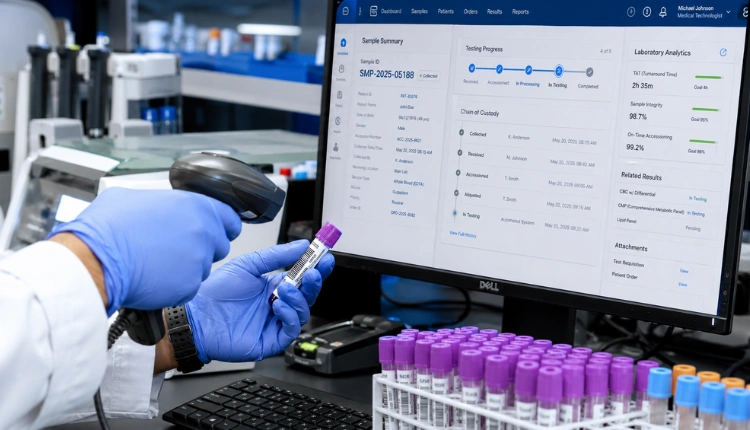

One in three hospital executives reports a denial rate of 10% or more. The revenue cycle directors I speak with are mostly chasing the symptom: resubmitting claims, hiring more coders, and buying scrubbers. Almost none of them have fixed the root cause. And the root cause is not the billing team. It is the gap between what happens in the consultation room and what ends up in the claim.
Listen to the podcast!
The Documentation-to-Billing Gap Nobody Wants to Own
Here is how most mid-size hospitals in India actually work right now. A doctor finishes a consultation. The clinical notes go somewhere: a paper file, a poorly structured EMR field, or a WhatsApp message to the ward staff. Later, a billing executive tries to reconstruct that encounter into an ICD-10 and CPT code. They were not in the room. That guess is where your revenue leaks.
When clinical documentation and billing are disconnected, as MedCore’s analysis of hospital information systems found, “codes get miscategorised, services go unbilled, or claims go out with missing information”. This is not a compliance failure. It is a structural one. The coder cannot code what the clinician never documented or documented in a format no billing system can read.
Payers reflect this in their denial data. A significant share of denied claims are not fraudulent; they are legitimate encounters that could not survive scrutiny because the documentation behind them was thin, mismatched, or missing a qualifier the payer required.
The Three Specific Places Codes Break Down

Across the hospitals where MedCore has been deployed, including sites running 150+ OPD patients per day, the most common denial trigger is not fraud. It is one of three documentation failures.
1. The SOAP-to-Code Translation
A SOAP note written for a clinician’s benefit looks very different from what a payer needs to justify reimbursement. Subjective and Assessment sections often contain the right clinical reasoning but it is buried in prose, with the specific specifiers, severity qualifiers, and laterality that ICD-10 demands nowhere in sight. The coder has to infer. Inference creates variance. Variance creates denials. 32% of denied claims cite coding errors as the primary reason and most of those errors trace back to this translation step, not deliberate miscoding.
2. The CPT-to-Diagnosis Mismatch
Even when the ICD-10 code is correct, if the CPT code for the procedure does not medically justify it under the payer’s policy, the claim fails. This is a pairing problem. The billing team often lacks the clinical context to make the pairing correctly. The clinician often does not know which CPT applies to what they just did. Nobody is checking the intersection. MedCore’s own billing analysis explicitly lists code entry drift (CPT and ICD-10 typed by billing staff rather than fed directly from clinical notes) as a root cause of denials, distinct from eligibility failures or missing signatures.
3. Discharge Documentation
This one is especially painful for inpatient claims. The discharge summary is frequently written quickly, after the clinical work is done, and rarely with a coder’s eye. One missing ICD-10 code, one service line rendered but not documented, and the claim gets denied or paid at a lower level. The scale of this problem is not abstract: The Medicare Fee-for-Service improper payment rate stood at $28.83 billion in FY2025, with coding-related documentation gaps cited as a primary driver. Our published guide on TPA and IRDAI insurance workflows specifically calls out validating discharge summaries and ICD-10 coding against payer policy terms as a distinct pre-submission step because hospitals routinely skip it.
The Fix Is at the Point of Care, Not the Billing Desk
Most hospitals try to solve the denial problem by improving billing operations, hiring senior coders, buying claim-scrubbing software, and building appeals workflows. These are all downstream interventions. They catch errors after the damage is done.
The real fix is connecting clinical documentation directly to billing codes at the point of care. Not retroactively. Not during billing review. During the consultation itself.
This is why the architecture of MedCore puts the Scribe Agent in the room with the doctor, not at the billing desk. It works as an ambient SOAP scribe with speaker tagging: the doctor talks, the patient responds, and the system listens with a different purpose than recording. It is simultaneously drafting the SOAP note and pre-filling ICD-10 and CPT codes as the encounter unfolds. By the time the consultation ends, a coding-aware document already exists.
That matters because it compresses the gap. There is no translation step. No “billing executive reconstructs the encounter from memory three hours later. Clinical reasoning and billing codes are generated from the same source event at the same time.
Denial-Risk Prediction Before Submission
Pre-filling codes is not enough on its own. Payer policies vary. TPAs have their own quirks. What is reimbursable under one scheme is denied under another.
Fighting those denials is expensive in its own right. U.S. hospitals and health systems spent an estimated $19.7 billion in 2022 fighting payer denials alone, and that figure excludes lost reimbursements that were never successfully appealed. Most denial management spend is reactive. It addresses the consequence, not the cause.
This is where MedCore’s Claims Agent addresses the second half of the problem. It auto-drafts the TPA claim from the SOAP note, ICD-10 codes the scribe agent produced, and it includes denial-risk prediction before the claim goes out. That is not a claim scrubber in the traditional sense. It is the system flagging, at the draft stage, that a particular code pairing or a missing qualifier is likely to get kicked back by this specific payer type. It flags missing pre-auth notes, elapsed deadlines, and mismatched CPT/ICD-10 codes before submission, not after.
With 33% of hospital executives reporting denial rates of 10% or more, the difference between submitting a claim with denial-risk flagging and submitting blind is not marginal. It is a workflow that determines whether your revenue cycle team is doing proactive cleanup or reactive damage control.
What This Looks Like in Practice
Walk through the actual workflow. A patient is seen in OPD. The Scribe Agent produces a SOAP note with ICD-10 and CPT pre-fill while the consultation happens. If the encounter involves a TPA claim, the claims agent pulls from that SOAP note along with the ICD-10 codes and drafts the claim. Before it goes out, the denial-risk score surfaces any pairing mismatches or missing documentation.
What the billing team reviews is not a blank form. It is a near-complete claim with specific flags where human judgement is actually required. They are reviewing and approving, not reconstructing from scratch.
For hospitals dealing with international patients and complex TPA structures, the documentation demands are even higher. Under GST rules confirmed at the 47th GST Council meeting, healthcare services under SAC 9993 are GST-exempt, while non-ICU room rent above ₹5,000/day draws 5% GST, meaning itemised bills must split these lines precisely. At the volume of sites running 150+ OPD patients per day, manual ICD-10 reconciliation across those distinctions is not a process problem. It is a structural impossibility.
The Uncomfortable Truth About Coding Tools
I should be honest about what this does not solve. Denial-risk prediction is probabilistic. It will not catch every payer-specific edge case, especially where policies change mid-year without notice and ICD, CPT, and HCPCS codes are updated every year, meaning even a well-configured system needs its code tables kept current. Code pre-fill still requires a clinician who documents with enough specificity; if the doctor says “chest pain” and nothing else, no tool can manufacture the detail a payer needs for reimbursement.
The workflow above raises the floor significantly. It does not eliminate the need for coding expertise; it concentrates that expertise where it matters, at review rather than reconstruction. The mechanism that actually improves billing accuracy is connecting clinical documentation directly to billing codes at the point of care. The tool enables that structure. The team still has to own the outcome.
The hospitals that will lose the most in 2026 are the ones treating the denial crisis as a billing problem. It is a documentation problem with billing consequences. Fixing it means intervening earlier in the chain, which is exactly what a connected practice management platform is built to support.
MedCore’s 14-day free trial gives your team enough time to run a real OPD cycle through the Scribe and Claims agents and see whether the denial-risk flags match the patterns already showing up in your resubmissions queue. That comparison alone tends to be clarifying.
Start your free MedCore trial and close the documentation gap before it closes your Q3 revenue.