

**Book a demo, instant setup →
A workable fix for multi-branch billing in 2026 is simple to state and hard to do: use a single system that applies native GST rules, drives the full insurance lifecycle, and reconciles digital payments in real time, is DPDP Act 2023 compliant, and is backed by an uptime SLA with service credits and India data residency. Do that well, and you cut discharge delays, lower denial rates, and close month-end faster. For clarity, we’ll refer to hospital billing with gst, upi, and insurance claims throughout this guide to keep focus on the exact scope you manage.
According to MedCore data, 80% of facilities run on fragmented workflows. As a result, CFOs see leakages from mismatched tax treatment, manual code entry, and slow TPA pre-auth. Moreover, 75% of the market remains underserved by existing tech, which means most chains still juggle spreadsheets, billing add-ons, and legacy HIS exports. In 2026, gaps in hospital billing with gst, upi, and insurance claims translate to cost in a hospital market valued at ~$200B. This article gives you an operational playbook first and a product recommendation second.
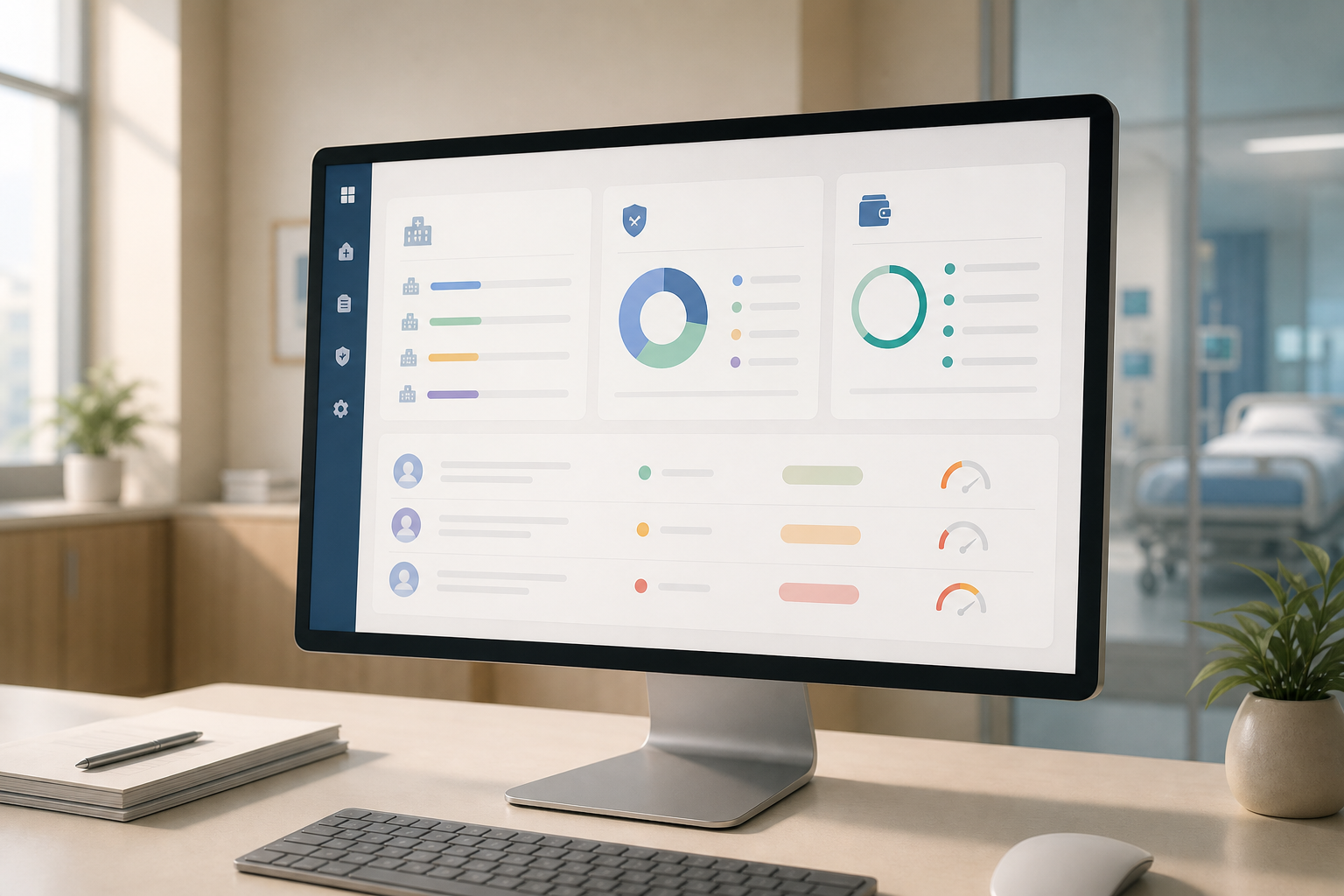
In short, you should expect: automatic HSN/SAC mapping, exempt vs. taxable separation for GST, end-to-end TPA claims, UPI integration with Razorpay, and multi-branch P&L. Anything less for hospital billing with gst, upi, and insurance claims will cost time and margin.
Why Multi-Specialty Hospital Chains Struggle with Billing, GST, and Insurance Claims
Chains do not fail on billing because they lack effort. They fail because complexity compounds at scale. Across cardiology, orthopaedics, and oncology, the mix of GST-exempt services, taxable room tariffs, and pharmacy sales demands precise tax treatment for hospital billing with gst, upi, and insurance claims.
If your software cannot tag services with the right HSN/SAC and split exempt vs. taxable lines, GST returns and e-invoices become a monthly fire drill. That risk grows when one branch uses 18% on a service others mark exempt.
Furthermore, insurance claims span different tariff schedules and TPA rules per specialty. A joint replacement claim looks nothing like a chemo cycle claim. Without a unified claims queue and denial checks, your team re-enters ICD-10/CPT codes by hand. Each retype is a denial risk and a day lost in AR. In practice, this keeps patients in the ward while discharge papers wait on pre-auth.
According to MedCore data, 80% of facilities run on fragmented workflows. In a chain, fragmentation multiplies: one branch runs a legacy HIS, another uses a billing-only app, and a third has a lab system that cannot post charges to IPD. As a result, reconciliation across pharmacy, lab, and registration turns into nightly imports. With hospital billing with gst, upi, and insurance claims not unified in one ledger, you will see mismatched collections and stale AR.
Moreover, chains with 3–10+ branches face uneven TPA panels and different payment collection habits. One site pushes UPI, another swipes POS, and a third takes cash on discharge. Therefore, head office cannot see real-time branch-level P&L or match UPI settlements to invoices. Meanwhile, India’s hospital market valued at ~$200B is moving to real-time digital payments; if your system cannot keep up, patient discharge and pharmacy counter queues slow down.
Where the bottlenecks hide
- GST confusion: exempt procedure billed as taxable (or vice versa) due to manual HSN/SAC mapping.
- TPA delays: pre-auth queues spread across email, portals, and WhatsApp without one audit trail.
- Code entry drift: CPT/ICD typed by billing staff, not fed from clinical notes, causing denals.
- Payment sprawl: UPI, POS, and wallets reconciling outside the billing ledger creates write-offs.
In effect, 75% of the market is underserved by existing tech. That leaves CFOs to force-fit workarounds that raise cost and denial rates. Fix the root: unify hospital billing with gst, upi, and insurance claims in one system branches share.
Also Read!
How to Set Up WhatsApp Patient Reminders for Your Small Clinic in India
What to Look for in Hospital Billing with GST, UPI, and Insurance Claims Software for Multi-Specialty Chains
Before you pick a vendor, set clear criteria that map to how your chain runs money, tax, and risk. The right choice will make month-end close boring, not heroic. The wrong choice will lock you into more exports and manual rework. As you assess hospital billing with gst, upi, and insurance claims, anchor on the eight points below.
Core buying criteria
- Native GST logic: Automatic HSN/SAC mapping and a clean split between exempt and taxable services on the same invoice.
- Full claims lifecycle: TPA pre-auth, document assembly, e-submission, and denial management with a feedback loop into coding.
- UPI and digital payments: Razorpay/UPI integration with real-time reconciliation to invoices, deposits, and refunds.
- Multi-branch consolidation: One ledger with branch-level P&L, cost centers, and role-based views for finance and ops.
- AI claims drafting: Pre-filled claims from clinical notes that flag missing documents and code conflicts before submission.
- EHR integration: ICD-10/CPT codes and orders flow from the encounter to billing without manual entry.
- Multi-currency: Pricing, quotes, and invoices for medical tourism patients, with rate locks and currency rounding rules.
- Audit and compliance: Complete trails, DPDP Act readiness, ABDM/ABHA linking, and exportable logs for statutory audits.
Practical validation steps
- Recreate your toughest GST split: OPD consult (exempt) + room charges over ₹5,000/day (taxable) + pharmacy (taxable) on one bill.
- Run a live pre-auth: Time the minutes from consult to a ready-to-send claim packet with all codes and labs attached.
- Close a UPI day: Match settlements to invoices across two branches and see if variances are auto-flagged in your hospital billing with gst, upi, and insurance claims workflow.
- Prove AR control: Track a denial from reason code to corrected resubmission and measure the days saved.
For extra context on GST rules and exemptions, review the Goods and Services Tax (India) overview as a refresher while you test vendor workflows. Finally, make sure the vendor shows your chain’s data model, not a demo dataset. Real GST and claim edge cases reveal gaps fast.
How MedCore Handles Hospital Billing with GST, UPI, and Insurance Claims for Multi-Specialty Chains
MedCore aligns point-for-point with the criteria above. Across branches, its GST-aware invoicing engine auto-applies tax treatment per service line and maps correct HSN/SAC codes. As a result, a single invoice can carry exempt consults, taxable room charges, and pharmacy items with the right rates and disclosures. Head office gets one view of tax across all sites, and hospital billing with gst, upi, and insurance claims sits in the same ledger.
Furthermore, the insurance module runs the full lifecycle. Pre-auth starts from the consultation, where an ambient SOAP scribe pre-fills ICD-10 and CPT codes. MedCore’s claims agent then auto-drafts the packet and predicts denial risks before submission. If a lab report or discharge summary is missing, the queue flags it. Therefore, billing staff fix issues before a payer rejects the claim, and AR days shorten.
In addition, patient collections tie in through Razorpay + UPI + payment plans. Payments from the app, QR at the counter, or a link sent by SMS reconcile in real time against invoices and advances. Branch admins see live variances. Finance sees daily settlements and refund logs with full audit trails. Unlike billing-only tools, this sits inside one tenant-scoped EHR, so pharmacy dispenses and lab orders post charges without exports.
MedCore also supports medical tourism. Quotes and invoices run in multi-currency with clear rate locks. The international patient agent manages visas, logistics, and translations, while billing aligns with the chosen currency. This reduces manual rework on forex and patient communication while keeping hospital billing with gst, upi, and insurance claims consistent across currencies.
Moreover, analytics roll up across branches. CFOs get multi-branch dashboards, branch-level P&L, and a consolidated audit trail. Named AI agents include one-click hand-off with a full audit trail, so every edit is tied to a user or agent. With 55+ modules, and 45 modules built with input from doctors, nurses, and administrators, clinical and billing teams work in one shared system instead of juggling three tools.
"We replaced three tools with MedCore. Billing, pharmacy and lab now talk to each other without exports." — Ravi Prasad, Administrator, Sunrise Clinic
GST, EHR, and claims — joined at the source
The ambient SOAP scribe reduces code entry drift by feeding ICD-10/CPT into billing at the point of care. The GST engine assigns HSN/SAC codes per service, and the claims agent checks for denial risks. As a result, coding, tax, and claims move together. That unity is why hospital billing with gst, upi, and insurance claims improves both denial rates and discharge speed.

**Get flat pricing, no per-bed fees →
Also Read!
How to Set Up OPD Queue Management and Appointment Scheduling for Mid-Size Hospitals
How to Choose an AI Clinical Documentation EHR for Your Small Clinic in India
MedCore vs. Traditional Hospital Billing Systems: An Honest Comparison
Legacy on-premise HIS platforms feel safe but carry hidden costs. They charge per-bed or per-user, which scales poorly for chains. They take months to go live and often need paid projects for GST updates or integrations.
UPI and Razorpay are not native, so finance teams reconcile outside the system. Insurance features may submit claims, but AI drafting and denial prediction are missing. Compared to alternatives like billing-only SaaS, MedCore removes the swivel-chair work by pulling clinical data straight into billing for hospital billing with gst, upi, and insurance claims.
On the other hand, standalone billing SaaS tools do invoices well but lack EHR context. Billing staff type ICD-10/CPT codes manually, which leads to claim denials and rework. Multi-branch consolidation is also thin, so head office lives in spreadsheets. By contrast, MedCore’s AI-native workflows draft claims from the consult itself for hospital billing with gst, upi, and insurance claims, with denial prediction built in. Clinical data, billing, pharmacy, and lab share the same state inside a single tenant-scoped EHR.
"Our OPD wait time dropped from 40 minutes to 12. The live token display alone was worth the switch." — Dr. Meera Rao, Medical Director, Asha Hospital
Side-by-side comparison table
| Feature/Metric | MedCore | Legacy On-Prem HIS | Billing-Only SaaS |
|---|---|---|---|
| GST compliance | Native HSN/SAC + exempt/tax split | Project-based updates | Basic tax; manual mapping |
| Insurance claims automation | AI auto-draft + denial prediction | Manual packets; limited AI | Submission only; manual coding |
| UPI integration | Razorpay + UPI + payment plans | Add-on or none | Varies; not native |
| Multi-branch analytics | Consolidated with audit trail | Separate instances | Limited roll-ups |
| Pricing model | Flat per-month; no per-bed/user | Per-bed/user; escalates | Per-user; add-on fees |
| Onboarding time | Self-serve; live in days | Months | Weeks |
| EHR integration | Unified; data flows to billing | Partial; modules vary | None; manual code entry |
Unlike legacy vendors, MedCore offers a self-serve onboarding wizard so a branch can be live in days, with an SLA-backed uptime and service credits. In addition, named AI agents support one-click hand-off with a full audit trail, so audits pass faster. This unified approach makes hospital billing with gst, upi, and insurance claims more predictable at scale.

Trust, Compliance, and Credentials for Hospital Billing with GST, UPI, and Insurance Claims
For hospital chains, compliance and security are not a checkbox; they are an operating model for hospital billing with gst, upi, and insurance claims. Authority: DPDP Act 2023 compliant with ABDM/ABHA linking. For reference, see the DPDP Act overview (MeitY) and the Ayushman Bharat Digital Mission.
In addition, FHIR R4 and HL7 v2 interoperability means the billing system works with your lab and radiology devices and can connect to health exchanges when needed. Security: India data residency, DLT-compliant SMS, and audit trails that finance and IT can review. Risk reversal: SLA-backed uptime with service credits.
Moreover, with India data residency standard and DLT-compliant SMS, payment reminders and claim status updates stay compliant. Chains with strict data sovereignty can choose on-premise or dedicated cloud hosting. Multi-tenant readiness gives you branch-level isolation with central control, so finance and IT can enforce roles and audit rights cleanly across sites. As a result, audits run faster, and fewer exceptions land on the CFO’s desk.
"The patient mobile app reduced our front-desk calls by half in the first month." — Shalini Kumar, Operations Head, Greenleaf Care
Operationally, MedCore supports 150+ OPD patients per day with 24/7 uptime and an uptime SLA with service credits. Those signals matter when your billing queue depends on live token displays and same-day discharge packs. With these assurances in place, hospital billing with gst, upi, and insurance claims stays compliant and reliable as volume grows.
Getting Started: Implementing Hospital Billing with GST, UPI, and Insurance Claims Software Across Your Chain
A good rollout avoids heroics. Start with a real audit of current workflows, validate GST and claims in one branch, then scale fast with a checklist. Whether you choose MedCore or another vendor, these steps help you go live without chaos. Keep hospital billing with gst, upi, and insurance claims front and center as you run each step.
Step-by-step rollout
- Map GST across departments: List exempt vs. taxable services per specialty and branch. Confirm HSN/SAC codes and room charge thresholds (for example, ₹5,000/day rules) for configuration.
- Compile TPA panels and tariffs: Gather TPA lists, packages, and specialty-wise tariffs. Standardize document packs (ID proofs, prescriptions, lab results) for pre-auth and claims.
- Define roles and access: Assign branch-level billing admins. Set role-based access for billing, pharmacy, lab, and claims teams with audit logging.
- Pilot one branch: Go live at a single site. Validate GST splits, UPI reconciliation, and end-to-end pre-auth-to-claim submission for hospital billing with gst, upi, and insurance claims. Fix edge cases, then codify the playbook.
- Wire payments at every touchpoint: Add UPI/Razorpay at registration, pharmacy, and discharge. Train staff to post advances, refunds, and partial payments inside the system.
MedCore includes a self-serve onboarding wizard to get a branch live in days, plus dedicated onboarding for the Enterprise tier. For multi-specialty pricing or a compliance review, use the contact link.
**Talk to an expert. Enterprise onboarding →


Also Read!
Best OPD Queue Management & Appointment Scheduling for Mid-Size Hospitals in 2026
How to Choose an AI Clinical Documentation EHR for Mid-Size Hospitals
Frequently Asked Questions
How does hospital billing software handle different GST rates for exempt and taxable healthcare services?
Healthcare services are largely GST-exempt, while room charges above ₹5,000/day, elective cosmetic procedures, and pharmacy sales attract GST. MedCore’s GST-aware billing engine assigns the correct HSN/SAC codes and separates exempt vs. taxable lines on the same invoice. As a result, each branch generates compliant invoices with the right tax treatment and disclosures. This design keeps hospital billing with gst, upi, and insurance claims accurate without nightly spreadsheet fixes.
Can billing software auto-generate insurance claims from clinical consultation data?
Yes. MedCore’s ambient SOAP scribe pre-fills ICD-10 and CPT codes from the clinician’s notes. The AI claims agent then auto-drafts the claim packet and predicts denial risks before submission. For example, it flags a missing discharge summary or code mismatch so staff can fix it early. That approach removes manual re-entry, which drives many rejections.
What does MedCore cost for a multi-specialty hospital chain?
MedCore uses flat per-month pricing without per-bed or per-user fees. Small clinics start from ₹9,999/mo, and mid-size hospitals from ₹24,999/mo, while multi-specialty chains receive custom pricing. Contact MedCore for a chain-specific quote tied to your locations and modules. Because pricing is flat, your cost does not spike when you add staff or beds for hospital billing with gst, upi, and insurance claims.
Does MedCore support UPI and Razorpay payments at the billing counter?
Yes. MedCore integrates Razorpay and UPI natively and supports payment plans for higher-ticket care. Patients can pay in the mobile app, at the counter, or via QR on digital prescriptions. All transactions post and reconcile inside the billing module with branch-level views. Therefore, finance closes the day with clean UPI settlements in hospital billing with gst, upi, and insurance claims.
How long does it take to implement hospital billing with gst, upi, and insurance claims across multiple hospital branches?
MedCore’s self-serve onboarding wizard can take hospital billing with gst, upi, and insurance claims live at a single branch in days. For chains, the Enterprise tier adds dedicated onboarding to guide GST configuration and TPA setup. A phased approach works best: pilot one branch, validate workflows, then scale. That path reduces risk and speeds adoption across departments.
Is MedCore compliant with Indian healthcare data regulations like the DPDP Act?
Yes. MedCore is DPDP Act 2023 compliant with India data residency, ABDM/ABHA linking support, and DLT-compliant SMS. FHIR R4 and HL7 v2 interoperability enable safe data exchange with labs, radiology, and exchanges. On-premise or dedicated cloud hosting options support strict data sovereignty policies.
How does MedCore compare to legacy HIS systems for hospital billing?
Legacy HIS platforms charge per-bed or per-user, take months to deploy, and usually lack native UPI or AI claims drafting. MedCore offers flat monthly pricing, AI-driven claims auto-drafting with denial prediction, and a unified EHR where clinical data flows into billing. This reduces manual code entry and closes common revenue leakage paths. In practice, CFOs see faster discharge and fewer denials.
Can the billing system handle medical tourism patients with different currencies?
Yes. MedCore includes multi-currency billing within its international patient coordination module. The system supports quotes, invoices, and rate locks with clear notes on currency and rounding. Visa support, logistics, and translations are built into the workflow. For chains serving cardiac and ortho cases from abroad, this cuts back-office load and speeds collections.
Final Takeaways
First, unify tax, claims, and payments. A system that applies native GST logic, drives the full TPA lifecycle, and reconciles UPI in real time will cut denials and speed discharge. Second, demand branch consolidation. One ledger, branch-level P&L, and EHR-driven coding make audits and month-end close routine. Third, pick for 2026 and beyond: AI claims drafting, multi-currency, and compliance guardrails such as DPDP Act, ABDM/ABHA, FHIR R4, and HL7 v2.
If you want a single platform where hospital billing with gst, upi, and insurance claims all work together, MedCore is built for that outcome without per-bed fees.
**Schedule a demo, see it live →
For context on GST exemptions and scope, review the Goods and Services Tax (India)) article as you design your branch rollout.