It’s 7:30 PM.
The last patient walked out nearly an hour ago, but the clinic lights are still on. Instead of heading home, a physician is staring at an Electronic Health Record (EHR), clicking through unfinished charts, updating diagnoses, documenting treatment plans, and completing notes that couldn’t be finished during consultations.
This isn’t unusual anymore—it’s modern healthcare.
Clinical documentation has quietly become one of the biggest challenges facing healthcare providers. Between increasingly detailed compliance requirements, evolving billing regulations, and growing patient volumes, documentation now consumes a substantial part of a clinician’s workday. In many practices, providers spend nearly as much time documenting care as they do delivering it.
That’s exactly why the AI medical scribe has gone from being an emerging innovation to a practical necessity in 2026.
Instead of asking clinicians to type faster or hire additional staff, AI medical scribes automate one of healthcare’s most repetitive tasks: transforming patient conversations into structured clinical notes. The result is less administrative work, faster documentation, and more time where it belongs—with patients.
Whether you’re researching what is an AI medical scribe, comparing a free AI medical scribe with premium solutions, or evaluating the right platform for your organization, this guide will help you make an informed decision.
What Is an AI Medical Scribe?
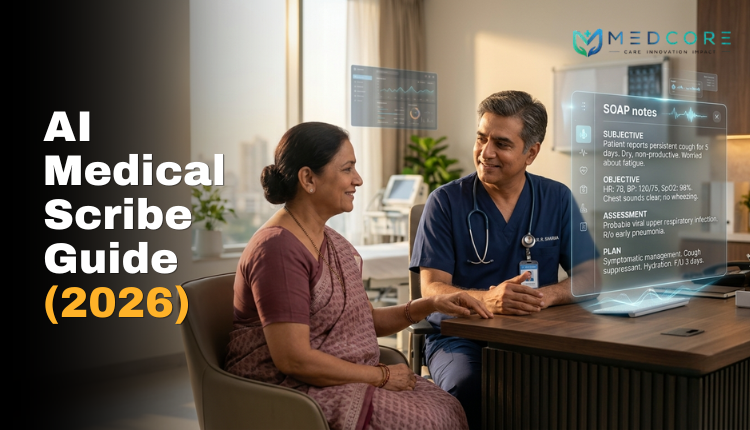
An AI medical scribe is intelligent software that listens to clinician-patient conversations, understands the medical context, and automatically creates structured clinical documentation that the provider reviews before adding it to the patient’s medical record.
Unlike traditional dictation software that simply converts speech into text, an AI medical scribe understands clinical language.
It can identify:
- Symptoms and chief complaints
- Medical history
- Physical examination findings
- Diagnoses
- Treatment plans
- Medications
- Follow-up recommendations
The output isn’t just a transcript—it’s a well-organized clinical note that aligns with documentation standards such as SOAP notes, progress notes, or consultation reports.
Think of it as a digital documentation assistant that works quietly in the background while clinicians focus on delivering care.
Why AI Medical Scribes Are No Longer Optional

Healthcare has never generated more data than it does today.
Every consultation requires documentation for clinical continuity, regulatory compliance, reimbursement, quality reporting, and future treatment decisions. While Electronic Health Records solved the problem of paper-based documentation, they also introduced an entirely new challenge—administrative overload.
Today’s clinicians often find themselves balancing two responsibilities simultaneously:
- Caring for patients.
- Documenting every detail of that care.
The longer this continues, the greater the impact on productivity, staff satisfaction, and patient experience.
Here’s why healthcare organizations are increasingly investing in AI-powered documentation.
1. Documentation Has Become a Full-Time Responsibility
Clinical notes have grown significantly more detailed over the last decade.
Providers now document not only diagnoses but also clinical reasoning, medication history, risk assessments, billing requirements, referrals, and compliance-related information.
Every additional requirement adds minutes to every patient visit.
Over dozens of appointments each day, those minutes quickly turn into hours.
2. Physician Burnout Continues to Rise
One of the biggest contributors to clinician burnout isn’t patient care—it’s administrative work.
Late-night charting, unfinished documentation, and constant EHR interactions reduce work-life balance while increasing cognitive fatigue.
AI medical scribes address one of burnout’s largest causes by reducing manual documentation rather than asking clinicians to work faster.
3. Healthcare Staffing Challenges Aren’t Slowing Down
Many organizations previously relied on human scribes to reduce documentation workload.
While effective, that approach introduced new challenges:
- Recruiting skilled scribes
- Ongoing training
- Staff turnover
- Additional payroll costs
- Privacy considerations
AI-powered documentation provides similar support without depending on additional clinical staff.
4. Digital Healthcare Demands Smarter Documentation
Healthcare now extends well beyond traditional examination rooms.
Documentation must support:
- In-person consultations
- Telehealth appointments
- Multi-location healthcare systems
- Remote patient monitoring
- Collaborative care teams
A modern medical AI scribe integrates naturally into these workflows, ensuring documentation remains consistent regardless of where care takes place.
From Paper Charts to AI Scribes: A Brief Evolution
AI medical scribes didn’t appear overnight.
They’re the result of decades of healthcare documentation evolving alongside technology.
| Documentation Method | Main Challenge |
| Paper Records | Difficult to store, retrieve, and share information |
| Dictation & Transcription | Expensive, delayed turnaround, dependent on manual transcription |
| Electronic Health Records | Improved accessibility but significantly increased documentation time |
| Human Medical Scribes | Better workflow but higher staffing costs and limited scalability |
| AI Medical Scribes | Faster documentation with clinician oversight and enterprise scalability |
Every stage improved documentation in some way, yet each introduced new operational challenges.
AI represents the next logical step—not by replacing clinicians, but by reducing the administrative work surrounding patient care.
How Does an AI Medical Scribe Work?

Although the underlying technology combines speech recognition, Natural Language Processing (NLP), machine learning, and Large Language Models (LLMs), the user experience is remarkably simple.
Here’s what typically happens during a patient visit.
Step 1: The Conversation Is Captured
The AI securely listens throughout the consultation using a mobile device, desktop application, exam-room microphone, or telehealth platform.
Clinicians don’t need to change how they speak.
Natural conversation is enough.
Step 2: The AI Understands Clinical Context
This is where AI differs from traditional voice dictation.
Instead of creating a word-for-word transcript, it interprets the medical meaning behind the discussion.
The system identifies:
- Symptoms
- Duration
- Medical history
- Examination findings
- Diagnoses
- Treatment recommendations
- Follow-up plans
Modern platforms also distinguish between different speakers, ensuring patient statements aren’t confused with clinician observations.
Step 3: Clinical Notes Are Generated
Using the extracted information, the AI automatically creates documentation in the preferred format, including:
- SOAP Notes
- Progress Notes
- History & Physical (H&P)
- Consultation Notes
- Follow-up Documentation
Instead of receiving pages of raw conversation, clinicians receive a structured draft that’s ready for review.
Step 4: Provider Review and Approval
AI doesn’t replace clinical judgment.
Before documentation becomes part of the patient’s permanent medical record, providers review the generated note, make any necessary edits, and approve the final version.
This human oversight maintains both accuracy and regulatory compliance.
The Biggest Benefits of an AI Medical Scribe
The real value of AI isn’t simply that it types faster.
It’s that it changes how clinicians spend their day.
Instead of documenting every interaction manually, providers can dedicate more attention to clinical decision-making and patient communication.
Some of the biggest advantages include:
More Time With Patients
Less screen time means more meaningful conversations, stronger patient relationships, and better overall consultation experiences.
Faster Documentation
Many clinicians finish documentation before leaving the clinic instead of completing charts during evenings or weekends.
Greater Documentation Consistency
Standardized note generation reduces missing information while supporting cleaner coding, billing, and compliance.
Lower Administrative Costs
Compared to maintaining dedicated transcription teams or hiring multiple human scribes, AI documentation scales more efficiently across practices of all sizes.
Better Team Productivity
Administrative staff spend less time chasing incomplete notes, while billing teams benefit from more structured documentation.
Reduced Burnout
Perhaps the greatest benefit isn’t financial—it’s personal.
When clinicians spend fewer hours documenting care, they regain valuable time, improve work-life balance, and experience less cognitive fatigue throughout the week.
How to Choose the Right AI Medical Scribe
There’s no universal “best” AI medical scribe.
The right solution depends on the problem you’re trying to solve.
Before comparing vendors or features, ask yourself one simple question:
What is creating the biggest documentation challenge in your practice today?
The answer often determines the type of platform you should prioritize.
| If Your Biggest Challenge Is… | Look For… |
| Spending hours on charting | Ambient AI documentation |
| Missing important clinical details | High-accuracy, specialty-trained AI |
| Rising staffing costs | AI-first documentation platform |
| Physician burnout | AI requiring minimal post-editing |
| Standardizing notes across providers | Enterprise templates and workflows |
| Long, complex consultations | Context-aware AI with advanced language understanding |
| Fast-paced urgent care visits | Lightweight, rapid documentation platform |
Choosing based on your workflow produces far better results than choosing based on marketing claims alone.
Essential Features Every AI Medical Scribe Should Have
Not every platform offers the same capabilities.
Before investing, evaluate these essential features.
High Clinical Accuracy
Healthcare documentation leaves little room for mistakes.
Look for software that accurately recognizes:
- Medical terminology
- Drug names
- Clinical abbreviations
- Different accents
- Multiple speakers
The less editing required after each consultation, the greater the time savings.
Ambient Documentation
The best AI scribes work almost invisibly.
Rather than asking clinicians to dictate commands or pause conversations, ambient AI quietly listens throughout the consultation and prepares documentation in the background.
That means providers can focus entirely on patients—not software.
Flexible Note Templates
Different specialties document care differently.
An effective AI medical scribe should support formats such as:
- SOAP Notes
- Progress Notes
- Consultation Notes
- History & Physical
- Specialty-specific templates
Customizable templates also help organizations maintain documentation consistency across multiple providers.
Seamless EHR Integration
Switching between multiple applications defeats the purpose of automation.
Look for platforms that integrate directly with your existing EHR so notes flow naturally into clinical workflows without unnecessary copying or manual formatting.
Strong Security Standards
Healthcare organizations manage highly sensitive patient information.
Choose solutions that prioritize:
- Data encryption
- Access controls
- Audit logs
- HIPAA compliance
- Secure cloud infrastructure
Security should never become an afterthought.
Bringing It All Together with MedCore
Understanding what makes a great AI medical scribe is only half the equation. The real value comes when those capabilities are part of a connected healthcare ecosystem rather than a standalone documentation tool.
That’s where MedCore comes in. Built specifically for Indian healthcare providers, MedCore combines an ambient AI medical scribe with hospital management, patient engagement, billing, compliance, and workflow automation—giving clinics and hospitals a single platform to manage the entire patient journey instead of juggling multiple disconnected systems.
How MedCore Helps Healthcare Teams Work Smarter
Many healthcare solutions solve one problem at a time. One handles appointments, another manages billing, while a separate tool generates clinical notes.
MedCore takes a different approach.
As an AI-native healthcare operating system, it brings together clinical documentation, operations, finance, patient communication, and automation into one unified platform. From the moment a patient books an appointment to post-treatment follow-ups, every workflow stays connected, reducing manual effort and improving operational efficiency.
Key Features of MedCore
| Feature | Benefit |
| Ambient AI SOAP Scribe | Creates structured SOAP notes automatically during consultations. |
| 24/7 AI Voice Receptionist | Books appointments and answers patient queries around the clock. |
| AI Triage (8 Indian Languages) | Supports multilingual patient intake for faster triage. |
| AI Radiology Drafting | Generates draft radiology reports for quick review. |
| Claims Auto-Drafting | Converts SOAP notes into claim drafts to speed up insurance processing. |
| Unified Hospital Management | Integrates EHR, billing, pharmacy, lab, HR, and operations in one platform. |
| Patient Engagement Automation | Automates reminders, follow-ups, WhatsApp, SMS, email, and feedback. |
| ABDM & DPDP Ready | Built for Indian healthcare with ABHA linking, FHIR R4, HL7 support, and India-based data residency. |
With 55+ integrated modules, support for 8 Indian languages, AI-powered automation, and end-to-end hospital management, MedCore goes beyond documentation to simplify how modern healthcare facilities operate every day.
Simplify Documentation. Streamline Operations
An AI medical scribe delivers the greatest value when it works alongside every other hospital workflow—not separately from it.
By combining intelligent clinical documentation with patient engagement, hospital management, billing, compliance, and automation, MedCore helps healthcare teams spend less time on administration and more time delivering exceptional patient care.
Ready to modernize your healthcare operations? Book a personalized MedCore demo and see how an AI-native healthcare platform can transform your clinic or hospital.
Where AI Medical Scribes Deliver the Greatest Impact

Although almost every healthcare specialty benefits from automated documentation, some experience even greater improvements because of the complexity of their clinical notes.
Primary Care
Primary care physicians often manage preventive care, chronic conditions, medication reviews, and long patient histories in a single appointment.
AI scribes organize these conversations into structured notes while reducing documentation time.
Psychiatry
Psychiatry relies heavily on lengthy, narrative conversations.
Modern AI platforms capture emotional context, treatment discussions, medication updates, and behavioral observations far more effectively than traditional dictation tools.
Urgent Care
High patient turnover demands rapid documentation.
AI-generated notes allow clinicians to move between patients faster while maintaining consistent documentation quality.
Telehealth
Virtual consultations generate the same documentation requirements as in-person visits.
AI medical scribes help maintain consistency regardless of where the appointment takes place.
Multi-Specialty Healthcare Systems
Enterprise organizations benefit from standardized documentation across departments.
Consistent note structures improve collaboration, analytics, coding accuracy, and overall operational efficiency.
Final Thoughts
Healthcare has spent decades searching for ways to reduce documentation without compromising care quality.
The AI medical scribe represents one of the most meaningful advances toward that goal.
By reducing repetitive administrative work, improving documentation consistency, and allowing clinicians to spend more time with patients, AI is transforming clinical documentation from a daily burden into a streamlined workflow.
Whether you’re exploring a free AI medical scribe or investing in an enterprise-grade platform, the most important consideration isn’t simply choosing the newest technology.
It’s choosing a solution that fits your workflow, integrates with your existing systems, and genuinely gives clinicians more time to practice medicine.
As healthcare continues to embrace intelligent automation, AI medical scribes are quickly becoming less of a competitive advantage—and more of an expected standard for efficient, patient-centered care.
Frequently Asked Questions
1. What is an AI medical scribe?
An AI medical scribe is software that listens to clinician-patient conversations, understands the medical context, and generates structured clinical notes that providers review before adding them to the patient’s medical record.
2. Is a free AI medical scribe suitable for clinical practice?
A free AI medical scribe is useful for testing AI-assisted documentation or supporting low patient volumes. Larger practices generally benefit from paid solutions that offer better accuracy, stronger security, and EHR integration.
3. Can AI medical scribes replace human scribes?
AI medical scribes automate much of the documentation process, reducing the need for human scribes in many settings. However, clinicians still review and approve every note before it becomes part of the patient’s official medical record.
4. Are AI medical scribes secure?
Most enterprise platforms follow healthcare security standards by using encryption, access controls, audit trails, and compliance measures designed to protect sensitive patient information.
5. Which healthcare specialties benefit most from AI medical scribes?
Primary care, internal medicine, psychiatry, urgent care, telehealth, cardiology, and multi-specialty healthcare organizations are among the biggest beneficiaries due to their extensive documentation requirements.