AI is the 20th-century resource that is emerging and evolving across every industry. The modern 20th-century revolution seems to bring about significant positive and negative changes in the world.
While industries like Technology, robotics, electronics, and mechanics seem to be its primary customers, artificial intelligence and its different branches are equally potent in contributing to medicine.
AI in healthcare refers to the use of different branches of artificial intelligence in healthcare, such as machine learning, deep learning, natural language processing, computer vision, and other related tools to support medical and healthcare-related tasks.
In this blog, we present an in-depth understanding of how AI in healthcare is turning into a modern-day beneficiary revolution.
The Rise of AI in Healthcare.
The WHO Director-General, Tedros Adhanom Ghebreyesus, claims,
“AI is already playing a role in diagnosis and clinical care, drug development, disease surveillance, outbreak response, and health systems management.The future of healthcare is digital, and we must do what we can to promote universal access to these innovations and prevent them from becoming another driver for inequity. ”
Artificial intelligence is rapidly becoming a powerful force in modern healthcare. By changing how doctors, hospitals, and patients interact with medical services, AI analyses large volumes of medical data, identifies patterns, and assists healthcare professionals in areas such as disease detection, medical imaging, patient triage, and treatment planning.
AI is also transforming areas beyond clinical care, like hospital administration, by automating tasks such as appointment scheduling, documentation, billing, patient communication, and follow-ups.
One of the biggest advantages of AI is its ability to reduce repetitive workloads while improving efficiency. For example, AI-powered tools can help doctors generate clinical notes, assist radiologists in analysing medical images, or help hospitals respond to routine patient enquiries through virtual assistants.
As these technologies become more advanced, healthcare organisations can use AI to make faster, data-driven decisions while providing a more convenient patient experience.
It works as an intelligent support system, helping healthcare professionals save time, improve workflows, and focus more on what matters most—quality patient care.
How Is AI in Healthcare Different from Traditional Equipment?

AI in healthcare is resulting in a significant boost in accuracy and efficiency. Operations such as diagnosing diseases, imaging and reading reports, and predicting and analyzing future medical risks are being converted into more data-oriented processes. Here we analyze the difference AI is making recently.
1. Traditional equipment measures; AI interprets
A regular MRI machine, ECG monitor, or blood analyzer captures data — an image, a waveform, a chemical reading. The data itself isn’t capable of informing you about what it actually means. A human (radiologist or cardiologist) always has to interpret it.
AI-based tools simplify the process by analyzing the output and generating a judgment — “this looks like a tumor” or “this rhythm suggests atrial fibrillation,” which is a fundamentally different function.
2. Fixed rules vs. learned patterns
Regular medical equipment operates on fixed, engineered rules, like a glucose meter uses a known chemical reaction, and a ventilator follows programmed thresholds you set. Its behavior is predictable and doesn’t change unless a technician reprograms it.
AI systems, especially machine-learning-based ones, learn patterns from training data. Two versions of the “same” AI tool trained on different data can behave differently, which is powerful, but also less predictable and harder to fully audit than a fixed rule.
For example, imagine two AI models designed to identify skin cancer from photos:
- Model A is trained mostly on images of patients with lighter skin tones.
- Model B is trained on a more diverse dataset containing patients with different skin tones.
Even though both models perform the same task, Model A may be less accurate for people with darker skin because it has seen fewer similar examples during training.
3. Improves (or degrades) over time
A standard piece of equipment performs the same way on day one and year ten. Many AI systems are designed to keep learning from new data, meaning their behavior can genuinely change post-deployment — for better (adapting to new patient populations) or worse (drifting away from validated performance, a phenomenon regulators call “model drift”).
4. Different kind of failure mode
When traditional equipment fails, it’s usually mechanical or obvious over time wear and tear — a broken sensor, a miscalibrated reading, or an error code.
When AI fails, it can fail silently and confidently — giving a wrong diagnosis with no indication anything is off, because the system doesn’t really know that it’s wrong, the way a broken thermometer visibly reads absurd numbers.
5. Data-hungry vs. self-contained
An X-ray machine doesn’t need thousands of prior patients’ scans to take today’s X-ray.
AI diagnostic tools, by contrast, depend entirely on the quality and amount of the data they were trained on. This is why AI performance can vary by hospital, population, or even the specific machine brand used to capture images — a dependency traditional equipment doesn’t have.
6. Regulatory pathway is different in kind, not just degree
Traditional equipment is validated primarily for hardware safety and measurement accuracy, which means to enquire whether or not the machine is reading blood pressure correctly, or whether the MRI produces a clear image.
AI tools additionally require validation of the algorithm’s clinical judgment — proving the software’s diagnostic or predictive claims hold up across diverse patients, which is a newer, less standardized regulatory challenge.
7. Replaces a cognitive task, not just a physical one
Older medical technology mostly automated physical or sensing tasks — earlier ECGs replaced doctors who could manually feel a pulse, automated blood analyzers replaced manual lab testing.
AI is the first wave of medical technology automating the cognitive/diagnostic task itself — the part of medicine that used to require a trained expert’s judgment call.
The Big Transformations Brought by AI in Healthcare
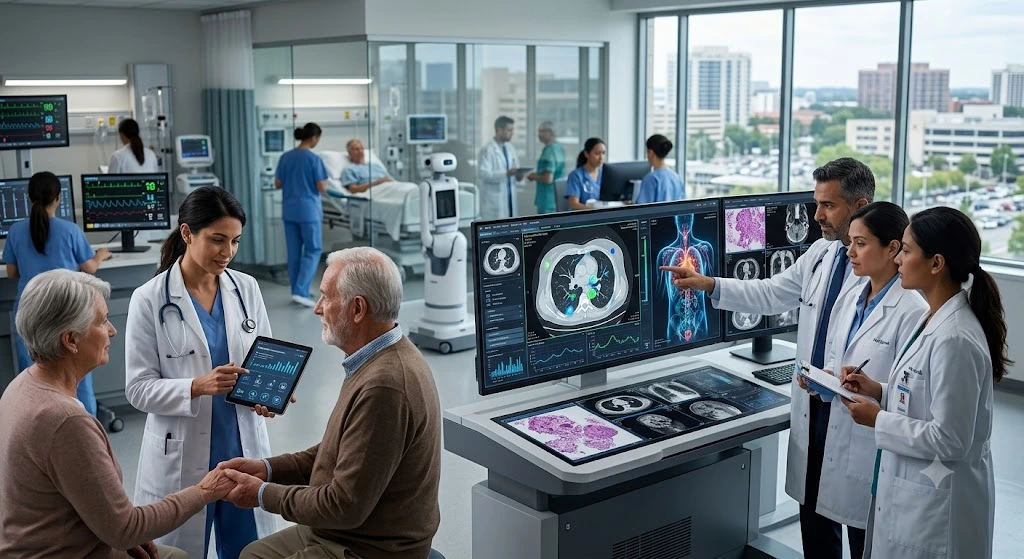
Artificial intelligence is fundamentally reshaping healthcare across clinical care, drug discovery, diagnostics, and administrative operations.
The global market value for AI in healthcare is projected to expand from $16.61 billion in 2024 to $630.92 billion by 2033.
1. Medical Imaging and Early Diagnosis
- Radiology & Lesion Detection: AI algorithms identify subtle anomalies missed during standard evaluations. For example, AI tools have successfully detected up to 64% of epilepsy brain lesions previously missed by radiologists, and urgent care models significantly lower the estimated 10% miss rate for bone fractures.
- Predictive Diagnostics: Machine learning models analyze systemic data to predict diseases before clinical symptoms appear. Tools like AstraZeneca’s MILTON algorithm leverage biobank data to predict onset for over 1,000 diseases up to 10–15 years in advance.
- Early Sepsis Alerts: Real-time AI surveillance systems monitoring vital signs and lab data have lowered mortality by catching sepsis hours before clinical manifestation.
2. Acceleration of Drug Discovery and R&D
- Time and Cost Reduction: Traditional drug discovery takes 10–15 years and costs billions. AI-driven molecular target discovery now enables major pharmaceutical firms to run >90% of small molecule discovery pipelines with AI support, dramatically trimming initial research timelines.
- Clinical Trial Optimization: AI biomarker matching helps match candidates to clinical trials, reducing patient dropout rates and increasing overall trial success probability.
3. Administrative Burden & Physician Burnout Relief
- Clinical Documentation: Electronic Health Record (EHR) data processing and ambient AI scribes automatically convert doctor-patient conversations into structured notes.
- Burnout Reduction: Studies indicate that predictive EHR modeling and automated workflow tools cut down review time by up to 40%, helping clinicians spend less time entering data and more time with patients.
4. Remote Monitoring and Chronic Disease Management
- Continuous Monitoring: AI integrated with Wearable and Continuous Glucose Monitoring (CGM) systems processes real-time blood glucose data every 5 minutes.
- Preventing Hospital Readmissions: Digital health platforms and continuous remote monitoring tools powered by predictive risk engines have demonstrated up to a 30% reduction in hospital readmission rates for chronic disease patients.
| Domain | Traditional Baseline | AI-Enabled Transformation | Data / Impact Metric |
| Drug Discovery | 10–15 years target-to-market | Automated target identification & candidate selection | >90% of small molecule pipelines AI-assisted |
| Diagnostics | Visual inspection under high workload | Pattern recognition on high-volume imaging | 64% detection of previously missed brain lesions |
| Hospital Care | Reactive crisis response | Continuous predictive monitoring | 30% reduction in hospital readmissions |
| Clinical Admin | Manual EHR data entry & note drafting | Ambient AI transcription and charting | Up to 40% reduction in patient review time |
Also Read –
Multilingual Triage: The Language Gap That Breaks Routing
Best AI Clinical Documentation EHR for Small Clinics in India
How MedCore is Adapting AI in Healthcare
MedCore is an AI-native hospital management platform designed to help clinics and hospitals manage their complete operations from one place.
From patient appointments and clinical records to billing, pharmacy, laboratory workflows, staff management, and patient communication, MedCore brings everything together into one connected system.
What makes it stand out is its use of AI and automation to handle repetitive tasks, streamline workflows, and help healthcare professionals spend more time focusing on patient care.
Built specifically for Indian healthcare facilities, MedCore combines modern hospital management tools with AI-powered capabilities to create a smarter, faster, and more connected healthcare experience.
Why Choose MedCore?
- AI Voice Receptionist: MedCore offers an AI-powered voice agent that can handle patient calls around the clock. It can assist with appointment bookings, lab report queries, billing questions, and other routine enquiries while passing complex cases to human staff when needed.
- AI-Powered Patient Triage: The platform can help collect patient symptoms and support the process of directing patients to the appropriate specialty or escalating potential warning signs. This can make the initial patient journey more organised and efficient.
- Ambient AI SOAP Scribe: Doctors can use AI-assisted documentation tools to create structured SOAP notes during or after consultations. This helps reduce the time spent on manual paperwork and allows doctors to focus more on their patients.
- AI Radiology Drafting: MedCore can assist radiologists by drafting findings and impressions from imaging studies. The radiologist remains involved in reviewing and approving or editing the draft before it is finalised.
- Complete Hospital Management: The platform brings together essential hospital workflows, including EHRs, prescriptions, laboratory management, pharmacy, admissions, bed management, and OPD queues. This reduces the need to switch between multiple disconnected systems.
- Smart Billing and Financial Management: MedCore supports GST-aware invoicing, UPI payments, insurance and TPA workflows, payment plans, refunds, and other financial processes. This helps healthcare facilities manage both patient care and financial operations in one place.
- Patient Engagement and Communication: Hospitals can communicate with patients through channels such as WhatsApp, SMS, email, and notifications. Appointment reminders, lab-report alerts, feedback collection, and follow-ups can help create a better patient experience.
- AI-Powered Follow-Ups and Predictions: MedCore includes automation for patient follow-ups and tools that can support predictions such as appointment no-show risks and pharmacy demand. These capabilities can help hospitals plan their operations more effectively.
- Mobile Access for Patients and Doctors: The platform includes mobile-focused features such as appointment booking, live queue updates, access to lab reports, prescription QR codes, and bill payments. This gives patients easier access to important healthcare information.
- Built for Indian Healthcare: MedCore is designed around the requirements of Indian clinics and hospitals, with features such as GST-aware billing, UPI-first payments, ABDM/ABHA capabilities, and support for multiple Indian languages.
Why do Modern Hospitals Need Medcore?
Modern hospitals handle hundreds of tasks every day, and managing these tasks through separate software or manual processes can lead to delays, repetitive work, and disconnected information.
MedCore brings clinical, operational, financial, and patient-engagement workflows together on one platform, helping hospitals work more efficiently.
Its AI-powered features can automate routine tasks such as handling patient enquiries, supporting documentation, managing follow-ups, and streamlining workflows.
By reducing administrative pressure and connecting different departments, MedCore helps doctors, nurses, and hospital staff spend less time managing complex processes and more time focusing on what matters most—delivering better patient care.
Takeways
AI in healthcare is a potentially growing aspect of 20th century medicine that can bring about transformation in modern healthcare by improving efficiency, automating routine tasks, and supporting better patient care.
As hospitals embrace this digital shift, platforms like MedCore can help bring AI-powered automation and hospital management together, creating a smarter and more efficient healthcare ecosystem.
FAQs
1. How is AI used in healthcare?
AI is used in healthcare for tasks such as disease detection, medical imaging analysis, patient triage, clinical documentation, personalised treatment, and automating administrative workflows.
2. Can AI replace doctors in the future?
No, AI is designed to support healthcare professionals rather than completely replace them. Doctors are still essential for clinical judgment, decision-making, and patient care.
3. What are the benefits of AI in healthcare?
AI can improve efficiency, reduce administrative workloads, support faster analysis, enhance patient experiences, and help healthcare professionals make more informed decisions.
4. How does AI improve hospital management?
AI can automate tasks such as appointment scheduling, patient follow-ups, documentation, and routine enquiries, helping hospitals streamline their daily operations.
5. What is the future of AI in healthcare?
AI is expected to play an increasingly important role in healthcare by supporting smarter diagnostics, personalised care, automation, and more efficient hospital operations.