**Book an instant demo of ai-powered ehr and clinical documentation today →
DPDP Act 2023 aligned • ABHA/ABDM linking • FHIR/HL7 support • India data residency with encryption • DLT-compliant messaging
80% of facilities in India still run fragmented workflows, which is why AI-powered EHR and clinical documentation now matter more than hype. For 2026, the practical answer is simple: pick an AI‑native EHR that writes SOAP notes in the background, links ABHA IDs, supports FHIR/HL7, handles GST billing, and offers flat, predictable pricing you can approve in one meeting.
You juggle OPD queues, short staff, and patients who expect WhatsApp updates and digital prescriptions. Paper slips and WhatsApp photos do not make a record. As a result, notes get lost, Rx refills get messy, and insurance paperwork eats your evenings. Meanwhile, 75% of the market is still underserved by tech built for corporate hospitals, not clinics like yours.
This guide shows how to assess an AI option that fits Indian ground truth: multi-language intake, ABDM/ABHA linking, DPDP Act 2023 alignment with India data residency and encryption, UPI/Razorpay billing, and a setup you can finish in days without an IT team. You will also see real outcomes, like OPD wait times dropping from 40 to 12 minutes, and how flat pricing from ₹9,999/month makes budget talks straightforward.
Why Small Clinics in India Still Struggle with Clinical Documentation
Paper stays because it is fast to grab, but it breaks at scale. A nurse writes vitals on a pad, the doctor dictates a brief SOAP, and the pharmacist gets a half-readable Rx copy. Later, the file goes missing, the patient returns without prior notes, and you re-take history from scratch. By the third repeat, both sides feel the strain.
Moreover, paper fragments your workflow. The front desk runs Excel, the pharmacy runs a separate app, and labs send PDFs on email or WhatsApp. Therefore, no single view shows SOAP notes, orders, bills, and prior visits in one place. It feels “normal” until an audit, a medico-legal query, or an insurance claim arrives.
ABDM and ABHA promise a shared health rail. However, without a system that can link ABHA IDs and speak FHIR/HL7, your data stays siloed. Staff end up keying the same demographics into three tools. As a result, errors slip in, and reconciliations take hours.
What actually breaks in a typical day
- Manual SOAP notes: Hard to read, tough to search, and not analytics-ready.
- Lost or duplicate prescriptions: Patients bounce between pharmacy and OPD for corrections.
- No ABDM linking: Data cannot move, so referrals and second opinions restart from zero.
- Burnout at the front desk: Calls for tokens, reports, and bills never stop.
- Disconnected billing: GST, card, UPI, and Razorpay sit outside the record, so audits are painful.
In fact, the cost is not just time. It is also trust. Patients expect a QR Rx, a WhatsApp reminder, and a lab report in their phone app.
When your team cannot deliver that with confidence, reviews suffer, and repeat visits dip. With 80% of facilities still on fragmented workflows, the gap is clear. You need an integrated, AI-ready system that fits the clinic pace without slow rollouts or hidden fees.
To be explicit, this section is not a pitch. It is a mirror. If parts of your day match this picture, you are not alone. The fix is less about new gadgets and more about a unified record where notes, orders, and payments live together.
What to Look for in an AI EHR for a Small Indian Clinic
Accuracy comes first. An AI SOAP scribe must capture Indian consultations well, not just “summaries.” Specifically, it should anchor findings to ICD‑10 and CPT suggestions so coding and claims do not become guesswork later. Human-in-the-loop review should be one click, not a retype. If the tool cannot show what it heard and why it filled a code, skip it.
Compliance is next. In India, the DPDP Act 2023, ABDM/ABHA linking, FHIR R4, and HL7 v2 are table stakes. For national digital health rails, check that your vendor can register, link, and exchange data on demand, not “in phase two.” If you need a primer on the public rails, see the ABDM (Ayushman Bharat Digital Mission) overview.
Practical buying criteria for clinics
- AI SOAP scribe accuracy: Evidence of ICD‑10/CPT pre-fill and SNOMED-anchored routing.
- Language fit: Intake and triage in at least 8 Indian languages for OPD reality.
- ABDM/ABHA linking: Out of the box, with ABHA search and link flow during registration.
- DPDP alignment and India data residency: Data should stay in-country with audit trails.
- Billing that matches India: GST-aware invoicing, Razorpay and UPI built-in, and TPA support.
- Pricing that is sane: Flat per-month, no per-user or per-bed traps. Forecastable OPEX wins board nods.
- Setup without an IT team: A self-serve onboarding wizard that gets you live in days.
- Patient reach: WhatsApp reminders (DLT-compliant) and a patient mobile app.
Furthermore, you should test front-desk fit. Can staff manage online and walk-in appointments, run a token display, and triage rush cases without tab-hopping? Does the patient app reduce calls, or just add another inbox? These details decide whether your OPD runs smoother next week.
For a deeper checklist tailored to clinics, this walkthrough is popular with practice leads: How to Choose an AI Clinical Documentation EHR for Your Small Clinic in India. Use it with your team during a 30‑minute vendor demo to keep the questions sharp and the scope tight.
Finally, confirm that your vendor names the plan and the start price in INR. Flat, published pricing saves time. If you hear “custom quote for basic features,” that is a red flag. The right AI-powered EHR and clinical documentation solution should feel transparent from day one.
Also Read!
Best Hospital Billing with GST, UPI, and Insurance Claims for Mid-Size Hospitals in 2026
How to Set Up WhatsApp Patient Reminders for Medical Tourism Hospitals in India
How MedCore Delivers AI-Powered Clinical Documentation for Small Clinics
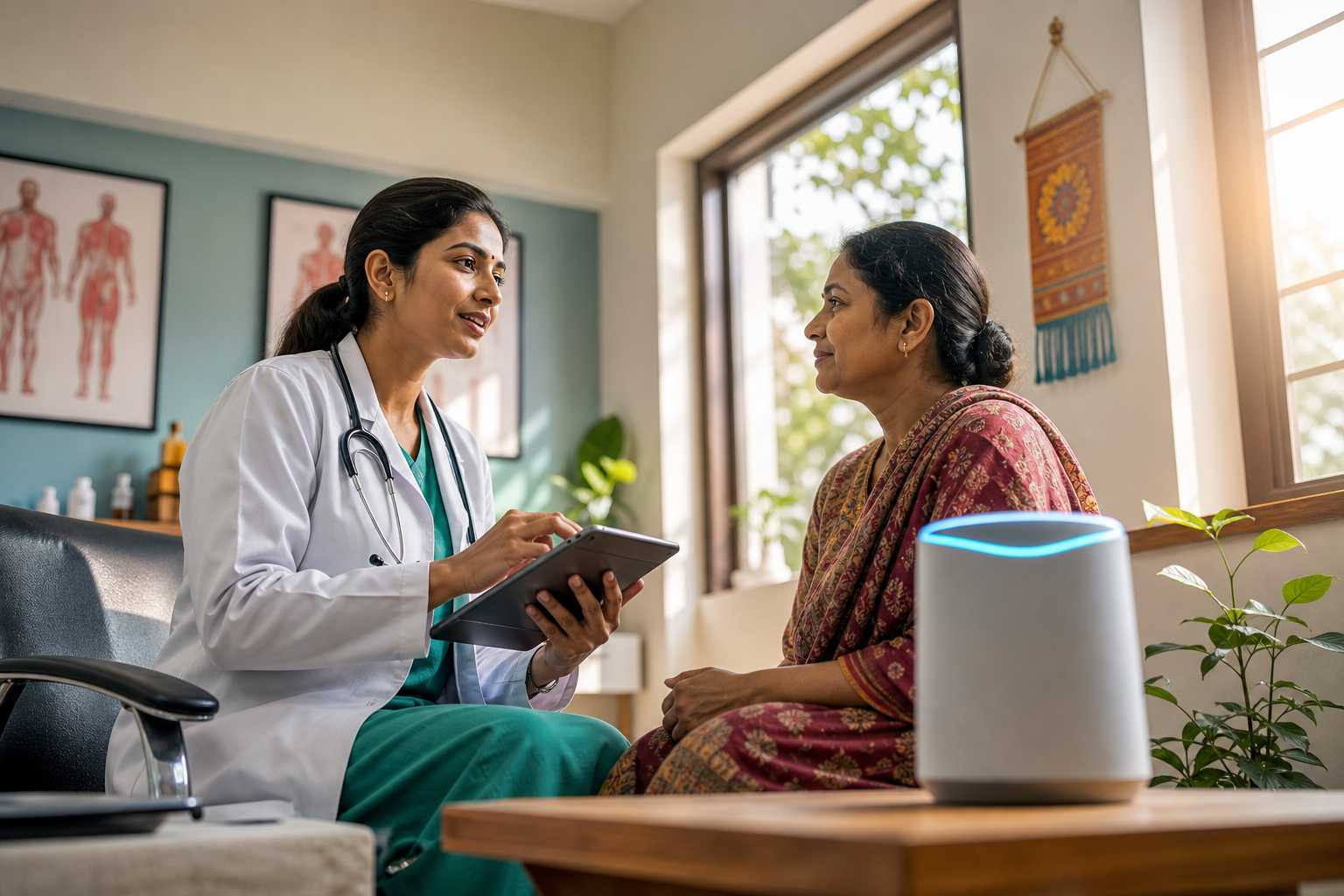
MedCore is AI-native with a unified EHR. The ambient SOAP scribe listens to the consult, drafts structured notes, and pre-fills ICD‑10 and CPT codes for review. You stay in control with quick edits and an audit trail. Because the draft is structured, Rx, orders, and claims flow out without re-entry.
Moreover, MedCore’s agents work where clinics feel the pinch. The triage agent handles 8 Indian languages, routes by SNOMED, and flags risk. The voice receptionist runs 24/7, so missed calls drop. The radiology agent drafts impressions with per-finding confidence, which your radiologist can accept or revise in seconds.
Billing lives in the same record. As a result, GST invoices, UPI, and Razorpay payments post back to the chart. Digital prescriptions include a QR code, so pharmacy handover is clean. The live OPD queue displays tokens in real time, while the EHR surfaces vulnerability flags to speed up care.
"Our OPD wait time dropped from 40 minutes to 12. The live token display alone was worth the switch." — Dr. Meera Rao, Medical Director, Asha Hospital
"We replaced three tools with MedCore. Billing, pharmacy and lab now talk to each other without exports." — Ravi Prasad, Administrator, Sunrise Clinic
Clinics handling 150+ OPD patients per day already run on MedCore, with 55+ modules available as they expand.
Furthermore, MedCore pricing is flat and clear: Small Clinic starts from ₹9,999/mo. There are no per-bed or per-user surprises as you grow. With the self-serve onboarding wizard, your clinic can be live in days, not months. The patient mobile app shows live tokens, lab reports, and bill pay, which means fewer front-desk calls.
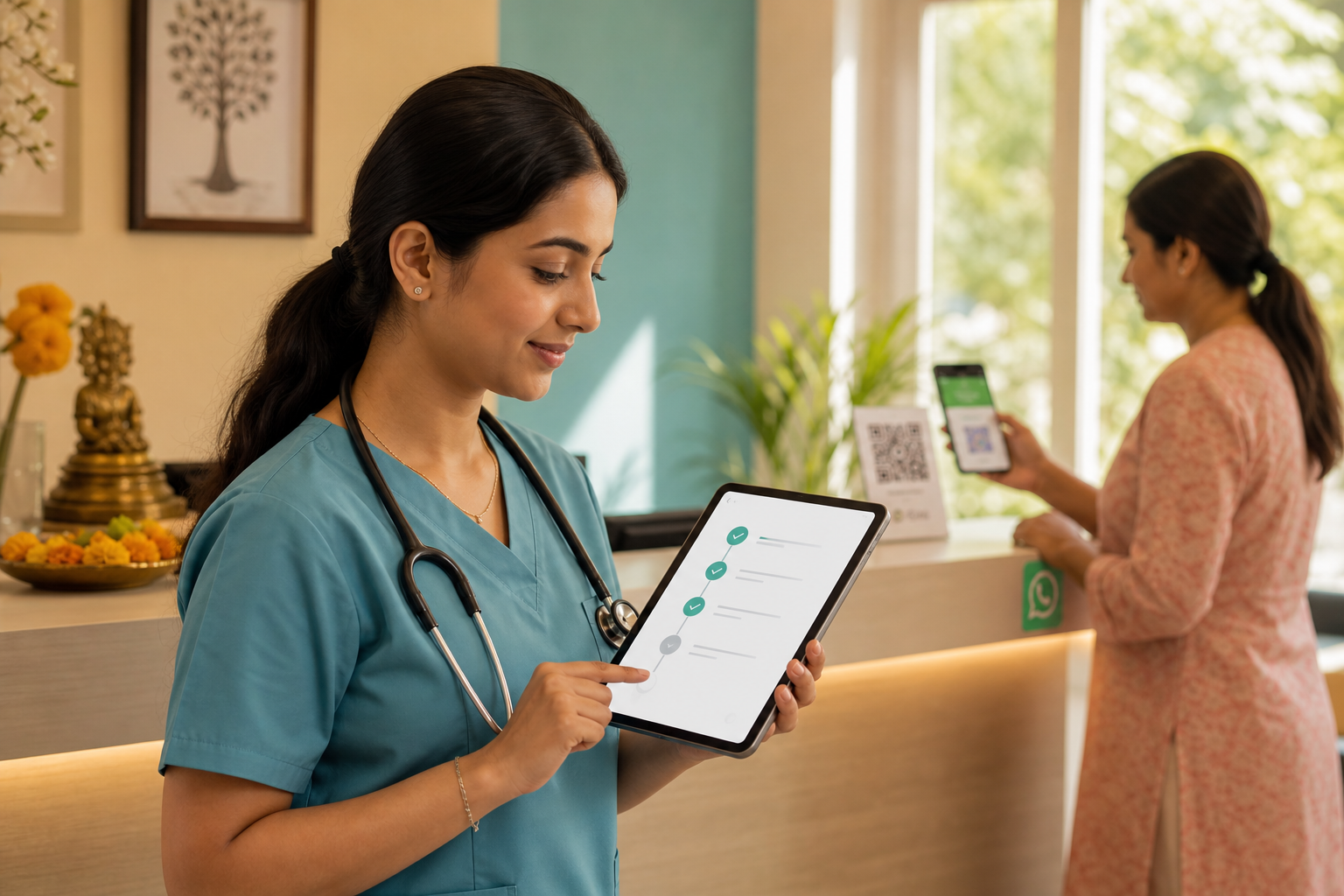
 → OPD token display → ambient SOAP scribe with ICD-10/CPT → digital Rx with QR → GST billing with UPI/Razorpay; clean UI mockups; brand-neutral)
In practice, clinics report smoother days. The AI-powered EHR and clinical documentation flow remove duplicate typing, and the OPD queue stays visible to staff and patients alike. Because the EHR, lab, pharmacy, and billing share one state, handoffs feel instant. You get speed without extra headcount.
MedCore vs Generic EHRs and Legacy HMS: An Honest Comparison
Generic HMS tools can be fine for large, complex hospitals with deep IT teams. However, small clinics need AI-native workflows, not bolt-on widgets. Compared to alternatives like Practo Ray or HealthPlix, MedCore puts agents, the EHR, and transactions in one system of record. That is why the queue, scribe, Rx, and billing talk to each other without exports.
Language matters too. Clinics see patients who switch between Hindi, Kannada, Tamil, Telugu, Bengali, Marathi, Gujarati, and English in one day. MedCore’s triage agent supports 8 Indian languages. Many legacy tools stop at English and Hindi, which creates gaps at intake.
Pricing is another fork in the road. Per-user or per-bed pricing looks low at first, then grows fast as you add staff. MedCore keeps it flat per month. For a clinic with 12 staff, this can be the difference between a 3× bill and a steady OPEX line.
Side-by-side at a glance
| Area | MedCore | Generic HMS/EHR |
|---|---|---|
| AI depth | Ambient SOAP scribe; AI triage; radiology drafting; claims risk | Basic templates; limited or bolt-on AI |
| Language support | 8 Indian languages | 1–2 languages |
| Pricing | Flat per-month; no per-user/bed fees | Per-user/bed escalators |
| ABDM readiness | ABHA linking; FHIR R4; HL7 v2 inbound | Partial or planned |
| Onboarding speed | Self-serve; live in days | Services-heavy; weeks to months |
"The patient mobile app reduced our front-desk calls by half in the first month." — Shalini Kumar, Operations Head, Greenleaf Care
If you run a multi-specialty chain with bespoke workflows and an in-house IT team, some legacy HMS platforms may still suit you. Yet for small clinics that need speed, AI-native depth, and a unified record, MedCore’s integrated approach fits better. For a more detailed market view, see this breakdown: MedCore vs Practo for Mid-Size Hospitals: Which Is Better for AI Clinical Documentation EHR?. It explains why bolt-ons struggle to keep data in sync across the day.
The bottom line: choose a system built as AI-first with a single EHR. That choice keeps your OPD moving and your data consistent in 2026 and beyond.
Also Read!
Mid-Size Hospital Guide to Billing with GST and Insurance Claims
Best Patient Engagement WhatsApp Reminders for Medical Tourism Hospitals India in 2026
Trust, Compliance, and Credentials That Matter in India
Trust starts with compliance and uptime. MedCore aligns with the DPDP Act 2023, supports FHIR R4 and HL7 v2 for data exchange, and links ABHA IDs under ABDM. Records stay in India data centers with encryption, and DLT-compliant SMS keeps your messaging lawful. Security and audit logs come built-in, so you can answer audits with confidence.
Scale is not abstract. Clinics run 150+ OPD patients per day on MedCore with 55+ modules available as they expand services. Meanwhile, the AI voice receptionist runs 24/7, so calls get picked even outside OPD hours. Eight Indian languages at intake reduce mis-hear risks and repeat triage.
Furthermore, social proof should be about results, not slogans. OPD wait time reduced from 40 to 12 minutes is not theory; it is daily relief for teams and patients. Flat pricing from ₹9,999/mo means you can plan cash flow without fear of per-user creep.
Credentials snapshot you can verify
- DPDP Act 2023 aligned with India data residency and encryption
- FHIR R4 and HL7 v2 interoperability with ABDM/ABHA linking
- Patient volume fit: 150+ OPD patients per day
- 55+ modules; 8 Indian languages; AI Voice Receptionist (24/7)
- DLT-compliant SMS and WhatsApp messaging support
If your board asks for standards references, share the ABDM overview you already saw above. It gives the national context your compliance lead will appreciate.
Getting Started: From Sign-Up to First Patient in Days
You do not need an IT team. MedCore’s self-serve onboarding wizard guides you through a short setup and imports your basics. Most clinics go live in days, then refine templates as they see how the AI scribe fits each specialty.
- Step 1: Create your account and pick “Small Clinic” (from ₹9,999/mo). Confirm GST details and payment mode.
- Step 2: Add providers, front desk, and pharmacy users. Roles are pre-set with least‑privilege access.
- Step 3: Connect WhatsApp. Starter includes 1,000 messages/month with DLT templates you can approve in minutes.
- Step 4: Turn on ABHA linking at registration, enable the OPD queue display, and print your first digital Rx with QR.
Next, test two full patient journeys end-to-end. For example, try a Hindi triage, an English consult with the ambient SOAP scribe, and a UPI bill. Then run a TPA case to see claims auto-drafting from the consultation. You will feel the gains fast.
If you are short on time, book a 30‑minute session and let a specialist configure the queue, scribe settings, and DLT messages while you watch. That way, your team can start strong on day one with ai-powered ehr and clinical documentation set to your flow.
Before you compare a second tool, you might also want this explainer: ai powered ehr. It covers common pitfalls clinics hit in pilots and how to avoid them.
Frequently Asked Questions
How much does an AI clinical documentation EHR cost for a small clinic in India?
MedCore starts at ₹9,999/mo with flat pricing, no per-user or per-bed fees. The plan includes the AI SOAP scribe, OPD queue, digital prescriptions with QR, GST-aware billing, and 1,000 WhatsApp messages per month on the Starter tier. As you grow, you can add modules without changing platforms. This keeps OPEX predictable and board approvals simple.
Does MedCore support ABDM and ABHA health ID linking?
Yes. MedCore includes ABDM/ABHA linking out of the box so you can search, link, and exchange records on national rails. It also supports FHIR R4 and HL7 v2 interoperability to connect with labs and other systems. This ensures your data moves with patients while staying structured and auditable.
How accurate is the AI SOAP scribe for Indian clinical consultations?
The ambient SOAP scribe auto-fills ICD‑10 and CPT codes based on the consultation, then shows its draft for quick review. It supports 8 Indian languages and uses SNOMED-anchored routing for clinical accuracy. You stay in charge with human‑in‑the-loop editing and a full audit trail. As a result, documentation time drops while coding quality improves.
Can a solo doctor set up MedCore without an IT team?
Yes. The self-serve onboarding wizard gets clinics live in days with role templates and best‑practice defaults. The system configures your patient app, WhatsApp integration, and OPD token display automatically. If you prefer help, you can book a 30-minute session for guidance. Either way, no IT staff are needed.
How does MedCore compare to Practo Ray or HealthPlix for small clinics?
MedCore is AI-native with ambient SOAP scribing, 8‑language triage, and a unified EHR, not bolt-on AI. Flat pricing avoids the per-user scaling costs that add up in legacy models. You also get 55+ modules to expand as your clinic grows. For small clinics that want speed and depth, this combination is hard to match.
Is patient data stored in India and compliant with DPDP Act 2023?
Yes. MedCore guarantees India data residency with encryption and audit logs to align with the DPDP Act 2023. Messaging uses DLT-compliant SMS and WhatsApp templates where needed. This keeps your patient communications lawful and traceable. Your compliance lead will find the controls clear.
Does MedCore work for clinics that also do insurance or TPA billing?
Yes. MedCore includes insurance/TPA pre-auth and claims auto-drafting from consultations. The AI claims agent predicts denial risks before submission, which reduces rejections. Because the claim pulls from structured notes, you avoid copy‑paste errors and missing fields. This saves both time and cash flow stress.
What if I outgrow the small clinic plan?
MedCore scales from ₹9,999/mo (solo clinic) to ₹24,999/mo (mid-size hospital) and up to enterprise multi-specialty tiers. You stay on the same platform with the same EHR, so there is no data migration or workflow disruption. You add modules as you expand services. Growth becomes an unlock, not a rebuild.
The Bottom Line
- Pick AI-native with a single, unified EHR. That keeps notes, Rx, orders, and bills in sync and searchable in 2026.
- Demand India-first readiness: DPDP alignment, ABDM/ABHA linking, FHIR/HL7, GST billing, UPI/Razorpay, and WhatsApp with DLT.
- Insist on flat, published pricing and a self-serve setup you can finish in days, not months.
If you want to test this in your OPD next week, book a quick run-through with your team.