**Book a live demo of the patient engagement app with WhatsApp reminders today →
A patient engagement app with whatsapp reminders demands rock-solid security & compliance: DPDP-aligned • India data residency • DLT-compliant WhatsApp • FHIR R4 + HL7 v2. Trusted by hospitals handling 150+ OPD patients/day.
Eighty percent of Indian healthcare facilities run on fragmented workflows (MedCore data). A patient engagement app with whatsapp reminders is the fastest way to close that gap for cross-border care in 2026. Here’s the direct answer: to increase show-ups, reduce front-desk load, and keep international patients on track, you need DLT-compliant WhatsApp reminders tied to a unified EHR, multilingual agents, and visa-plus-billing workflows in one place.
However, international care is not a simple upgrade. Your teams juggle time zones, embassies, travel agents, and cash vs insurance across currencies. Patients arrive stressed after 8–14 hour flights and face pre-op fasting, consent, and payment checks on day one. As a result, missed messages or slow replies turn into no-shows, reschedules, or poor CAHPS-style feedback.
Moreover, the market gap is real. MedCore’s data shows 75% of the market is underserved by existing tech, which still treats WhatsApp as a one-way marketing channel rather than a clinical engagement lane. In 2026, the winning stack must connect reminders to the medical record, billing, and care plans, not sit as another silo.
Therefore, this guide is education-first. You’ll learn how to assess WhatsApp platforms for medical tourism, what “DLT + DPDP + FHIR” means in practice, and how MedCore’s agents and unified EHR solve gaps that generic CRMs and WhatsApp-only tools leave open.

Why Medical Tourism Hospitals in India Struggle with Patient Engagement
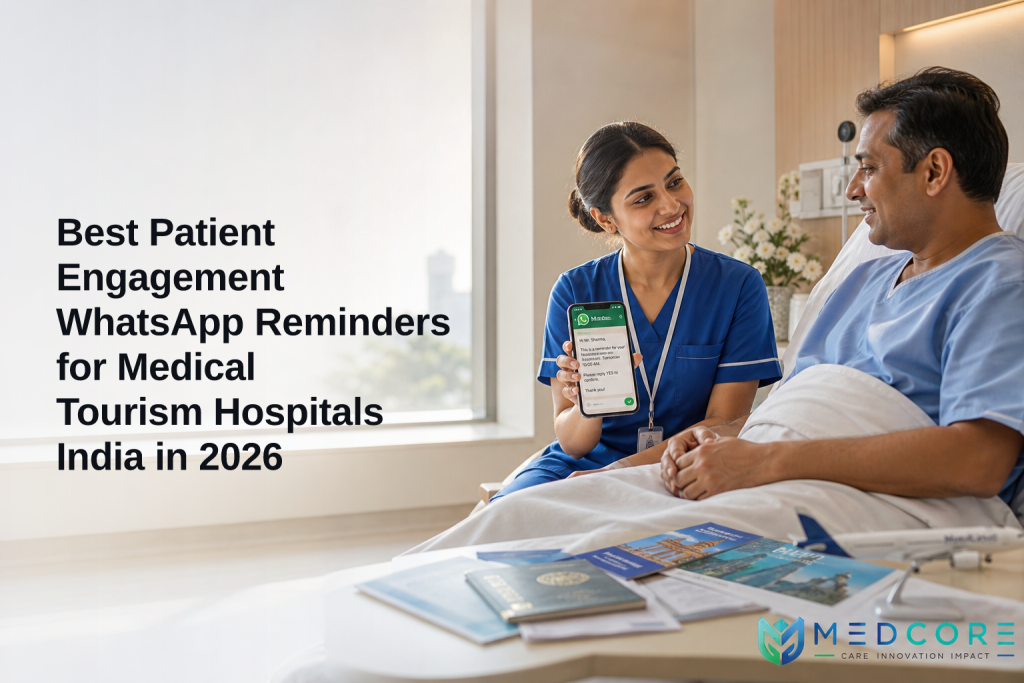
Time zones, languages, and paperwork collide in medical tourism. Your front desk closes at 7 PM IST, but your patient’s local time is 1 PM in Nairobi or 9 AM in Warsaw. Messages sent at the wrong hour get ignored. Pre-op instructions missed 24 hours before surgery snowball into cancellations. A patient engagement app with whatsapp reminders that schedules by the patient’s local time fixes half the problem right away.
In addition, language adds friction. Families text in Arabic, Russian, or Bengali while lab, OT, and billing teams write in English. Screenshots bounce between staff and coordinators, and tasks slip. Visa letters, attestation, and payment proofs live in long threads that no one owns. As a result, one missed document can delay admission by a full day.
Furthermore, coordination extends past discharge. The patient flies home, then needs suture removal on Day 7, review labs on Day 14, and a consult on Day 30. If your reminders don’t account for time zones, travel fatigue, and local clinics, follow-up care breaks. Per MedCore’s market study, 80% of facilities still run disjointed processes, and 75% remain underserved by tools that don’t tie WhatsApp to the EHR or visa workflows.
Cross-border friction points you can fix this quarter
- Time-zone aware reminders for pre-op fasting, arrival slots, and medication holds
- Multilingual chat and templates for 8 Indian languages plus common international tongues
- Visa, invitation, and insurance docs tracked as tasks, not as scattered PDFs
- Multi-currency quotes and receipts with clear GST treatment and audit trails
- Post-discharge day-based plans that auto-adjust for flights and holidays
“We see engagement dip when we rely on manual WhatsApp and email. Automation that knows time zones and language context is no longer a nice-to-have.” — Medical tourism coordinator, composite insight
However, technology alone won’t fix policy gaps. You also need clear consent flows, opt-in records, and a unified system so clinical, billing, and travel data stay in sync.
What to Look for in a WhatsApp Patient Engagement Platform for Medical Tourism
Start with compliance and reach. You need DLT-compliant WhatsApp messaging, Indian data residency, and consent logs aligned with the Digital Personal Data Protection (DPDP) Act 2023. If the vendor can’t show DPDP-ready consent capture and audit trails, walk away. For context, see the Digital Personal Data Protection Act, 2023.
Next, confirm clinical-grade interoperability. Your platform should speak FHIR R4 for modern APIs and accept HL7 v2 inbound from lab or radiology systems. Templates should be multilingual, including the 8 Indian languages MedCore supports, with safe character handling for names, dates, and currency. For a standard overview, see FHIR on Wikipedia.
Moreover, your buyers’ checklist must reflect tourism workflows. Visa invitation letters, airline change notes, and multi-currency billing need a home in the same system that sends pre-op and post-op reminders. If you use one tool for reminders, another for billing, and email for visas, things will fall through the cracks again.
Practical must-have checks
- DLT-compliant WhatsApp API with opt-in/opt-out and consent history
- DPDP Act 2023 alignment plus India data residency for PHI
- FHIR R4 APIs and HL7 v2 inbound to sync appointments and results
- Multilingual templates across at least 8 Indian languages
- Multi-currency quotes, deposits, and final bills tied to the EHR
- Automated pre-op and post-op reminder flows with time-zone logic
However, don’t stop at features. Ask how reminders map to clinical states. For example, does “pre-op fasting” trigger only after anesthesia clearance? Do discharge reminders pause if a patient stays an extra night? A patient engagement app with whatsapp reminders is useful only if it reads and writes to a single source of truth, your EHR, not a spreadsheet.
For more context on deployment at scale, compare insights from this mid-market explainer: Best Patient Engagement WhatsApp Reminders for Mid-Size Hospitals in 2026.
Also Read!
Best AI Clinical Documentation EHR for Multi-Specialty Hospital Chains in 2026
Best AI Clinical Documentation EHR for Mid-Size Hospitals in 2026
How MedCore Solves WhatsApp Patient Engagement for Medical Tourism Hospitals
MedCore is AI-native with integrated workflows and a unified EHR, built for hospitals that see international patients. The Outbound Follow-up Agent reaches families on voice and WhatsApp with DLT-compliant reminders that reflect the patient’s clinical state and time zone. As a result, pre-arrival instructions, lab preps, and day-of-surgery nudges arrive when patients can act on them.
Moreover, the International Patient Agent handles visa letters, document checklists, translations, and multi-currency billing in the same system that powers OPD and IPD. Coordinators can see tasks at a glance: invitation letter issued, deposit received, airport pickup confirmed. Because billing, pharmacy, and lab share one EHR, you won’t reconcile exports every Friday.
Furthermore, front-desk load drops when the AI Voice Receptionist answers 24/7, books slots, and routes urgent calls. On the patient side, the branded Android/iOS app shows live queue tokens, lab reports, and upcoming appointments. This isn’t a marketing inbox, it’s care operations you can audit.
“The patient mobile app reduced our front-desk calls by half in the first month.” — Shalini Kumar, Operations Head, Greenleaf Care
Specifically, MedCore includes:
- WhatsApp messaging with 1,000 messages/month on Starter and 10,000 messages/month on Professional
- WhatsApp reminders (DLT) mapped to pre-op, admission, discharge, and post-op plans
- A predictions agent for no-show scoring so staff can double-confirm high-risk arrivals
- A patient app with lab results and appointment booking, tied to the same EHR
- Named AI agents with one-click hand-off and a full audit trail
Unlike standalone WhatsApp tools, MedCore’s reminders read OPD queue data, anesthesia notes, and ward discharge times from the unified record. Unlike generic CRMs, it supports multi-currency billing and international coordination natively, not as a custom add-on. This is what lets your team run a single plan from pre-arrival to post-discharge without copy-paste.

Finally, you can start small. Hospitals handling 150+ OPD patients per day use the Outbound Follow-up Agent first, then add International Patient Agent and the Voice Receptionist as the tourism program scales. A patient engagement app with whatsapp reminders is most effective when it grows with your throughput.
MedCore vs. Generic Hospital CRMs: An Honest Comparison
If you’re using a generic hospital CRM or a WhatsApp marketing tool, you’ve felt the gaps. You get broadcast templates, basic segments, and an inbox. But you don’t get an EHR, visa workflows, or clinical triggers that shift reminders when surgery moves. You also pay per user or per bed, which punishes growth.
MedCore takes a different route. It offers flat per-month pricing without per-bed or per-user fees, and it’s AI-native with integrated workflows and a unified EHR. That means fewer tools, fewer exports, and fewer handoffs.
“We replaced three tools with MedCore. Billing, pharmacy and lab now talk to each other without exports.” — Ravi Prasad, Administrator, Sunrise Clinic
Here is a simple view to ground your decision.
| Requirement | MedCore (Unified EHR) | Generic CRM | WhatsApp-only Tool |
|---|---|---|---|
| Medical tourism workflows | Built-in (visa, translations, currency) | Custom work or none | None |
| EHR integration | Native, single shared state | Add-ons, partial sync | None |
| Pricing | Flat per-month | Per-user or per-bed | Per-message + seats |
| DLT + DPDP alignment | Yes (DLT-compliant messaging) | Varies | Varies |
However, no tool is perfect. MedCore still depends on DLT template approvals from telco registrars, which can add days to go-live if your branding changes mid-stream. In addition, deep EHR features require brief staff training; most teams complete this in days, not weeks. We think that’s a fair trade to avoid three separate tools and data drift.
If you’re still exploring the market, this practical explainer compares strategies in the mid-segment: MedCore vs Practo for Mid-Size Hospitals: Which Is Better for Patient Engagement WhatsApp Reminders?
Trust, Compliance, and Credentials for Cross-Border Patient Data
Trust starts with standards.
- DPDP Act 2023 alignment with India data residency and DLT-compliant messaging
- FHIR R4 and HL7 v2 inbound so appointments, results, and orders sync
- Not a bolt-on channel; part of a compliant clinical record
Moreover, scale matters. MedCore includes 55+ modules built with input from doctors, nurses, and administrators. Facilities handling 150+ OPD patients per day use it without losing track of queues or discharges.
“Our OPD wait time dropped from 40 minutes to 12. The live token display alone was worth the switch.” — Dr. Meera Rao, Medical Director, Asha Hospital
Furthermore, security isn’t a footnote. Consent and opt-in flows live inside the platform, and WhatsApp reminders (DLT) run within policy. Because everything sits on a single tenant-scoped EHR, billing, lab, and pharmacy share the same state as outreach and follow-ups. That’s why a patient engagement app with whatsapp reminders lands as reliable care, not spam.
As you vet vendors, ask to see their DPDP documentation, India data residency proof, and FHIR R4 endpoints. Also, request a sample HL7 v2 inbound feed from your LIS to confirm round-trip integrity.
Also Read!
Best AI Clinical Documentation EHR for Medical Tourism Hospitals in India — 2026
Best Hospital Lab Pharmacy Management for Multi-Specialty Hospital Chains in 2026
Getting Started: Onboarding WhatsApp Patient Engagement at Your Hospital
You can go live in days. MedCore offers a self-serve onboarding wizard that sets up core modules first, then adds agents and templates. The biggest external step is DLT template registration; MedCore guides you with ready samples for admissions, pre-op fasting, discharge, and follow-up care.
Second, configure multilingual WhatsApp flows. Start with English and Hindi, then extend to the 8 Indian languages supported by MedCore for triage and reminders. Third, connect your EHR appointments and orders so reminder logic tracks clinical state. Finally, turn on the International Patient Agent to manage visa docs and currency quotes in the same workspace.
Step-by-step quick start
- Register sender IDs and DLT templates using MedCore’s samples.
- Enable WhatsApp API and import multilingual templates.
- Connect FHIR R4 APIs and HL7 v2 inbound where needed.
- Map pre-op, admission, discharge, and post-op reminders to EHR states.
- Pilot with 25–50 international patients, then roll out hospital-wide.
Pricing is simple: Small Clinic from ₹9,999/mo, Mid-size Hospital from ₹24,999/mo, Multi-specialty: Contact us. Starter includes 1,000 WhatsApp messages/month; Professional includes 10,000. As a result, you can budget by program, not by seat count.

For further reading on rollout details, bookmark this how-to: How to Set Up WhatsApp Patient Reminders for Mid-Size Hospitals. If you want a broader market view, this primer covers platform choices and guardrails: "patient engagement software".
Frequently Asked Questions
How much does MedCore's WhatsApp patient engagement cost for a medical tourism hospital?
MedCore uses flat monthly pricing: ₹9,999/mo for Starter with 1,000 WhatsApp messages and ₹24,999/mo for Professional with 10,000 messages. There are no per-bed or per-user fees, so you can scale staff without hidden costs. Multi-specialty hospitals get custom pricing based on volume and integration depth. As a result, finance teams can plan by program size, not headcount.
Can MedCore send WhatsApp reminders in languages other than English and Hindi?
Yes. MedCore’s AI triage and outbound agents support 8 Indian languages for intake and guidance. WhatsApp templates can be set up in multiple languages, including those your international patients request. Moreover, the International Patient Agent handles translations inside the same workflow as visa and billing tasks. Therefore, coordinators don’t have to copy text into third-party tools.
Is WhatsApp messaging through MedCore compliant with India's DLT and DPDP regulations?
Yes. MedCore uses DLT-compliant messaging and is built for DPDP Act 2023 alignment with India data residency. Patient consent and opt-in workflows sit inside the platform, so audits are straightforward. Furthermore, template registries and sender IDs map to your brand for traceability. As a result, your outreach stays compliant across campaigns and hospitals.
How does MedCore handle international patients who need visa and travel coordination alongside reminders?
MedCore includes a dedicated International Patient Agent that manages visa documentation, multi-currency billing, and translations. At the same time, automated WhatsApp follow-ups cover pre-arrival, admission, and post-discharge checkpoints. Because these run on the unified EHR, reminders shift if surgery dates move or discharge extends. Therefore, fewer arrivals get stuck on paperwork, and more reach OT prepared.
Can MedCore integrate with our existing hospital EHR or billing system?
Yes. MedCore supports FHIR R4 APIs and HL7 v2 inbound integration to pull schedules, orders, and results from connected systems. It also offers a unified EHR so billing, lab, pharmacy, and WhatsApp reminders share the same state. On Enterprise, custom HL7 integrations are available for bespoke LIS or RIS feeds. As a result, you avoid manual exports and stale data.
What alternatives to MedCore exist for WhatsApp patient engagement in Indian hospitals?
You can use standalone WhatsApp Business API tools like WATI or Interakt, or a generic hospital CRM. However, these tools don’t include medical tourism workflows, unified EHR data, or clinical compliance in one place. They also tend to charge per seat and require extra exports for billing and lab. MedCore is built for the intersection of clinical care and international coordination.
How quickly can a hospital go live with MedCore's WhatsApp reminders?
Most hospitals go live in days with MedCore’s self-serve onboarding wizard. DLT template registration is the main external dependency, and MedCore provides sample templates and guidance. After that, multilingual flows and FHIR/HL7 connections are configured in the same setup. Therefore, you can pilot with a few dozen international patients before a full rollout.
Does MedCore reduce patient no-shows for medical tourism appointments?
Yes. MedCore includes AI-driven no-show scoring and pharmacy demand forecasts tied to your EHR. Automated WhatsApp reminders at booking, pre-travel, pre-appointment, and post-discharge address the biggest drop-off points. Moreover, time-zone scheduling and multilingual templates raise response rates. As a result, coordinators focus on high-risk cases while routine nudges run on their own.
The Bottom Line
- Cross-border care breaks when messaging, billing, and visas live in silos. Tie reminders to a unified EHR with time-zone logic and multilingual templates.
- Compliance and trust are non‑negotiable. Look for DPDP alignment, India data residency, and DLT-compliant WhatsApp with FHIR R4 and HL7 v2 support.
- MedCore replaces three-tool stacks with one AI-native system and flat monthly pricing, so you grow programs, not costs.
If you’re building or scaling a medical tourism line in 2026, a patient engagement app with whatsapp reminders only works if it speaks the language of your EHR, your coordinators, and your patients.