Paper folders and siloed tools slow care, hide costs, and increase errors. Medical data systems connect your EHR, billing, labs, imaging, and pharmacy so information follows each patient from registration to discharge with fewer mistakes and less rework. This beginner guide medical data systems gives you the plain-English basics for 2026, plus a simple plan to start.
According to approved market data, 80% of facilities still run on fragmented workflows. That gap is a big deal in India’s ~$200B hospital market, where 75% of the market is underserved by existing tech. You don’t need to be a CIO to fix this. You need a clear map of your workflows, a short list of standards to check, and a way to test onboarding speed before you commit.
Here’s the answer up front: start by mapping how patients, orders, and bills move in your facility. Then pick tools that speak the same language (FHIR R4 and HL7 v2), meet compliance (DPDP Act 2023, India data residency, ABDM/ABHA linking), and price growth fairly (avoid per-bed penalties). Finally, test setup in days, not months. The rest of this guide shows you how.

What Are Medical Data Systems and Why Do They Matter?
Think of medical data systems as the digital nervous system of a hospital or clinic.
-
EHR (Electronic Health Record): the patient’s clinical chart — history, vitals, notes, meds, allergies. – HMS (Hospital Management System): the admin brain — registration, beds, admissions, billing.
-
LIS (Laboratory Information System): orders, sample tracking, results, quality flags. – RIS (Radiology Information System): imaging orders, scheduling, protocols, and reports. – PACS (Picture Archiving and Communication System): where scans and images live and can be viewed.
Together, these tools reduce duplicate entry, cut delays, and make care safer. In a paper-plus-spreadsheet world, a nurse writes vitals on a slip, a clerk retypes demographics, and the lab tech calls with critical values. Data gets lost.
Time gets wasted. In a unified digital setup, a single patient ID links everything, orders move in seconds, results file to the chart, and bills use the same data. As a result, you get fewer errors and faster discharge.
Moreover, the stakes are large. India’s hospital market is valued at about $200B, yet 75% of facilities, especially solo clinics and mid-sized hospitals, are underserved by tech. That’s not a call to add more apps. Instead, it’s a prompt to connect the ones that matter. If your systems don’t talk, your teams will spend hours every week copying the same names, dates, and codes by hand.
From Registration to Discharge: How Data Should Flow
- Registration: front desk creates or finds a patient profile and links to ABHA (if used). One ID anchors all data.
- Triage/OPD: vitals and notes go to the EHR; orders for labs/imaging are placed from the chart.
- Lab/Imaging: LIS/RIS receive orders; PACS stores images; results return to the EHR with alerts for critical values.
- Pharmacy: e-prescriptions pull from the same chart; drug interactions show before dispense.
- Billing/Claims: charges auto-pull from orders and procedures; insurance pre-auth and claims draft from the record.
- Discharge: summary compiles from the chart; the bill closes without surprise manual add-ons.
In short, the right system makes the patient’s story move once and serve many teams. This beginner guide medical data systems frames that movement so you can spot gaps and fix them.
"We replaced three tools with MedCore. Billing, pharmacy and lab now talk to each other without exports." — Ravi Prasad, Administrator, Sunrise Clinic
Also Read!
A Beginner’s Guide to Health Care Privacy: Part 1 — What Your Data Rights Actually Are
Your Guide to Understanding PDS Health and Patient Data Systems
How to Evaluate a Medical Data System: A Step-by-Step Framework
Picking software is hard unless you anchor it to your real work. Use this six-step test you can run in a week. It’s practical, vendor-neutral, and works for clinics and hospitals of different sizes.
-
Map current workflows
Start with a whiteboard. First, trace one real patient from booking to follow-up. Second, mark every handoff: front desk, nurse, doctor, lab, radiology, pharmacy, billing. Third, note where staff retype data. Finally, flag delays, for example, lab results that arrive by WhatsApp instead of the chart. -
Identify integration needs (lab, pharmacy, billing)
List your core integrations: LIS for labs, RIS/PACS for imaging, pharmacy dispense, and billing/TPA. Include devices that must feed data (e.g., vital sign monitors). As a result, you’ll see which APIs or formats the system must support on day one. -
Check interoperability standards (FHIR R4, HL7)
Standards protect you from lock-in. Confirm support for FHIR R4 resources and HL7 v2 messaging for labs and ADT. If you want a primer, read the overview of FHIR on Wikipedia: Fast Healthcare Interoperability Resources. Moreover, ask to see a live demo of an inbound HL7 lab result filing to the EHR, not just a slide.
Compliance, Pricing, and Onboarding
-
Assess compliance requirements
If you serve patients in India, look for DPDP Act 2023 controls, DLT-compliant SMS, India data residency, and ABDM/ABHA linking. For background, see the Digital Personal Data Protection Act, 2023. Therefore, insist on encryption and an audit trail you can export. -
Compare pricing models
Beware per-bed or per-user pricing that punishes growth. Flat per-month pricing is easier to budget and won’t tax success. In addition, check the cost of WhatsApp/SMS, lab interfaces, and support. Hidden fees pile up fast. -
Test onboarding speed
Ask for a self-serve onboarding wizard and a short pilot. You should be live in days, not months. Specifically, import 50 patient records, place five lab orders, post five imaging studies, and close five bills. If that takes weeks, move on.
 Map workflows 2) Integrations 3) FHIR/HL7 4) Compliance 5) Pricing 6) Onboarding pilot; hospital-themed icons; clear arrows; legible labels)
"Our OPD wait time dropped from 40 minutes to 12. The live token display alone was worth the switch." — Dr. Meera Rao, Medical Director, Asha Hospital
Furthermore, don’t skip frontline staff in your pilot. Nurses and reception teams catch gaps that demos hide. If they can’t finish common tasks in under two minutes, the tool needs work.
**See pricing instantly →
5 Common Mistakes When Choosing a Medical Data System
It’s easy to buy the wrong mix of modules and get stuck. Here are five frequent traps, plus a simple fix for each.
1) Buying modules separately that don’t talk to each other
On paper, separate billing, lab, and pharmacy modules look cheap. In practice, you’ll retype patient IDs, lose orders, and fight mismatched names. Staff time becomes the glue. Over time, that costs more than the software.
Fix: Prefer a single tenant-scoped EHR with shared state across billing, lab, and pharmacy so orders and charges sync without exports.
2) Ignoring interoperability standards
Some systems promise “custom integrations later.” That turns into long queues and one-off code. Without FHIR R4 and HL7 v2, exchanging clinical data and lab results becomes fragile.
Fix: Require FHIR R4 and HL7 v2 in the contract, and validate with a real inbound lab message during the trial.
3) Overlooking data residency and privacy laws
If data leaves the country or audit logs are weak, you take legal and brand risk. In India, DPDP Act 2023 and India data residency are not “nice to have.” They are core safeguards for patients and for your license.
Fix: Ask for a signed statement of DPDP Act 2023 controls, DLT-compliant messaging, and India data residency, plus an audit export sample.
4) Choosing per-bed pricing that punishes growth
Per-bed or per-user fees look fine at 20 beds and hurt at 80. As you add branches, monthlies jump in steps you can’t plan for. Finance teams hate that surprise.
Fix: Choose flat per-month pricing without per-bed or per-user fees, and model 12 months of growth before you sign.
5) Underestimating training and onboarding time
Lengthy onboarding eats morale. If you need a vendor on-site for weeks to go live, you’ll delay benefits and tie up your senior staff.
Fix: Demand a self-serve onboarding wizard and a day-by-day plan to be live in days, with your own team driving setup.
Moreover, put these fixes into a short “go/no-go” checklist. Therefore, you can compare vendors in one meeting and move forward with confidence.
Also Read!
Tools and Platforms Worth Exploring
You have real choices in 2026. The right pick depends on your size, team skills, and growth plan. Here’s a neutral scan of options, including who they suit.
- Legacy HMS (established enterprise systems): Good for large, stable hospitals that want vendor-led rollouts and deep configurability. They can be heavy to set up but offer broad coverage if you can invest months in onboarding.
- Open-source EHRs (OpenMRS, Bahmni): Strong for teaching hospitals or tech-forward teams that can host and customize. You get control, but you own upgrades and support. Budget for in-house or partner engineering.
- Cloud-native AI platforms like MedCore: Designed for healthcare facilities excluding corporate hospitals. One option, MedCore, is AI-native with integrated workflows and a unified EHR, supports FHIR R4 and HL7 v2, includes DPDP Act 2023 compliance with ABDM/ABHA linking, and offers flat per-month pricing with a self-serve onboarding wizard. Built with input from doctors, nurses, and administrators across 45+ modules, it aims to be live in days rather than months.
- Global players (Epic, Cerner for large networks): Fit for very large networks with corporate IT, complex governance, and multi-country rollouts. Expect structured programs, strong analytics, and significant timelines.
How to shortlist without bias
- Match category to size: small clinics and mid-sized hospitals benefit from tools that include 55+ modules out of the box rather than a DIY interface hunt.
- Test two workflows: one OPD visit with labs and pharmacy; one IPD stay with imaging and discharge.
- Score pilots: time-on-task, error rates, and staff smiles matter more than slide decks.
"The patient mobile app reduced our front-desk calls by half in the first month." — Shalini Kumar, Operations Head, Greenleaf Care
What to Do This Week: Your First Steps Toward Better Medical Data Management
You don’t need a committee. Three focused actions this week can change your 2026 plan.
-
Audit your current data workflow gaps
Walk one patient through your system end to end. Note every retype, delay, and handoff. Photograph the handoffs on a whiteboard so your team sees the whole picture. -
Shortlist 2–3 systems that match your facility size
Solo clinics, mid-sized hospitals, and multi-specialty facilities need different shapes of the same idea. Prefer platforms that already bundle EHR, HMS, LIS/RIS integration, pharmacy, and billing. If a system claims 55+ modules, ask which ones you’ll use in month one and which can wait. -
Request demos with a prepared checklist of must-have features
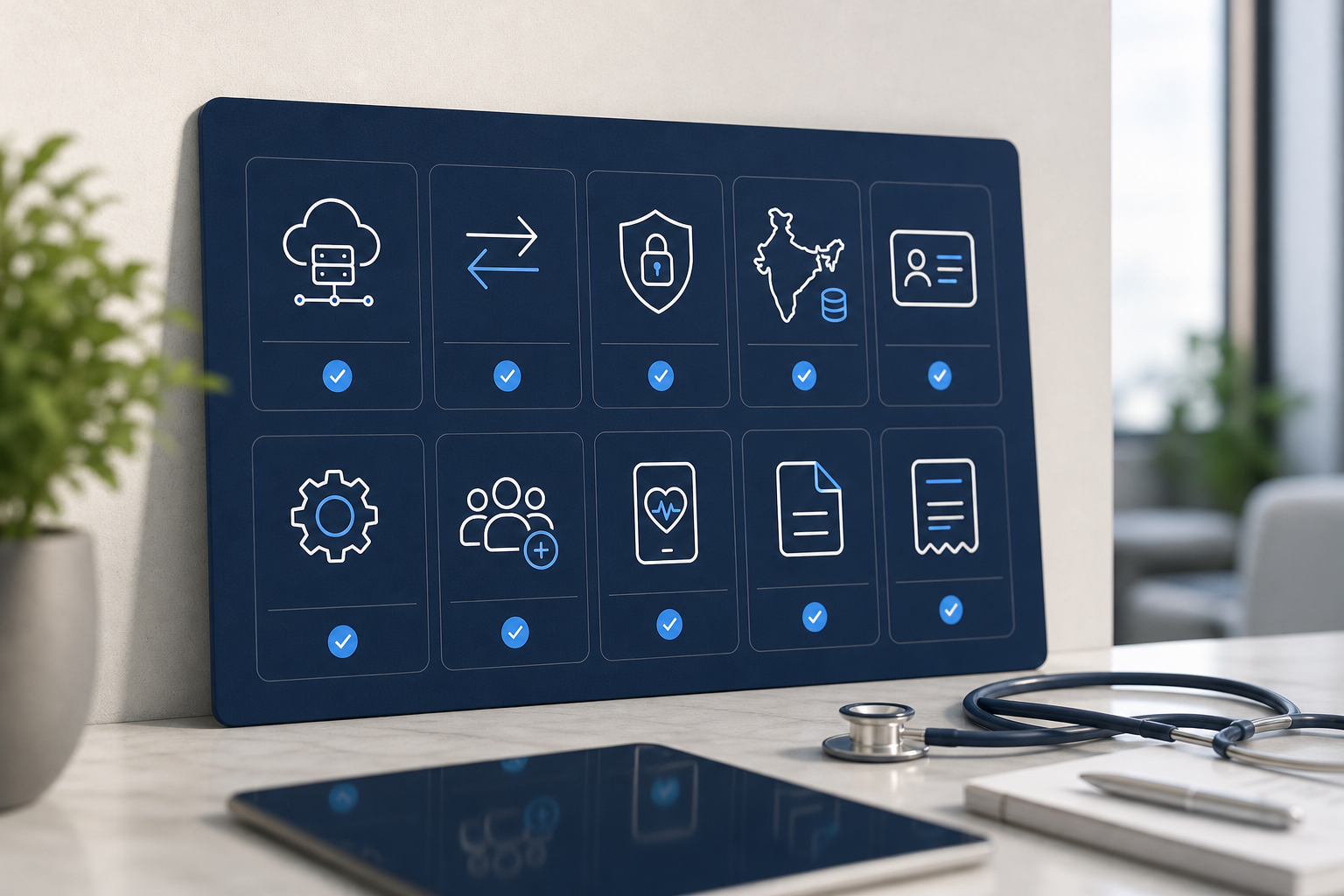
Bring a checklist: FHIR R4 and HL7 v2 support; DPDP Act 2023 compliance; India data residency; ABDM/ABHA linking; flat per-month pricing; self-serve onboarding wizard; patient app; OPD queue with tokens; GST-aware billing. Then, run your pilot cases and time them.
Moreover, set a 30-day decision deadline. Therefore, you keep momentum and finish the quarter with real gains instead of more slides.
Key Takeaways
- Connect the core: EHR, HMS, LIS, RIS, and PACS should share one patient ID so data follows care.
- Standards first: require FHIR R4 and HL7 v2; verify with a live lab-to-EHR message.
- Compliance matters: DPDP Act 2023 controls, India data residency, and ABDM/ABHA linking reduce risk.
- Price growth fairly: flat per-month pricing avoids per-bed penalties as you scale.
- Prove speed: insist on a self-serve onboarding wizard and be live in days, not months.
You can do this. Even small clinics benefit from structured data: faster visits, fewer billing surprises, and happier staff. The beginner guide medical data systems you just read is your map, now run the pilot and see the results in 2026.