80% of facilities run on fragmented workflows (Source: MedCore 2026). If you need hospital billing with gst, upi, and insurance claims to “just work,” you cannot juggle three systems in 2026 and still hit cash targets.
The short answer
Here’s the short answer first: for hospital billing with gst, upi, and insurance claims, mid-size hospitals that unify billing, a GST-aware tax engine, UPI/Razorpay payments, and insurance/TPA workflows in one EHR-backed system gain faster cash posting, fewer denials, and simpler audits. Then, when you add DPDP Act 2023 compliance, ABDM/ABHA linking, India data residency, and flat per‑month pricing, you protect margins without adding headcount while supporting 150+ OPD patients per day.
However, day to day, your team fights the same fires. Billing and claims live in one tool, GST filing in another, UPI payouts in a third, and clinical data sits apart. As a result, reconciliations drag on, claim packs miss codes, and GST summaries don’t tie back to invoices. Moreover, every export and import raises your audit risk.
Per MedCore’s approved stats, 75% of the market is still underserved by existing tech. That means most mid-size hospitals like yours feel this pain right now, especially in hospital billing with gst, upi, and insurance claims.
You need specifics, not slogans: GST slabs applied right, UPI settled against the right bill, and claims pre-filled from clinical notes. This guide sets clear buying criteria, shows how a modern system works end-to-end, and helps you move from “patchwork” to predictable cash in 2026.
Why Mid-Size Hospitals Struggle with Billing, GST, and Insurance Claims
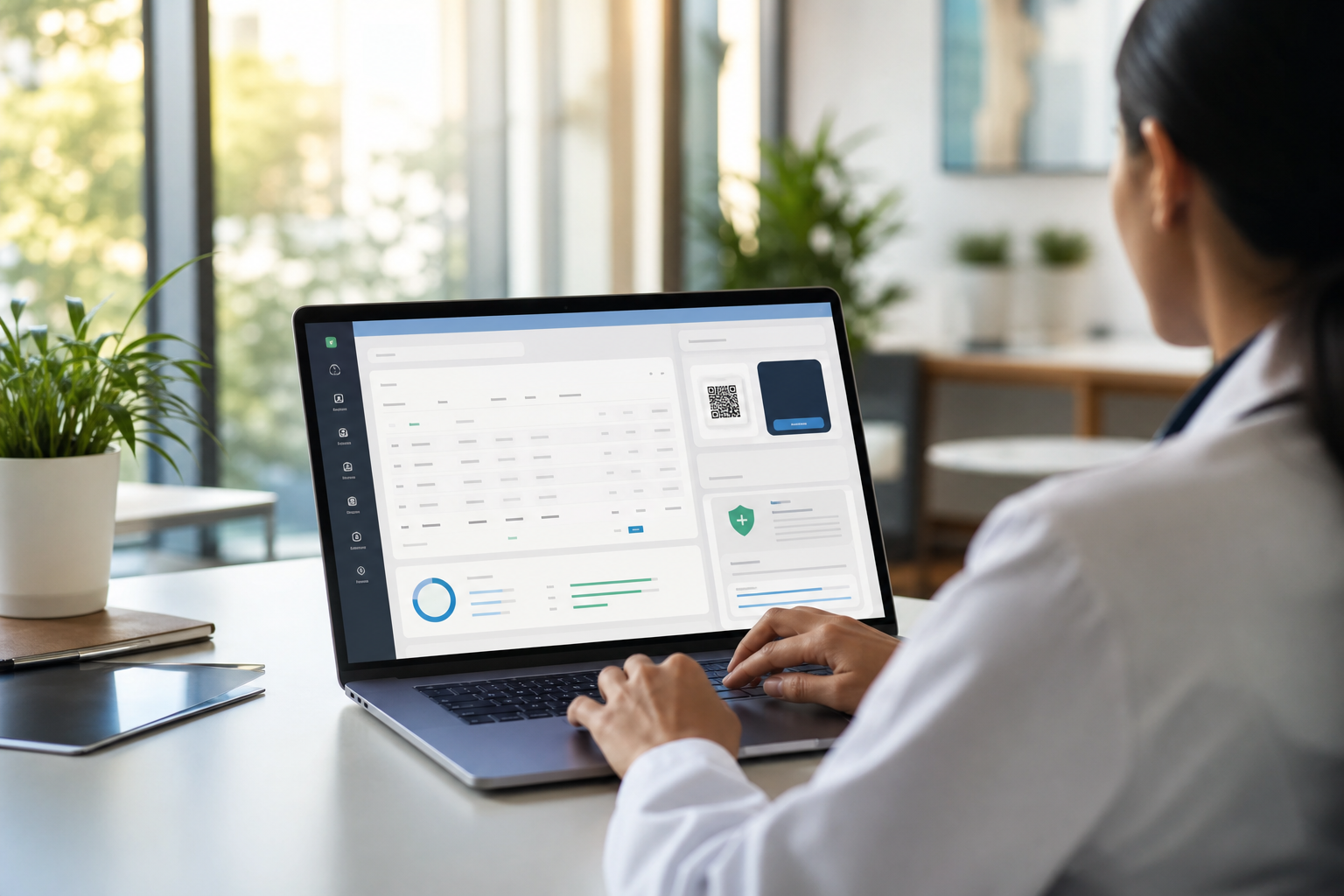
You feel the drag because the process is split. Billing teams post charges in one app. Finance files GST elsewhere.
Insurance teams assemble claims in folders. Meanwhile, UPI payments settle into Razorpay but don’t map back to the correct patient ledger. The result is slow cash, rework, and tense audits.
Per MedCore 2026 statistics, 80% of facilities run fragmented workflows, and 75% of the market is underserved. Those two facts show why your team spends nights on Excel. The core issue is not people or effort. It’s the distance between clinical data, tax logic, and payment rails. If you rely on exports, you are already behind.
GST and UPI context
For context on tax, India’s GST rules are strict about how supplies, discounts, and place-of-supply work. According to Wikipedia, GST in India is a destination-based tax with central and state components that changed how invoices and credits move across states. See the overview here: Goods and Services Tax (India). When your billing tool lacks native GST logic, staff must add tax per line by hand or through brittle templates. That’s where errors creep in.
In addition, UPI brings speed but adds a new reconciliation task. You must match UPI or card receipts (via Razorpay) to the exact invoice, split patient and insurer shares, and handle refunds. If your payment gateway sits outside your billing ledger, every mismatch costs time.
If your claims system cannot read data from the EHR, staff will retype, which drives denials.
Moreover, insurance claims need the clinical spine. ICD-10 codes must fit the notes. TAR/TPA pre-authorization must align with the plan and procedure. If your claims system cannot read data from the EHR, staff will retype, which drives denials.
Specifically, you need a billing stack for hospital billing with gst, upi, and insurance claims that pulls from the clinical record, applies GST slabs by service, posts UPI and plans, and compiles insurer claims without a copy-paste step. That is the only way hospital billing with gst, upi, and insurance claims can feel like one job, not four.
Where gaps cause rework
- Clinical-to-claim breaks: no auto-pull of ICD-10 and orders into claim forms.
- GST bolt-ons: tax slabs added by hand per line item.
- UPI reconciliation: Razorpay settlements not mapped to patient ledgers.
- TPA pre-auth: approvals tracked in email, not linked to the encounter.
What to Look for in a Hospital Billing System with GST and Insurance Claims
You want to buy once and fix the root cause of hospital billing with gst, upi, and insurance claims. Start with a GST-native tax engine. The system should auto-apply slabs by service, support tax-inclusive and exclusive pricing, and produce clean reports for filing. If a vendor relies on custom fields or spreadsheets for GST, expect edge-case errors to hit audits.
Next, insist on claims built from clinical data. The right system reads consultation notes, ICD-10, and orders, then drafts the claim for review. As a result, your team checks and submits, rather than retypes. A built-in denial-risk score flags missing docs and code mismatches before you send the claim. You cut back-and-forth with TPAs and lower rejections.
- UPI, Razorpay, and payment plans should post into the patient’s account, not a side ledger.
- Refunds, part payments, and insurer-patient splits should be first-class, not hacks.
- For mid-size facilities, this is where cash breaks or holds.
Furthermore, compliance must be table stakes. In India, DPDP Act 2023, ABDM/ABHA linking, and India data residency protect your hospital and patients. Interoperability also matters. FHIR R4 and HL7 v2 support keeps you open to labs, imaging, and future public programs. Ask for proofs, not promises.
Finally, pricing should be flat and fair for hospital billing with gst, upi, and insurance claims. A per-month plan without per-bed or per-user fees is easier to budget. If your costs scale with beds or staff IDs, growth punishes your margin. A self-serve onboarding wizard that gets you live in days keeps projects under control.
Buyer checklist: GST, UPI, claims, and compliance
- GST-native engine with correct slabs and reports.
- Auto-drafted claims from clinical data plus denial-risk scoring.
- UPI/Razorpay integration with real ledger posting.
- TPA pre-auth tracked against the encounter.
- DPDP Act 2023 compliance, ABDM/ABHA linking, FHIR R4.
- Flat per-month pricing that won’t tax your growth.
Tip: If you manage a chain, you may also want to read this chain-focused write-up for added nuance: Best Hospital Billing with GST and Insurance Claims for Multi-Specialty Hospital Chains in 2026.
Also Read!
How to Set Up WhatsApp Patient Reminders for Medical Tourism Hospitals in India
Mid-Size Hospital Guide to Billing with GST and Insurance Claims
How MedCore Handles Billing, GST, UPI, and Insurance Claims for Mid-Size Hospitals
MedCore is built for the 75% of the market that large tools ignore, especially those focused on hospital billing with gst, upi, and insurance claims. It unifies a single tenant-scoped EHR with billing, lab, and pharmacy, so data and money move together. In practical terms, that means GST applies from a rules engine, UPI posts to the right bill, and claims draft from the visit.
Moreover, MedCore anchors hospital billing with gst, upi, and insurance claims on shared clinical state. Doctors record notes, orders, and diagnoses once. Then billing uses the same record to produce the invoice, apply taxes, and prepare the claim. You eliminate copy-paste steps and their errors.
"We replaced three tools with MedCore. Billing, pharmacy and lab now talk to each other without exports." — Ravi Prasad, Administrator, Sunrise Clinic
GST-aware invoicing you can trust
MedCore’s GST-aware billing engine applies correct slabs by service type and produces filing-grade summaries. You can run tax-inclusive packages or itemized bills with per-line tax. Discounts, credit notes, and returns stay GST-consistent. Finance can export clean reports without data surgery.
Razorpay + UPI + payment plans, all reconciled
Payments flow through Razorpay and UPI inside the same ledger. Patient co-pays, insurer balances, and part payments map to one bill. Refunds and chargebacks route to the right account lines. As a result, your cash posting happens in hours, not at month-end.
Claims auto-drafted from consultations
MedCore reads the consultation record and pre-fills ICD-10, procedures, and notes into the claim. Staff attach labs and imaging from the same encounter. Therefore, claims go out complete the first time. A built-in agent scores denial risk so you can fix gaps before submission.
Insurance/TPA pre-auth built in
Pre-auth starts from the same visit. Staff pick the insurer and plan, then send a pre-filled request. When approval lands, the system locks the scope to avoid code drift. This direct link reduces “not as authorized” denials.
AI denial-risk agent, multi-currency, and patient experience
The claims agent flags weak documentation, code mismatches, and missing authorizations. For international patients, multi-currency billing supports quotes and receipts in the payer’s currency while your books stay in INR. Patients use the mobile app to see live tokens and pay bills.
"Our OPD wait time dropped from 40 minutes to 12. The live token display alone was worth the switch." — Dr. Meera Rao, Medical Director, Asha Hospital
As a result, mid-size hospitals see fewer denials, faster UPI reconciliation, and smoother audits. Compared to alternatives that bolt on GST or run claims in a separate app, MedCore keeps everything in one system your team already uses daily for hospital billing with gst, upi, and insurance claims.
**Get flat-rate pricing →
DPDP Act 2023 compliant with India data residency.
MedCore vs. Generic HMS and Legacy Billing Tools: An Honest Comparison
If you have tried a “generic” HMS or a legacy billing tool for hospital billing with gst, upi, and insurance claims, you know the trade-offs. Many add GST as a plug-in, draft claims by hand, and price by bed or user. You also wait months to go live. MedCore takes a different path: GST-native logic, AI claims drafting, flat per-month pricing, and a self-serve onboarding wizard that gets you live in days for hospital billing with gst, upi, and insurance claims.
Moreover, MedCore is a single tenant-scoped EHR with shared state across billing, lab, and pharmacy. That matters because bill lines, taxes, and claims all reference the same encounter. Where other tools fall short is data hand-offs. When ERPs demand complex integration, your teams add spreadsheets to fill the gaps.
However, let’s be clear: legacy ERP suites may have deeper non-clinical modules for finance or HR. If you need a global ERP ledger for dozens of cost centers, a legacy tool may fit that need. But for mid-size Indian hospitals focused on cash flow, claims, and GST, MedCore’s 55+ modules cover daily work without the weight and delay.
Side-by-side highlights
| Area | MedCore | Generic HMS / Legacy Billing |
|---|---|---|
| GST handling | Native GST rules engine | Bolt-on or manual slabs |
| Claims | Auto-drafted from consultations + denial-risk agent | Manual drafting in a separate tool |
| Pricing | Flat per-month, no per-bed/user | Per-bed or per-user fees |
| Onboarding | Self-serve wizard, live in days | Deployment in months |
| EHR link | Single tenant-scoped EHR with shared state | Exports/imports between modules |
| Modules | 55+ modules | Varies; add-ons cost extra |

If you operate a chain and want more detail on multi-branch rollouts and analytics, see this practical chain guide: How to Handle Hospital Billing, Insurance Claims, and GST for Multi-Specialty Hospital Chains.
Trust, Compliance, and Credentials That Matter for Hospital Billing
Trust starts with compliance and continues with uptime and throughput for hospital billing with gst, upi, and insurance claims.
Compliance and security
- Security: DPDP Act 2023 compliant with India data residency.
- ABDM/ABHA linking so patients and records connect to national health IDs.
- Interoperability: FHIR R4 and HL7 v2 support so labs and imaging can integrate without custom rewrites.
- Security: DLT-compliant messaging keeps your reminders and OTPs aligned with Indian telecom rules.
For reference, the National Health Authority details ABDM here: ABDM official site.
Operational proof
- 55+ modules used daily by mid-size hospitals for hospital billing with gst, upi, and insurance claims.
- Supports 150+ OPD patients per day.
- Works across 8 Indian languages.
- Patient app shows live tokens, lab results, and bills.
Those details matter because throughput and language access lower front-desk load and speed up patient flow. The patient app shows live tokens, lab results, and bills.
"The patient mobile app reduced our front-desk calls by half in the first month." — Shalini Kumar, Operations Head, Greenleaf Care
Security and privacy are not afterthoughts. With India data residency and DPDP alignment, your records stay in-country, and access is controlled. Combined with ABDM/ABHA linking and FHIR-native data, your hospital billing with gst, upi, and insurance claims processes are both modern and compliant.
Also Read!
Best Patient Engagement WhatsApp Reminders for Medical Tourism Hospitals India in 2026
Best AI Clinical Documentation EHR for Multi-Specialty Hospital Chains in 2026
Getting Started: Onboarding MedCore for Your Mid-Size Hospital
Switching tools should not stall your cash cycle. MedCore offers a self-serve onboarding wizard that gets you live in days, not months. Your billing, lab, and pharmacy share state from day one, so staff do not relearn steps across modules. That unity is what makes hospital billing with gst, upi, and insurance claims run fast without workarounds.
Here’s a simple plan you can follow this week.
-
Step 1: Map your charges and GST rules. Upload your services, packages, and taxes. The GST engine will apply slabs by service without per-invoice tweaks.
-
Step 2: Connect payments. Enable Razorpay and UPI, set payment plans, and test live posting into patient ledgers. Reconcile a test batch to confirm invoice mapping.
-
Step 3: Link clinical and claims. Import ICD-10 mappings and set up TPA panels. Create a test consultation and confirm the claim auto-drafts with notes and codes.
-
Step 4: Go live. Train front-desk and billing staff in one session. Use the patient app to cut queue questions on day one.
Pricing for mid-size hospitals starts from ₹24,999/mo with flat per-month billing, no per-bed or per-user fees. As a result, your costs stay steady as your OPD grows. If you need a custom plan for multi-specialty, the team will scope it with you for hospital billing with gst, upi, and insurance claims.

Frequently Asked Questions
How does MedCore handle GST calculations on hospital invoices?
MedCore has a native GST-aware billing engine. It auto-applies the correct tax slabs (5%, 12%, 18%) by service type, so you do not edit each invoice. It also supports tax-inclusive or exclusive pricing and respects discounts, returns, and credit notes. As a result, finance can export clean GST summaries for filing without manual fixes. Reports tie back to source invoices for audit trails, keeping hospital billing with gst, upi, and insurance claims consistent.
Can MedCore auto-generate insurance claims from consultation data?
Yes. MedCore’s AI claims agent auto-drafts claims directly from consultation records. ICD-10 codes are pre-filled from the clinical notes, and labs or imaging attach from the same encounter. The agent also flags denial risks before submission to TPAs, so you can add missing docs or fix code mismatches. This reduces rework and shortens time to approval.
What payment methods does MedCore support beyond cash?
MedCore supports Razorpay integration and UPI, plus payment plans for larger bills. It also handles multi-currency billing for international patients while keeping your books in INR. All receipts, refunds, and part payments reconcile inside the same billing module. This keeps hospital billing with gst, upi, and insurance claims aligned without external ledgers and month-end surprises.
How much does MedCore cost for a mid-size hospital?
Mid-size hospital plans start from ₹24,999/mo with flat pricing. There are no per-bed or per-user fees, so you can grow OPD without a pricing penalty. For multi-specialty hospitals with advanced needs, pricing is custom. You can review plan details and SLAs with the team for hospital billing with gst, upi, and insurance claims.
How long does it take to go live with MedCore?
MedCore offers a self-serve onboarding wizard, so your team can configure services, taxes, and pay rails quickly. Most mid-size hospitals go live in days, not the months you see with legacy HMS deployments. Because billing, lab, and pharmacy share state, training is short and focused. A single go-live checklist keeps every task clear and aligned with hospital billing with gst, upi, and insurance claims.
Is MedCore compliant with Indian healthcare data regulations?
Yes. MedCore is DPDP Act 2023 compliant, supports ABDM/ABHA linking, and provides India data residency. It also uses FHIR R4 and HL7 v2 for interoperability and runs DLT-compliant SMS for messaging. That mix keeps your records safe and your outreach compliant.
Does MedCore handle TPA pre-authorization workflows?
Yes. Insurance/TPA pre-auth is built in and linked to the clinical encounter. Claims are auto-drafted from consultations, and the AI agent scores denial risk. As a result, your team catches issues before you submit, reducing rejections and back-and-forth with TPAs.
What if we already use a separate billing tool — can MedCore replace it?
Yes. MedCore replaces fragmented tools by unifying billing, lab, and pharmacy in one shared-state system. As one administrator put it, "We replaced three tools with MedCore.". Ravi Prasad, Administrator, Sunrise Clinic. With one source of truth, reconciliations and audits get simpler.
Wrap-Up: What Mid-Size Hospitals Should Do Next
- Unify the workflow. You need one system where GST, UPI payments, and insurer claims all use the same clinical record — for hospital billing with gst, upi, and insurance claims. That is how you cut denials and speed cash.
- Buy for 2026, not 2016. Look for DPDP Act 2023 compliance, ABDM/ABHA linking, FHIR R4, and flat per-month pricing. Avoid per-bed fees that punish growth.
- Move in days, not months. Use a self-serve wizard and share state across billing, lab, and pharmacy from day one.
If you want a deeper drill into travel care and cross-border pay, this medical tourism piece adds useful context: Medical Tourism Hospital's Guide to Hospital Billing, Insurance Claims, and GST in India.