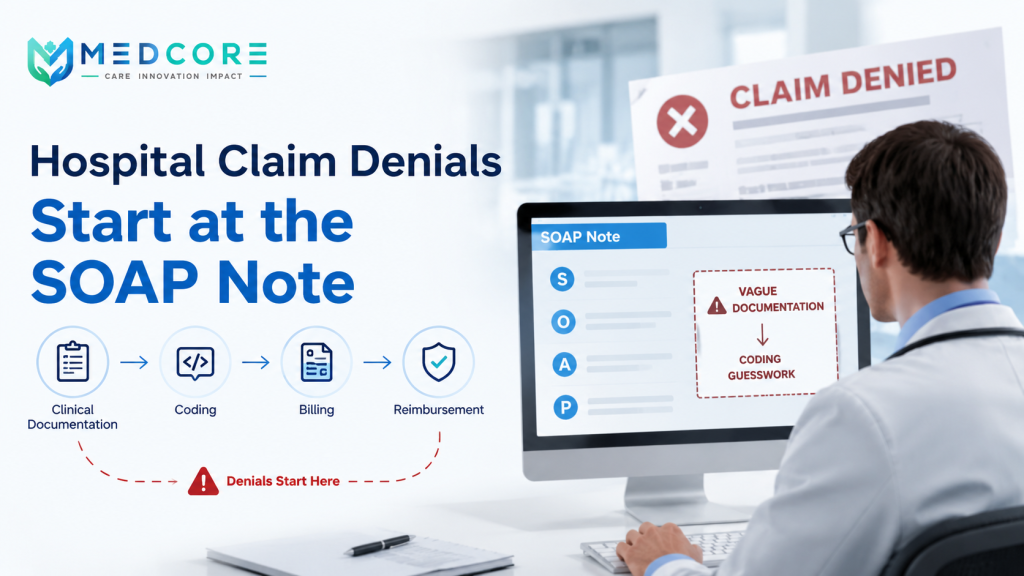
The denial arrives three weeks after discharge, and everyone looks at the billing team. Wrong room.
In almost every case, the denial was written into the encounter the moment a doctor dictated a vague chief complaint and a coder guessed at an ICD-10 code. Billing didn’t cause it. Billing filed the paperwork that made a pre-existing problem visible.
Denial rates are moving in one direction. From 2022 to 2024, 75% of providers reported increased denial rates and in 2025, 41% reported denial rates of 10% or higher, a larger share than the year before. For a 20-bed hospital, a 10% denial rate is not a rounding error. That is staff salaries.
The Actual Failure Chain
Here is what the failure chain looks like in a real outpatient encounter at a mid-size hospital:
- Doctor sees 30 patients in a session. SOAP notes are typed hurriedly or dictated in shorthand.
- Coder reviews the note 48 hours later and picks the closest ICD-10 code from what’s documented which is often the presenting symptom, not the confirmed diagnosis.
- A claim goes to the TPA with a code that doesn’t match the procedure, or lacks the specificity the payer requires for medical necessity.
- Denial lands. Someone spends two hours pulling records, writing an appeal, and resubmitting assuming anyone notices at all.
The appeal step is the expensive part everyone counts. The documentation step is the cheap fix everyone ignores.
This is not theoretical. Across the majority of Indian hospitals, CPT and ICD codes are still typed by billing staff rather than pulled from clinical notes. That failure mode has a name: “code entry drift.” It is the single largest contributor to coding-related denials which, according to the AMA, account for 15–20% of all claim rejections.
Why Ambient Documentation Changes the Math
The fundamental problem is that clinical documentation and billing documentation are treated as separate activities that happen at separate times. They are not. Every word in a SOAP note is a billing artifact. Treating it otherwise builds denial risk into every encounter before the patient leaves the room.
MedCore‘s Scribe Agent addresses this at the point of care. It runs as an ambient listener during the consultation, tags speakers, and drafts a structured SOAP note with ICD-10 and CPT codes pre-filled before the doctor has moved to the next patient. The physician reviews and approves; they are not transcribing from memory at 7 pm when precision drops.
That matters because a typical OPD session compresses documentation time to near zero. Asking a doctor to produce billing-grade notes in that window is unrealistic. Ambient capture is the only architecture that does not trade documentation quality for clinical throughput.
From SOAP to Claim: Closing the Gap
Documentation quality is necessary but not sufficient. The other half of the problem is what happens between an approved SOAP note and a submitted claim.
In most hospitals, this is still a manual hand-off. A coder takes the note, maps codes, fills a claim form, and submits with no systematic check for denial risk before it leaves the building. The payer’s adjudication algorithm is running a quality check on your work that you did not run yourself.
MedCore’s Claims Agent closes this gap. It auto-drafts the TPA claim directly from the approved SOAP note and ICD-10 codes, and it includes denial-risk prediction before submission. The team sees a flag on a weak claim before it goes out. Missing specificity on a diagnosis, a procedure code that commonly triggers manual review staff catches it then. Not three weeks later when it bounces back.
Faster processing of clean claims is not the same thing as fewer denied claims. Speed without upstream accuracy just accelerates the wrong outcome.
See how MedCore’s Claims Agent flags denial risk before submission explore the full claims workflow.
Where Multi-Specialty Hospitals Get This Wrong
Single-specialty clinics usually have a limited payer mix and a tight set of procedure codes. Denial patterns are recognizable and staff learn them over time.
Multi-specialty hospitals are a different problem. A patient may see an orthopedic surgeon, get referred for imaging, and pick up a prescription three separate billing events, each with its own documentation source and its own denial exposure. Add a follow-up consult and you have four. The compounded billing complexity in multi-specialty chains is well-documented: one branch runs a legacy HIS, another a billing-only app, a third a lab system that cannot post charges to IPD reconciliation runs as nightly imports. That is where claims break.
The Claims Agent pulling directly from a unified SOAP record not from department-by-department notes scattered across a file server is what makes comprehensive claim generation tractable in that environment. Discharge papers waiting on pre-auth because coding errors triggered a manual review queue is a consequence of documentation fragmentation, not billing error.
The Workflow That Actually Works
Here is the sequence that closes the documentation-to-claim gap using MedCore’s verified product workflow:
- Ambient capture during consultation. Scribe Agent listens, tags physician and patient speech, structures the encounter as a SOAP note in real time.
- Physician review before exit. Doctor approves or amends the draft. ICD-10 and CPT codes are pre-filled and visible the physician confirms they match clinical reality, not just what was easiest to type.
- Claim drafted from the approved note. Claims Agent generates the TPA claim from the same data the physician signed off on. No re-entry. No re-interpretation by a coder working from an incomplete summary written hours later.
- Denial-risk flag before submission. The agent surfaces claims carrying elevated denial risk. Staff resolves documentation gaps before the claim leaves.
- Escalation via Agent Console. Anything requiring human judgement a disputed code, an unusual procedure, a payer with idiosyncratic requirements goes to the Agent Console, which shows the full transcript and allows one-click escalation to the right person.
This sequence addresses where denials actually originate, rather than where they are traditionally fought.
What to Audit Before You Change Anything
Practice manager or CFO wondering whether your denial problem is a documentation problem or a billing problem? Run this check first:
- Pull your top 10 denial reasons from the last 90 days. If the majority are “insufficient documentation,” “missing medical necessity,” or “incorrect/inconsistent coding,” the root is documentation not billing execution.
- Ask how long after the encounter your coders typically access the SOAP note. Anything over 24 hours means you are relying on notes already degraded by session volume.
- Check whether your current RCM software shows denial-risk scores before submission. If not, you are running quality control retrospectively after the payer has already adjudicated against you.
The third point is the one most hospitals have not addressed. Pre-submission denial risk is now a tractable problem. Payer denial patterns are stable enough to model. ICD-10 and CPT mismatch flags are structured data checks not exotic AI that any system handling the claim draft can run, provided it has access to the clinical note that generated the codes.
A Note on Scale
Everything above applies whether you are a solo clinic or a 40-bed hospital. MedCore’s features were built inside a 40-bed hospital in Bangalore and beta-tested across 12 hospitals in Karnataka and Tamil Nadu not designed in a lab and retrofitted to real workflows. The 45 modules that shipped post-beta reflect what actual physicians, nurses, and administrators asked for. That is why the claims workflow connects directly to the scribe workflow instead of sitting in a separate billing silo.
India’s hospital market is valued at approximately $200B, with 75% of facilities underserved by existing billing technology. Denial risk does not spare the smaller end of that market. A 10-bed clinic losing revenue to denials feels it proportionally harder than a 300-bed corporate hospital with a dedicated revenue cycle team. The documentation-first approach matters more, not less, when there is no dedicated coder on staff to catch problems after the fact.
Stop auditing your billing team and start auditing your SOAP notes. The denial is already in there you just haven’t found it yet.
Start your free 14-day MedCore trial and see how ambient documentation and pre-submission denial-risk flagging work inside a single connected workflow no setup fee, no commitment.