Fix your billing team and your denial rate won’t budge. That’s the uncomfortable truth most practice managers discover after their third audit in a year. The break in the chain happens earlier in the exam room, not the billing queue and no amount of biller retraining closes a gap that was opened at documentation.
I’ve watched this pattern across clinics of all sizes. A 15-bed facility struggling with TPAs. A multi-speciality hospital with a dedicated coding team still losing revenue to avoidable denials. In almost every case, the root cause traces back to the same structural failure: clinical documentation and billing run on separate rails that never reliably meet.
The Upstream Leak Nobody Talks About
MedCore was built inside a 40-bed hospital in Bangalore, which means the people who designed it watched this failure mode up close. When clinical documentation and billing are disconnected, codes get mis-categorised, services go unbilled, or claims go out with missing information not occasionally, but as a near-inevitable consequence of the architecture itself.
That last phrase matters: near-inevitable. This isn’t a people problem. It’s a systems problem. When a doctor finishes a consultation and hands off a handwritten note or a dictated file, something is lost in every translation step that follows. The coder interprets. The biller formats. The TPA reviewer reads a claim that is three steps removed from what actually happened in that room.
Prior authorisations and missing or inaccurate data were the leading reasons for claim denials in 2024, according to AAPC. Outdated ICD codes remain a consistent trigger. And MD audit’s 2025 data makes the stakes plain: “Reactively fixing denials after they occur or addressing compliance findings after the fact is costly and unsustainable,“ in the words of MD audit CEO Ritesh Ramesh. The industry knows this. Hospitals keep doing it anyway, because fixing it requires changing a workflow, not just a process checklist.
Listen to this blog –
Where the Break Actually Happens: Three Specific Points
1. The Moment the Note Leaves the Doctor’s Hands
A SOAP note written in shorthand, a template clicked through too fast, a spoken dictation transcribed with the wrong laterality. Every one of these becomes a coding problem three days later. The doctor has moved on to the next patient. Nobody catches it until a denial arrives.
Eligibility checks are a related failure point. Eligibility checks happening before services are rendered not after is a specific process control for reducing claim denials. Yet in disconnected systems, the front desk verifies coverage at registration, the doctor sees the patient, and nobody re-checks before the claim goes out. Coverage lapses. Payer rules shift mid-year. The claim gets denied for a reason that existed at the time of service but wasn’t caught.
2. ICD-10 and CPT: The Coding Step That Breaks in Translation
Manual coding from clinical notes is inherently lossy. A coder reading a note applies their interpretation of the documented findings. If the note is ambiguous and most are, to some degree they make a judgement call. Sometimes it’s right. Sometimes it creates a modifier error, an un-bundling issue, or an outdated code that a payer’s system flags automatically.
The 2025 picture is harder than it was two years ago. Tele-health modifiers have tightened. CCM and RPM codes overlap in ways that trigger denials when billed together incorrectly. CMS is introducing digital prior authorisation rules by 2026, which adds another layer of compliance that has to be baked into documentation workflows now, not retrofitted later.
The practical answer isn’t to hire more coders. It’s to reduce the number of translation steps between what the clinician documents and what the payer sees.
3. The TPA Claim Itself
For hospitals dealing with third-party administrators which means most mid-size facilities in India the claim packet is where a documentation failure becomes a financial one. TPA integration requires exchanging payer IDs, EDI specs, and claim reason codes with each domestic and international administrator; missing any of these elements is flagged as a structural gap. And the discharge summary has to align exactly with the ICD-10 codes on the claim validating that alignment before submission is a non-negotiable step that fragmented systems routinely skip.
For hospitals treating international patients, the complexity multiplies. Itemised SAC codes on claim bills aren’t optional auditors check this first. A master list mapping every billable item to an HSN/SAC code, tax rate, and exemption note isn’t a nice-to-have; it’s a structural requirement that disconnected billing systems consistently fail to maintain.
What Closing the Gap Actually Looks Like
The fix isn’t a new QA checklist. It’s architectural: the clinical note, the codes, and the claim have to live in the same system, generated from the same data, reviewed in the same workflow.
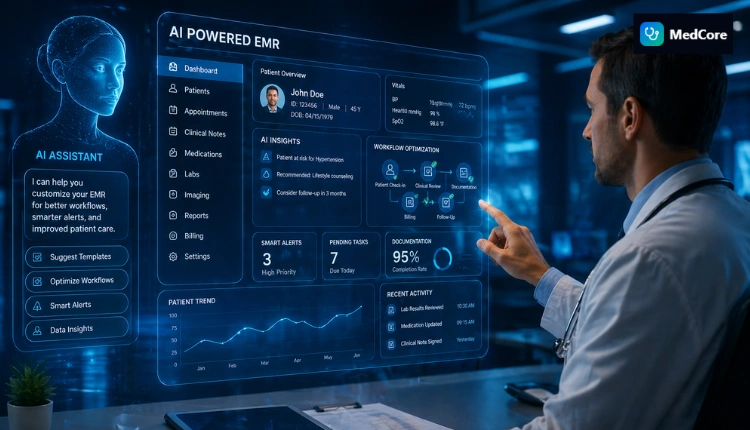
MedCore’s Scribe Agent captures consultations as ambient SOAP notes with speaker tagging, and pre-fills ICD-10 and CPT codes from the documented findings. That’s not a transcription tool. It’s the first link in a chain that goes directly to billing. The Claims Agent then auto-drafts the TPA claim from that same SOAP note and ICD-10 codes. Denial-risk prediction then flags the specific elements most likely to cause rejection before the claim goes anywhere.
The denial-risk step deserves its own moment. Most systems tell you a claim was denied after the fact. A system that flags risk before submission based on payer-specific patterns, code combinations, and documentation completeness is solving a different, earlier problem. You’re not chasing a denial. You’re preventing one.
This is what billing accuracy improving when a HIS connects clinical documentation directly to billing codes actually means in practice. Not a vague integration. A specific chain: consultation note → ICD-10/CPT pre-fill → claim draft → denial-risk check → submission. No handoff. No translation.
A Framework for Auditing Your Own Workflow
Before you can fix the gap, you have to locate it. Here’s how to run a fast internal audit:
Map every handoff between documentation and billing. Count the steps. Every step where a human re-interprets or re-enters data is a potential break point.
Check when eligibility verification happens. If it’s only at registration, you’re missing coverage changes that occur before the claim is filed. Re-verify at checkout, before submission.
Pull your denial reason codes for the last 90 days and sort by root cause. Coding errors and missing information are upstream failures. “Timely filing” and “duplicate claim” are process failures. They need different fixes.
Trace three denied claims back to their original clinical note. At which step did the information change, get dropped, or get misinterpreted? That step is your highest-priority problem.
Check your ICD-10 code currency. If your system doesn’t flag outdated codes automatically, someone has to do it manually and they won’t, reliably, under time pressure.
Most hospitals running this audit find the same thing: the break is at step one or two, not at the billing desk. The billing team is doing their best with incomplete information they didn’t generate.
The Market Context
MedCore’s own research puts 80% of India’s healthcare facilities on fragmented workflows the root cause of slow and error-prone billing and insurance claim processing. That’s not a statistic about technology adoption. It’s a description of the structural condition that makes claim denials so persistent. You can’t fix a fragmented-workflow problem with a point solution bolted onto an existing fragmented workflow.
Legacy HMS platforms weren’t designed with a connected documentation-to-claims chain. Most were built for large corporate hospitals that could afford dedicated coding departments to bridge the gap manually. Solo clinics and mid-size hospitals can’t staff that way. They need the connection to be structural, not staffed.
The Position I’ll Take
Billing teams get blamed for denial rates they didn’t cause. The real accountability belongs to whoever chose a system where clinical documentation and claims are separate modules, separate workflows, or separate vendors. That architectural choice is the decision that determines your denial rate more than any downstream process improvement.
If your current system requires a human to carry information from a clinical note to a billing code to a claim, you don’t have a billing problem. You have a documentation-architecture problem. Fix that first. Everything downstream gets easier.
MedCore was shaped by 45 modules shipped after direct beta work with doctors, nurses, and administrators across 12 hospitals in Karnataka and Tamil Nadu. That background matters because it means the Scribe-to-Claims chain was designed by people who watched manual handoffs fail in real clinical environments, not by engineers guessing at how billing works.
If you want to see how a connected documentation-to-claims workflow actually runs in practice, start your free 14-day MedCore trial no commitment, and you’ll know within a week whether the chain holds.