Sending a reminder SMS the night before an appointment is not a no-show strategy. It’s a consolation prize.
I’ve talked to enough clinic administrators to know the real frustration: the patient who was always going to cancel already cancelled in their head. The reminder reached them they just didn’t reply. Meanwhile, the 10 AM slot stayed open, the doctor sat idle for twenty minutes, and the front desk fielded three walk-ins who now had to wait ninety.
The mistake is treating no-shows as a communication problem. They’re a prediction problem. And the fix lives upstream before the slot is even confirmed.
Why the “send a reminder” instinct fails
Reminders work on the patient who forgot. They do nothing for the patient who booked impulsively, lives far away, has a history of missing appointments, or scheduled during a time slot they’ve never honored before. That distinction matters enormously in a busy OPD, and it’s information your front desk almost never has at booking time.
India’s healthcare infrastructure makes this worse. With approximately 80% of the country’s $200B healthcare market still running on fragmented workflows and manual coordination, most clinics have no systematic way to surface that history even when it exists in their records. The booking clerk sees a name and a time. That’s it.
The result is a scheduling system built on optimism. And optimism is expensive.
What prediction-first scheduling actually looks like
The right question isn’t “did we remind this patient?” It’s “how likely is this patient to show?” Ask that at booking time, and the entire downstream workflow changes.
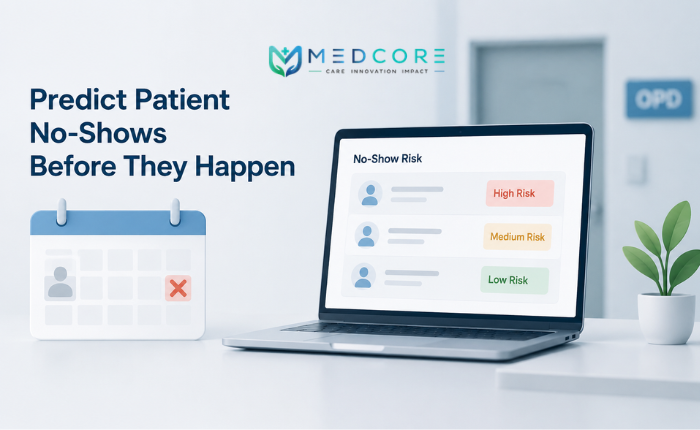
MedCore’s Predictions Agent assigns a no-show score to each booked appointment, drawing on the patient’s appointment history and other signals accessible within the system. That score surfaces in the OPD queue before the day begins not after the slot is already lost.
Here’s why that timing matters. A high-risk slot flagged twelve hours in advance can be double-booked with a walk-in or a wait-listed patient. The same flag the morning of the appointment is nearly useless you have no time to fill the gap. Prediction value decays fast. You need it early.
Listen to this blog here –
The confirmation gap nobody talks about
There’s a step between “booked” and “confirmed” that most practice management software ignores entirely. A patient who scheduled via phone is not the same as a patient who has actively acknowledged the appointment in the 24 hours before. That acknowledgment gap is where no-shows breed.
MedCore’s Outbound Follow-up Agent closes it without adding to front-desk workload. After a booking is placed, the agent contacts the patient via voice call or WhatsApp, gets an active confirmation, and only then marks the slot as firm. If there’s no response after multiple attempts, the slot can be flagged for reallocation not left in a false-confirmed state that blows up your OPD morning.
This is meaningfully different from automated SMS. A WhatsApp message that asks “Can you confirm you’re coming?” and waits for a reply creates a real two-way record. An SMS blast creates a sent-at timestamp and nothing else.
The booking channel problem
Prediction accuracy depends on knowing who booked and how. A patient who called, spoke to a receptionist, and confirmed a time is lower risk than one who clicked through a form at 1 AM and never engaged again. The booking channel is signal, and most clinics throw it away.
MedCore’s AI Voice Receptionist captures this at the source. It qualifies callers, books them directly into the OPD queue, and critically hands off to a human agent with a full transcript when needed. Every phone booking carries context: how the patient described their concern, whether they hesitated on the time slot, what language they used. That context doesn’t disappear after the call ends.
That call data compounds over time. Over 70% of global healthcare C-suite executives cited operational efficiency as a top priority in 2025 but efficiency built on opaque booking data is fragile. You need the signal chain intact from first contact to appointment day.
No-shows are one symptom. The OPD queue is the patient.
A no-show doesn’t just waste a slot. It creates a ripple. The doctor’s rhythm breaks. Walk-ins stack up. The queue display shows waits that don’t reflect reality. Patients who arrived on time start getting restless.
MedCore’s Live OPD Queue handles this in real time Socket.IO live updates mean the display reflects actual state, not a snapshot from thirty minutes ago. Vulnerability flagging ensures that elderly patients or those with flagged conditions aren’t quietly waiting while the queue reshuffles around them. These aren’t cosmetic features. They’re how you prevent the operational damage a no-show triggers from cascading through the next two hours of clinic time.
The queue and the prediction layer aren’t separate systems. They’re the same system, handling the same problem at different points in the timeline.
Where pharmacy demand forecasting fits in
This one surprises clinic managers when I mention it. No-show prediction and pharmacy demand forecasting feel unrelated. They’re not.
Your pharmacy demand on any given day is downstream of your confirmed appointment load specifically filtered through speciality, chief complaint, and historical prescribing patterns. If your OPD books twenty diabetic follow-ups on Thursday and ten of them reliably no-show, your pharmacy order for related formulations should reflect twelve confirmed visits, not twenty scheduled ones.
MedCore’s Predictions Agent includes pharmacy demand forecasting as part of the same prediction layer. That’s not coincidence it’s the same underlying logic applied to a different downstream question. Clinic managers who treat these as separate problems end up over-ordering on high-no-show days and scrambling on the days when attendance actually peaks.
What solo and small clinics get wrong about this
Solo and very small practices often struggle with integration they lack IT staff to vet tools or negotiate integrations. That’s a consistent finding in research on AI adoption in private medical practice. The instinct is to assume that prediction tooling is for large hospitals with data science teams. It isn’t.
MedCore was built inside a 40-bed hospital in Bangalore and beta-tested across 12 hospitals in Karnataka and Tamil Nadu before launch. The Predictions Agent isn’t an enterprise add-on it’s part of a platform designed for clinics that can’t afford to staff around operational waste. Solo clinics with one to three doctors feel a missed appointment more acutely than a 30-bed hospital does. That’s precisely who needs the prediction layer most.
The global AI in healthcare market is projected to surpass $50 billion in 2026, driven in part by exactly this kind of operational intelligence becoming accessible outside enterprise tiers. The practice management software market itself is projected to reach $23.70 billion by 2032 and most of that growth is happening in mid-market and small-clinic segments, not the enterprise deals that grab headlines.
The step-by-step: building a prediction-first scheduling workflow
- Score at booking, not the day before. Every new appointment should carry a no-show risk score before the slot is confirmed. Flag high-risk slots in the same moment they’re created not as an afterthought the evening before.
- Use active confirmation, not passive notification. Route high-risk bookings through the Outbound Follow-up Agent for a two-way WhatsApp or voice confirmation. A reply is evidence. A sent message is not.
- Build a wait-list that actually works. High-risk slots should trigger an active wait-list ping not sit idle waiting for a cancellation to arrive manually. If the slot is likely to open, treat it as likely to open now.
- Let the OPD queue reflect reality in real time. Once predictions feed into confirmed vs. probable slots, the queue display and staff allocation need to update accordingly not run off a morning snapshot.
- Close the pharmacy loop. Share confirmed appointment projections with whoever manages pharmacy orders. Demand forecasting only works if the forecast is being read by someone with authority to adjust orders before the day starts.
None of these steps require a data scientist or an IT department. They require software that treats prediction as a first-class workflow, not a feature bolted onto a reminder system.
One trade-off worth naming
Prediction-first scheduling does one thing that pure reminder systems don’t: it makes explicit which patients are at risk. That creates a management decision the clinic previously didn’t have to make. Do you double-book the flagged slot? Reach out proactively? Adjust the booking window for certain patient types?
Those decisions require a policy. Clinics that deploy prediction tools without a documented protocol for acting on high-risk flags often end up with accurate predictions they don’t use. The tool surfaces the signal. The clinic has to decide what to do with it in advance not in the moment.
That’s the real operational work prediction-first scheduling demands. It’s considerably less than the work of managing a broken OPD morning. But it’s not zero, and it’s worth saying plainly.
For a deeper look at how AI is reshaping clinical operations beyond scheduling, read the broader picture of AI in the medical field. The same prediction infrastructure that flags no-shows also drives ER triage severity scoring and pharmacy demand. One architecture, not five separate purchases.
If your clinic still runs scheduling on optimism and SMS blasts, the gap between where you are and where prediction-first scheduling puts you is smaller than you think. The 45 modules shipped after beta with doctors, nurses, and administrators mean there’s no integration puzzle to solve on your own.
Start your free 14-day MedCore trial and see the Predictions Agent, Outbound Follow-up Agent, and Live OPD Queue working together in your clinic’s actual workflow not a sanitised demo environment.