Every day, in hospitals across India, a billing executive opens a doctor’s SOAP note and starts typing the same diagnosis codes into a claims form. The SOAP note already has them. Nobody designed this redundancy on purpose it just calcified, workflow layer by workflow layer, until double-entry became normal.
This is not a minor inefficiency. Administrative overhead in hospitals re-entry, re-reading, reconciling across disconnected modules consumes a disproportionate share of operating budgets, and the cost stays invisible precisely because it looks like normal work.
It doesn’t land until you watch a billing team manually re-read clinical notes to reconstruct what a doctor already documented an hour earlier.
The fix is not hiring faster billers. It’s recognising that a well-structured SOAP note, with ICD-10 and CPT codes attached at the point of care, is a claim draft and treating it that way from the start.
Listen to this blog here –
Where the Disconnect Actually Lives
The problem is architectural, not motivational. Most hospital management systems store clinical documentation and billing in separate modules. The doctor writes in one place; billing reads it and re-enters in another. Even when both modules sit inside the same HMS, they rarely talk the ICD-10 code the doctor selected never travels to the claims screen automatically. Someone has to carry it across.
That handoff is where errors multiply. A coder misreads a modifier. A diagnosis is mapped to a slightly different code under TPA rules versus standard ICD-10. The claim goes out with a mismatch. The denial comes back three weeks later. The billing team digs up the original note. The cycle costs far more than the original claim was worth.
India’s hospital sector has a particular exposure here. MedCore‘s market research puts roughly 80% of India’s ~$200B hospital and healthcare market on fragmented workflows and manual coordination which means most claims processes are still hand-off dependent, even in hospitals that consider themselves digitised. For any practice evaluating hospital management software in India, that baseline is the problem to solve first.
The One-Workflow Model
What a connected system actually looks like is this: the doctor consults, the documentation happens simultaneously, and the coded output from that consultation feeds the claim without a human relay race in between.
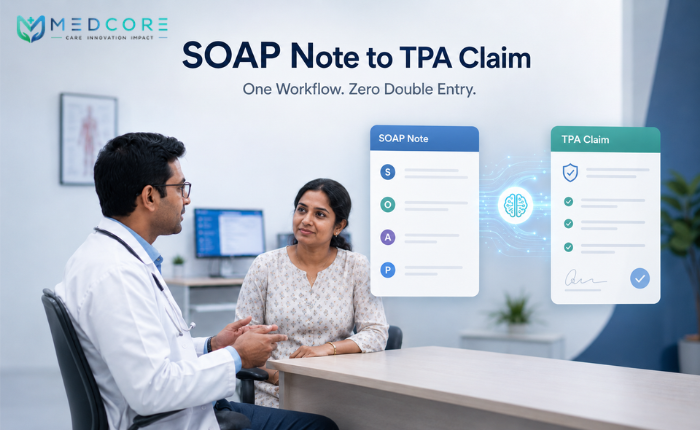
MedCore’s Scribe Agent works as an ambient SOAP scribe with speaker tagging. It captures the consultation in real time, structures the output into a SOAP note, and pre-fills ICD-10 and CPT codes before the doctor has left the room. The doctor reviews and approves that part stays human. But the coding is already done.
The Claims Agent then picks up that SOAP note and ICD-10 output and auto-drafts the TPA claim. It does not start from a blank form. It starts from what the Scribe Agent produced. The billing team is no longer re-reading clinical notes they’re reviewing a pre-populated claim for accuracy and approving it.
That is not a marginal improvement. That is the elimination of an entire manual translation step that exists in most hospitals today.
See how the Scribe-to-Claims pipeline is built: explore every MedCore feature the AI documentation and claims modules are detailed there.
Denial Risk Is a Coding Problem Disguised as a Claims Problem
Claims get denied for many reasons late submission, missing pre-authorisation, wrong member ID but coding mismatches are among the most common and most preventable. When ICD-10 codes are applied at the point of documentation, with the clinical context still fresh, the codes are more accurate. When they are applied later by a coder working from notes, there is inherent information loss.
MedCore’s Claims Agent includes denial-risk prediction it flags a claim before submission if it detects patterns likely to trigger rejection. That is only possible because the agent has the full SOAP transcript to work from, not just a summary. It can see the clinical reasoning, not just the final code.
This matters most for TPA claims, where the payer often requests detailed justification. A claim that arrives pre-populated with structured clinical documentation with the consultation transcript available is significantly easier to defend in a dispute than one that references a brief typed note.
What Commonly Goes Wrong With Implementation
The one-workflow model sounds straightforward. In practice, three things cause it to fail at rollout.
1. Doctors who treat documentation as an afterthought
If the Scribe Agent is running but the doctor handles all the clinical reasoning in their head and only dictates a summary afterwards, the ICD-10 pre-fill will be shallow. The agent needs enough clinical context to code accurately. That means the consultation symptoms, assessment, plan has to happen in a way the scribe can capture. For most doctors, this is a habits change, not a technology change. It takes a few weeks, not a few minutes.
2. Keeping billing and clinical modules separate anyway
Some hospitals implement an ambient scribe and then manually export the notes to a separate billing system. The integration never happens. The coding stays manual. The denial-risk prediction is never triggered because the claims are drafted outside the system entirely. The whole point of the pipeline is that the SOAP output flows directly into the Claims Agent breaking that flow reintroduces the original problem.
3. No review discipline on the pre-filled claim
Auto-drafted is not auto-approved. The Claims Agent produces a draft. A billing reviewer still needs to check it for TPA-specific code requirements, for any clinical nuance the scribe missed, for policy-specific documentation rules. Hospitals that treat the draft as final and submit without review will see a different class of errors replace the ones they eliminated. The workflow improves human review; it does not replace it.
45 Modules, One Pipeline
The reason the Scribe-to-Claims pipeline is worth building properly is that documentation quality affects more than just billing. A well-structured SOAP note with speaker tagging and coded diagnoses feeds downstream systems too pharmacy demand forecasting, follow-up scheduling, lab ordering. When documentation is an afterthought, every system downstream degrades with it.
MedCore shipped 45 modules after a beta that ran with doctors, nurses, and administrators across 12 hospitals in Karnataka and Tamil Nadu. The clinical documentation and claims workflow was not designed in isolation from the OPD queue, the billing engine, or the pharmacy. That integration is the reason the one-workflow model is possible not because any single feature is clever, but because the data moves correctly between them.
For solo clinics to mid-size hospitals, the practical starting point is the Scribe Agent. Get documentation structured and coded at the point of care. Once that is running cleanly, the Claims Agent has something real to work with. That sequencing matters trying to automate claims without structured upstream documentation produces a faster version of the same bad output.
Two pieces worth reading before you choose a system: how AI medical scribes handle real-time documentation, and how AI-powered EHR and clinical documentation functions in practice. The claims problem is downstream of the documentation problem. Fix the documentation first.
A Framework for Evaluating Your Current Process
Before switching anything, map what you actually have. Three questions:
How many times does an ICD-10 code get entered for a single encounter? If the answer is more than once in the doctor’s notes and again in the claims screen you have the redundancy problem.
Where does your TPA claim draft originate? If it starts from a blank form rather than from structured clinical output, your billers are spending time on translation, not review.
How long after consultation does a claim get drafted? Longer gaps mean more information loss. Same-day drafting from a scribe transcript is categorically more accurate than next-day drafting from memory and notes.
Those three answers tell you how much of your billing team’s time is genuinely value-adding versus being consumed by avoidable re-entry. In most hospitals, the answer is uncomfortable.
The administrative cost problem in healthcare is real, and it will not be solved by adding headcount. The lever is eliminating steps that only exist because systems were never designed to talk to each other. The SOAP note and the TPA claim are the same data. Build the pipeline that treats them that way.
Start your free 14-day MedCore trial and see how the Scribe Agent and Claims Agent work as a single pipeline not two separate tools you have to connect yourself.