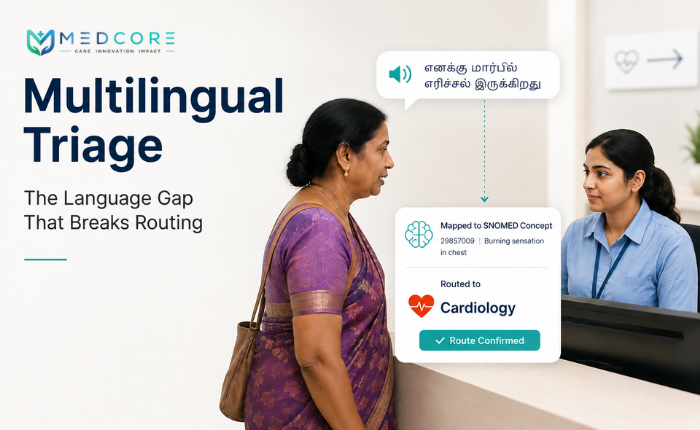
The misdiagnosis was not in the consultation room. It happened at the front desk, when a Kannada-speaking patient described a burning sensation in her chest, the registration staff logged it as “stomach complaint,” and she was routed to a general physician instead of cardiology. That routing decision made in thirty seconds by someone juggling five other patients shaped everything that followed.
This is not an edge case. In a country with 22 scheduled languages and hundreds of regional dialects, the triage language gap is one of the most expensive and least-discussed failure modes in Indian clinic and hospital operations. And the software industry has largely ignored it.
Listen to this full blog here :
What the Research Actually Says
Among patients treated by clinicians who did not share their language, 30% had difficulty understanding medical instructions and 30% reported problems with the reliability of information they received. That is not a communication nuance that is a third of your non-native-language patients walking out with instructions they cannot follow.
Scale that to adverse events and the picture gets worse. Non-native speakers are two to four times more likely to experience mistakes in their care, with documented costs running into millions annually across health systems that have tried to quantify it. India has never done that national accounting. The actual figure is almost certainly higher here, because the language diversity is greater and interpreter services are essentially non-existent outside a handful of metro teaching hospitals.
Studies have linked language barriers to worse health outcomes, higher rates of serious medical events, longer hospital stays, and higher readmission rates. Longer stays and read admissions are not just patient-safety problems they are revenue and capacity problems. A bed occupied by a preventable readmission is a bed unavailable for a new admission.
The question for clinic and hospital operators is not whether this matters. It is where the problem actually enters the system.
The Real Point of Failure Is Triage, Not Translation
Most discussions of language barriers in healthcare focus on the consultation itself the doctor-patient conversation. That is a real problem, but it is downstream of a more fundamental one: by the time the doctor opens a chart, the presenting complaint has already been filtered through two or three translation layers. Front desk staff, who may speak a different regional language than the patient, make a judgement call about what department to route to. That judgement shapes every clinical decision that follows.
Wrong routing has a compounding cost. When patients fall through the cracks of care coordination, costs rise exponentially as preventable complications lead to hospitalization. A patient routed to the wrong speciality sees one doctor, gets referred, waits again, sees a second doctor, and may or may not have their original complaint accurately represented in either encounter record. Each hand-off is another translation opportunity and another point of loss.
The deeper irony: most hospital management systems sold in India today treat triage as a scheduling problem. They offer appointment slots, queue tokens, and maybe a wait-list view. None of that touches the language question. The patient still has to survive the intake conversation in whatever language the front desk happens to speak.
What Multilingual Triage Actually Requires
A genuine multilingual triage solution has to do three things. It must capture the presenting complaint in the patient’s own language. It must map that complaint to clinical vocabulary not a free-text field a registration clerk fills in from memory. And the routing decision must follow from that vocabulary, not from whoever happened to be at the desk.
This is where MedCore takes a different position from most HMS vendors. The platform’s Triage Agent accepts symptom input in eight Indian languages and anchors the output to SNOMED terminology before routing. That matters because SNOMED is a clinical ontology it maps the patient’s words to a medically defined concept that the routing engine can act on, not a free-text string the doctor has to re-interpret later.
The workflow is worth walking through concretely. A patient who calls in or arrives and describes symptoms in Tamil does not get an English-speaking receptionist typing notes into a field. The Triage Agent captures the symptom description in the patient’s language, maps it to the appropriate SNOMED concept, and routes accordingly. The routing decision is grounded in the clinical meaning of what the patient said not in the language competency of whoever was at the desk.
This is not a translation product. Translation would just convert the Tamil into English and hand it to the same registration staff making the same judgment call. SNOMED-anchored routing removes the judgment call from the language-competency layer entirely.
Where It Connects to Documentation
Fixing triage routing is only half the problem. The other half is what ends up in the clinical record because a patient who was correctly routed but whose presenting complaint was poorly documented is still at risk downstream.
MedCore’s Scribe Agent handles the consultation side: it generates an ambient SOAP note with speaker tagging and pre-fills ICD-10 and CPT codes from what was actually said in the room. In a multilingual triage context, that matters because the Scribe Agent’s output is grounded in the clinical encounter itself, not in the registration-stage translation. The doctor sees what the patient said not a twice-filtered summary.
For a deeper look at how ambient documentation changes the consultation workflow, MedCore’s guide to AI medical scribing covers the mechanics of speaker tagging and SOAP generation in detail. For the broader EHR and documentation picture, the AI-powered EHR and clinical documentation guide is worth reading alongside this.
The Mistake Buyers Make When Evaluating This
Here is what I see repeatedly when clinics evaluate HMS platforms for multilingual capability: they ask whether the software supports multiple languages in the UI. That is the wrong question.
A localized UI means the menus are in Kannada or Telugu. It says nothing about whether the symptom capture, the routing logic, or the clinical documentation is grounded in what the patient actually communicated. You can have a fully localized interface and still have a registration clerk typing “stomach complaint” because that is what they understood.
The right questions are: Where in the workflow does language conversion happen? Who or what makes the routing decision, and what vocabulary is it based on? Does the clinical record reflect the patient’s own description, or a staff member’s paraphrase of it?
Most HMS vendors including many that advertise “multilingual support” cannot give you clean answers to those questions. They have translated their interface. They have not touched the clinical intake workflow.
A Practical Evaluation Framework
If you are a clinic administrator or medical director evaluating this, here is what to actually test during any demo or trial period:
- Simulate a non-English intake. Have a staff member describe symptoms in a regional language and follow the routing output. Does the system route on clinical vocabulary or on free-text?
- Check the SOAP note source. After a bilingual consultation, open the generated note. Does it reflect what was said, or what was typed at registration?
- Look at the escalation path. When a triage agent is uncertain, what happens? Is there a clean hand-off to a human with full context, or does the conversation start over?
- Test the edge cases. Mixed-language conversations a patient who switches between Hindi and English mid-description are common. How does the system handle that?
MedCore’s Agent Console is built for that third point: when escalation is needed, a human agent receives the full transcript and can take over with one click, without asking the patient to repeat themselves. Asking a distressed patient to re-describe symptoms because the system handed off without context is exactly the kind of friction that erodes trust and that produces incomplete histories in the record.
Triage Is Infrastructure, Not a Feature
India’s healthcare system is approximately a $200 billion market, with around 80% of facilities still running on fragmented workflows and manual coordination. The language problem is not separable from that fragmentation it is one of its primary drivers. Every manual intake step, every free-text field, every routing decision made by a staff member also managing a queue of twenty people is a point where language diversity introduces error.
The question is whether the platform you are evaluating treats clinical intake as a language problem or just a scheduling one.
For a broader view of how AI is reshaping clinical workflows in Indian healthcare, that context sits directly behind this one. The triage language gap is among the clearest examples of a workflow problem technology can actually solve but only when that technology is built around clinical vocabulary, not the interface layer.
MedCore was built inside a 40-bed hospital in Bangalore. It was then beta-tested across 12 hospitals in Karnataka and Tamil Nadu two states where patients routinely present in Kannada, Tamil, Telugu, and a dozen sub-regional variants. That operational reality shaped the Triage Agent’s design from the start; SNOMED anchoring was not an afterthought added for a feature matrix.
If your clinic is still routing on front-desk interpretation, you are not managing triage. You are managing what your registration staff remembers from a conversation they were half-listening to. Start your free 14-day MedCore trial and run the multilingual intake test yourself the routing log will tell you more than any demo ever will.