Healthcare in India is evolving rapidly.
Patients no longer judge hospitals only by medical treatment. They also notice waiting times, appointment experiences, billing speed, communication, and overall convenience.
And this is exactly where opd management becomes critical.
For most hospitals and clinics, the Outpatient Department (OPD) is the busiest area. It handles registrations, consultations, diagnostics, prescriptions, billing, and follow-ups every single day. If this workflow becomes slow or disorganized, the entire patient experience suffers.
Unfortunately, many healthcare facilities still rely on outdated systems, manual records, disconnected departments, or inefficient queue handling. The result?
- Long patient waiting times
- Confused scheduling
- Lost revenue opportunities
- Overworked staff
- Poor patient satisfaction
Modern hospitals can no longer afford these inefficiencies.
This is why advanced opd management software is becoming one of the most important investments in healthcare today. From faster patient flow to automated billing and smart appointment scheduling, digital OPD systems are transforming how hospitals operate.
In this blog, we’ll explore how a modern opd management system improves patient care, reduces operational stress, and helps hospitals deliver a smoother healthcare experience.
Why OPD Management Matters More Than Ever
The OPD is often the first interaction a patient has with a hospital.
A patient arriving for consultation immediately forms opinions based on:
- Registration speed
- Queue handling
- Doctor availability
- Staff coordination
- Billing efficiency
- Follow-up communication
Even excellent doctors cannot fully compensate for a chaotic outpatient process.
This is why effective hospital opd management directly impacts both patient trust and operational success.
In India especially, outpatient departments face extremely high patient volumes daily. Without structured workflows, even small inefficiencies quickly create massive delays.
For example:
- Manual appointment tracking creates scheduling conflicts
- Paper-based records slow consultations
- Unorganized queues frustrate patients
- Poor coordination between pharmacy and diagnostics causes confusion
- Delayed billing increases crowding
Over time, these issues reduce hospital productivity and patient retention.
A modern opd hospital management system helps eliminate these bottlenecks through automation, centralized records, and intelligent workflow management.
What Is An OPD Management System?
An opd management system is a digital healthcare solution designed to automate and optimize outpatient department operations.
It manages everything from patient registration to appointment scheduling, queue tracking, billing, prescriptions, reporting, and follow-up management.
Instead of handling multiple processes manually, hospitals can manage all outpatient workflows through one centralized platform.
Modern opd management software usually includes:
- Online appointment booking
- Patient registration
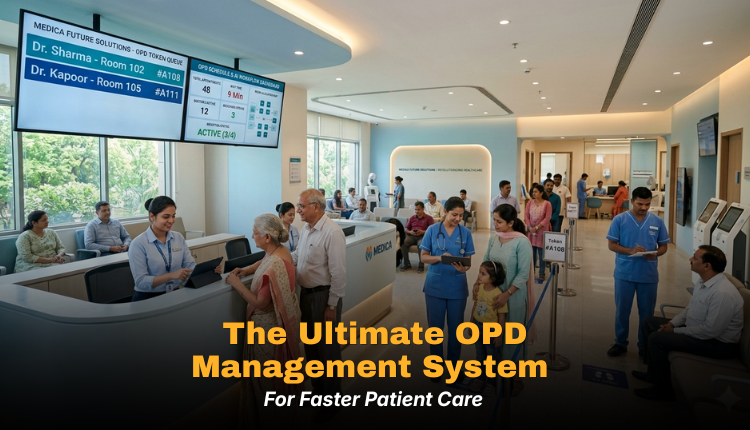
- Queue management
- EMR (Electronic Medical Records)
- Prescription management
- Billing and payments
- Doctor scheduling
- SMS and WhatsApp notifications
- Analytics dashboards
- Follow-up reminders
These systems improve coordination across departments while reducing administrative workload.
Most importantly, they help doctors focus more on patients instead of paperwork.
Common Problems In Traditional OPD Operations
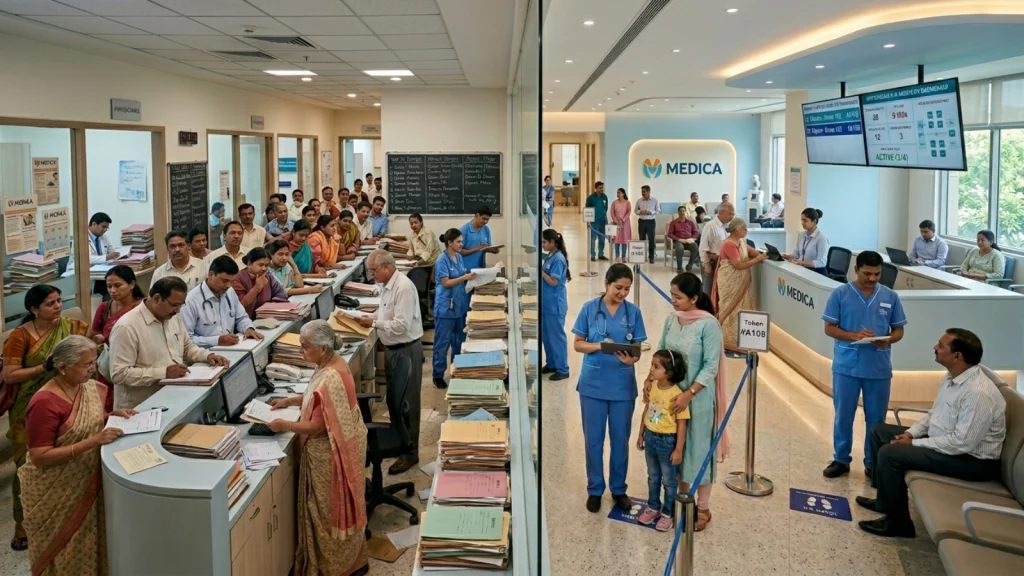
Before understanding the benefits of digital systems, it’s important to recognize the challenges many hospitals still face.
1. Long Waiting Times
One of the biggest patient complaints is excessive waiting.
Patients may spend:
- 20 minutes at registration
- 45 minutes waiting for consultation
- More time at billing or pharmacy
This creates frustration and overcrowding.
A smart opd management system streamlines scheduling and queue handling to reduce unnecessary delays.
2. Manual Registration Errors
Paper-based registration often causes:
- Duplicate patient records
- Incorrect patient details
- Missing files
- Slow retrieval of medical history
This impacts both efficiency and patient safety.
Digital records solve these problems instantly.
3. Poor Queue Management
Traditional token systems are often confusing and unorganized.
Patients have little visibility regarding:
- Their waiting position
- Doctor availability
- Estimated consultation time
Modern queue systems provide real-time updates and better transparency.
4. Revenue Leakage
Many hospitals lose revenue without realizing it.
Patients may:
- Get diagnostics done externally
- Buy medicines outside the hospital
- Skip recommended follow-ups
Without tracking systems, hospitals cannot identify these gaps effectively.
Advanced hospital opd management solutions provide visibility into patient journeys and conversion patterns.
5. Administrative Burden On Staff
Front-desk employees and nurses often spend excessive time on:
- Manual documentation
- Searching patient files
- Updating records
- Managing queues manually
This reduces productivity and increases stress levels.
Automation significantly improves workflow efficiency.
Key Features Of Modern OPD Management Software
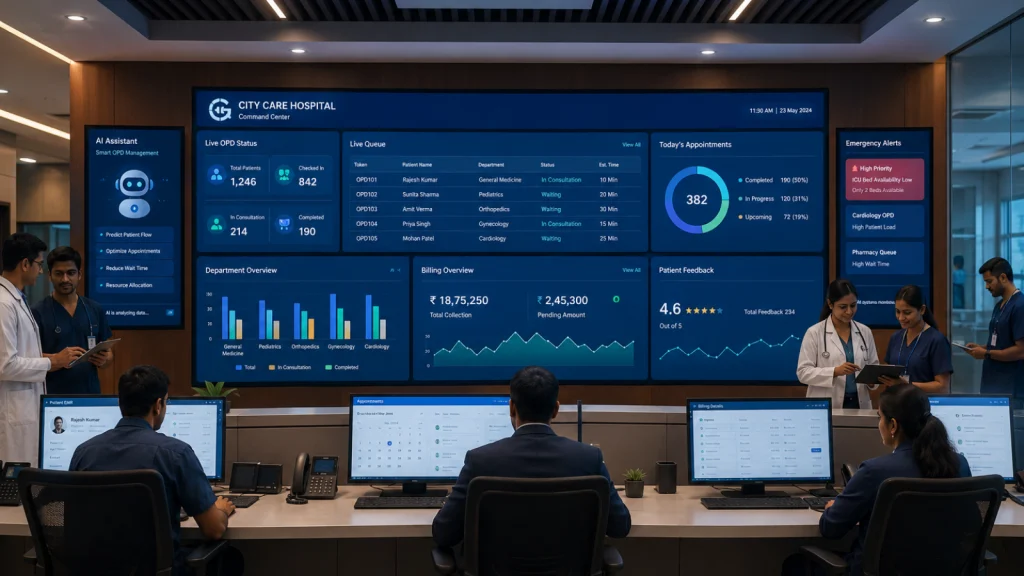
Today’s healthcare technology goes far beyond basic data entry.
Modern opd management software focuses on speed, automation, intelligence, and patient convenience.
Here are the most important features hospitals should look for:
1. Online Appointment Scheduling
Patients can book appointments through:
- Mobile apps
- Websites
- Reception counters
- WhatsApp integration
This reduces crowding and improves scheduling accuracy.
Advanced systems also allow:
- Appointment rescheduling
- Automated confirmations
- Reminder notifications
- Doctor-wise slot booking
As a result, hospitals experience fewer no-shows and smoother patient flow.
2. Smart Queue Management
Queue chaos is one of the biggest operational problems in OPDs.
Modern systems solve this using:
- Token-based queues
- Real-time wait tracking
- Priority handling
- Digital display systems
- SMS alerts
Patients know exactly when their turn is approaching.
This creates a calmer and more organized environment.
3. Electronic Medical Records (EMR)
EMRs centralize patient history digitally.
Doctors can instantly access:
- Previous consultations
- Prescriptions
- Lab reports
- Diagnoses
- Allergies
- Treatment history
This improves diagnosis accuracy and reduces repetitive questioning.
It also saves valuable consultation time.
4. AI-Assisted Prescription Management
Some advanced systems now support:
- Voice-based prescription capture
- Handwriting recognition
- Medication suggestions
- Drug interaction alerts
These tools reduce manual workload while improving prescription accuracy.
Doctors can focus more on clinical interaction rather than typing endlessly.
5. Billing & Payment Automation
Manual billing often creates delays and accounting errors.
A digital opd hospital management system automates:
- Consultation billing
- Pharmacy charges
- Diagnostic payments
- Insurance processing
- Invoice generation
This speeds up transactions and improves revenue tracking.
6. Real-Time Analytics & Reporting
Modern healthcare decisions require data.
Advanced dashboards provide insights into:
- Daily patient footfall
- Peak consultation hours
- Revenue trends
- Doctor performance
- Appointment patterns
- Patient retention rates
This helps administrators make smarter operational decisions.
How OPD Management Improves Patient Care
Technology should never replace human care.
Instead, it should remove operational friction so healthcare professionals can focus more on patients.
That’s exactly what effective opd management achieves.
Faster Consultations
When patient history, prescriptions, and reports are instantly available, doctors spend less time searching for information.
This leads to:
- Faster consultations
- Better decision-making
- Reduced patient waiting
Patients feel more valued and attended to.
Better Communication
Automated reminders improve communication significantly.
Patients receive:
- Appointment confirmations
- Follow-up reminders
- Prescription alerts
- Diagnostic notifications
This improves treatment adherence and reduces missed appointments.
Reduced Stress For Patients
Long queues and confusion create anxiety.
A well-organized OPD experience feels:
- Professional
- Transparent
- Comfortable
- Efficient
Patients trust hospitals that respect their time.
Improved Continuity Of Care
A centralized opd management system ensures every department remains connected.
Doctors, pharmacists, lab technicians, and billing teams can coordinate seamlessly.
This creates smoother patient journeys from consultation to recovery.
The Revenue Benefits Of Smart Hospital OPD Management
Many hospitals focus heavily on increasing admissions.
However, optimizing outpatient workflows often produces faster and more sustainable growth.
Here’s how.
Better Diagnostic Conversions
When systems track diagnostic recommendations properly, hospitals can:
- Reduce patient drop-offs
- Improve follow-up engagement
- Increase in-house diagnostic conversions
This directly impacts revenue growth.
Improved Pharmacy Sales
Integrated prescription and pharmacy systems encourage patients to purchase medicines internally rather than externally.
This reduces revenue leakage significantly.
Higher Patient Retention
Patients prefer hospitals that offer:
- Faster service
- Organized workflows
- Convenient scheduling
- Better communication
Positive experiences encourage repeat visits and referrals.
Increased Operational Efficiency
Automation reduces:
- Administrative workload
- Manual errors
- Staffing pressure
- Resource wastage
Hospitals can serve more patients without increasing operational chaos.
Why Small Hospitals Need OPD Software Too
Many smaller healthcare facilities assume digital transformation is only for large hospitals.
That’s no longer true.
Even small clinics and medium-sized hospitals benefit enormously from lightweight opd management software.
In fact, smaller facilities often gain the most because they operate with limited administrative staff.
Simple digital solutions help:
- Reduce paperwork
- Improve scheduling
- Manage patient records efficiently
- Speed up billing
- Enhance professionalism
Most importantly, they allow healthcare staff to spend more time on patient care rather than administrative tasks.
Choosing The Right OPD Management System
Not every system fits every hospital.
When selecting an opd hospital management system, healthcare providers should focus on practical usability rather than unnecessary complexity.
Important factors include:
Ease Of Use
Doctors and staff should learn the system quickly without extensive technical training.
Scalability
The software should support future expansion as patient volume increases.
Integration Capabilities
The platform should connect smoothly with:
- Laboratory systems
- Pharmacy systems
- Billing software
- EMR platforms
- IPD workflows
Data Security
Patient information must remain secure and compliant with healthcare regulations.
Customization
Hospitals should be able to customize workflows according to their operational needs.
As hospitals continue searching for smarter and more connected healthcare solutions, platforms like MedCore are helping healthcare providers simplify operations, reduce patient wait times, and improve coordination across departments. With AI-powered workflows, real-time OPD management, integrated billing, and patient engagement tools, modern platforms are redefining how hospitals deliver outpatient care in India.
How MedCore Is Simplifying Modern OPD Management
Managing a busy outpatient department requires speed, coordination, and accuracy. Hospitals today need more than basic software, they need a connected platform that can streamline patient flow, billing, communication, and clinical workflows without increasing administrative burden.
This is where MedCore stands out.
Built for modern Indian healthcare facilities, MedCore combines OPD management, billing, pharmacy, laboratory operations, patient engagement, and AI-powered automation into one centralized platform. It helps hospitals reduce delays, improve coordination, and deliver faster patient care through smarter workflows.
Key Features Of MedCore
- Real-Time OPD Queue Management
Manage patient flow efficiently with live token displays, real-time queue tracking, and multi-counter support that help reduce waiting times and improve patient experience. - AI-Powered Clinical Assistance
Features like AI triage in 8 Indian languages, ambient SOAP scribe, and AI radiology drafting help doctors reduce manual documentation and focus more on patient care. - Smart Billing & Financial Automation
Automate GST billing, insurance claims, refunds, UPI payments, and payroll workflows to improve financial accuracy and speed up operations. - Integrated Patient Mobile App
Patients can track live queues, access prescriptions and lab reports, receive reminders, and book appointments directly through the mobile app. - Complete Hospital-Wide Integration
Connect OPD, IPD, pharmacy, laboratory, HR, emergency, and telemedicine workflows through one unified platform for smoother coordination. - Advanced Compliance & Data Security
Stay healthcare-ready with ABDM/ABHA integration, FHIR R4 support, HL7 interoperability, DPDP-compliant data handling, and complete audit trails. - AI-Driven Analytics & Automation
Gain real-time insights into hospital performance with AI-powered KPI dashboards, predictive workflows, and operational analytics. - Multi-Language Support For Indian Healthcare
Support patients and staff more effectively with AI-powered workflows available in multiple Indian languages.
Modern healthcare requires faster workflows, better patient experiences, and smarter hospital operations. MedCore helps hospitals achieve this with intelligent OPD management, AI-powered automation, integrated billing, and seamless hospital-wide coordination.
If your hospital is looking to reduce wait times and improve operational efficiency, MedCore offers a future-ready solution built for modern Indian healthcare.
Book a demo today and explore how MedCore can transform your hospital workflow.
The Future Of OPD Management In India
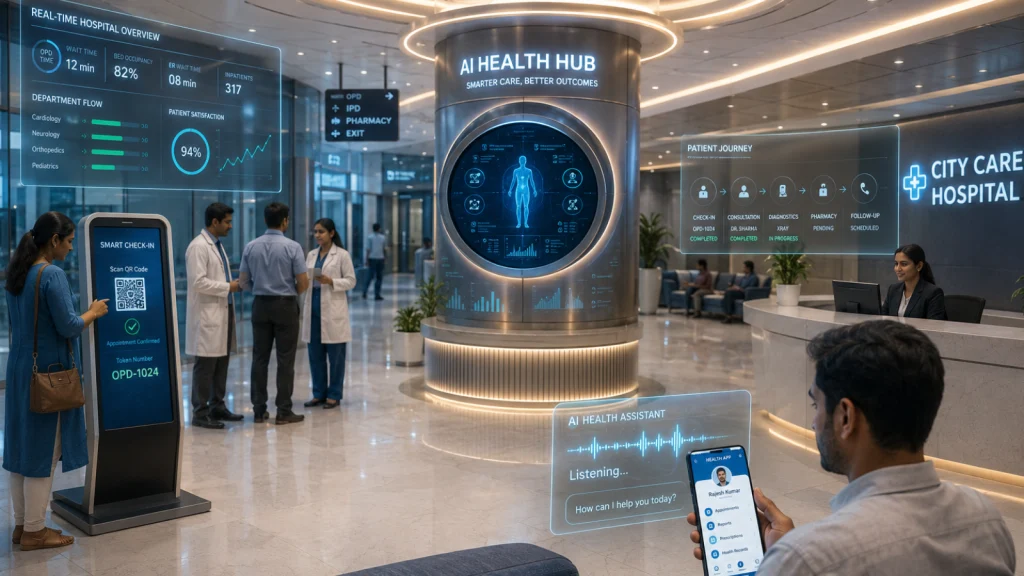
Healthcare expectations are changing rapidly.
Patients now expect:
- Faster appointments
- Digital convenience
- Shorter waiting times
- Transparent communication
- Seamless experiences
Hospitals that continue relying on outdated manual workflows may struggle to compete in the coming years.
The future of hospital opd management will increasingly involve:
- AI-driven workflows
- Predictive scheduling
- Voice-enabled documentation
- Smart analytics
- Mobile-first patient engagement
- Automated patient journeys
The goal is not simply digitization.
The real goal is delivering faster, smarter, and more patient-focused healthcare.
Final Thoughts
The outpatient department is no longer just a consultation area.
It is the operational heartbeat of modern healthcare.
An efficient opd management system improves:
- Patient satisfaction
- Hospital productivity
- Revenue visibility
- Staff efficiency
- Clinical coordination
From smart queues and online appointments to EMRs and automated billing, digital transformation is reshaping outpatient care across India.
Hospitals that invest in intelligent opd management software today will be better prepared for the future of healthcare tomorrow.
Because in modern healthcare, speed, convenience, and patient experience matter just as much as treatment itself.
And the right OPD system makes all three possible.
Frequently Asked Questions: –
1. What is an OPD management system?
An opd management system is software that helps hospitals manage appointments, patient records, billing, queues, prescriptions, and outpatient workflows more efficiently.
2. How does OPD management software reduce patient waiting time?
It streamlines appointments, automates queue handling, provides real-time token tracking, and improves coordination between departments.
3. Why is hospital OPD management important?
Effective hospital opd management improves patient experience, reduces operational delays, increases staff productivity, and helps hospitals manage higher patient volumes smoothly.
4. Can small clinics use OPD management software?
Yes. Modern opd management software is scalable and works well for small clinics, medium-sized hospitals, and large healthcare facilities.
5. What features should an OPD hospital management system include?
A good opd hospital management system should include appointment scheduling, queue management, EMR, billing, analytics, patient communication, and integration with pharmacy and laboratory systems.