If your front desk is still managing appointments through phone calls, paper registers, or a basic spreadsheet, you are not just wasting time; you are actively losing patients. A modern patient scheduling system changes everything: it automates bookings, reduces no-shows, and frees your clinical staff to focus on care rather than coordination. Today’s clinics handle dozens to hundreds of appointments daily, and the pressure on scheduling teams only grows with each passing quarter.
Patients now expect the same instant convenience from their doctor that they get from booking a restaurant or a flight confirmation, reminders, and the ability to self-serve at any hour. In this guide, we walk through what a patient scheduling system actually does, what features separate great platforms from mediocre ones, how to choose confidently, and which solution is worth your attention in 2026.
Listen to this podcast!
What Is a Patient Scheduling System?
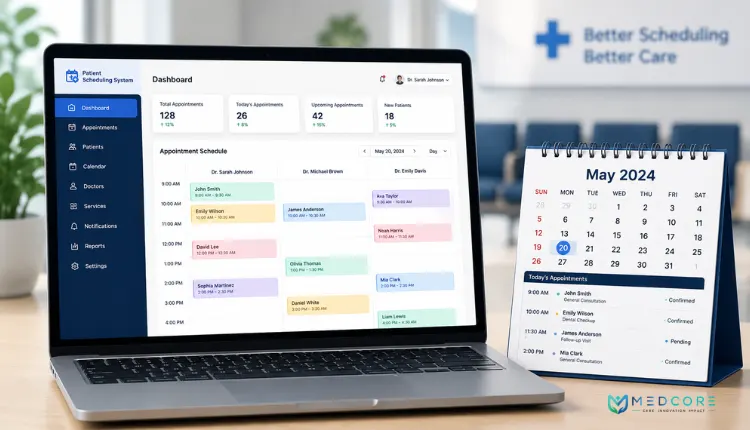
A patient scheduling system is a digital platform that manages the entire appointment lifecycle from booking and confirmation through reminders, queue management, and post-visit follow-up. Unlike manual scheduling, these systems run continuously, accepting bookings across multiple channels, phone, app, website, or WhatsApp- and instantly reflecting real-time availability across all of them. An online patient scheduling system goes further by letting patients initiate and manage appointments through a web portal or mobile app without calling the front desk. This shift matters enormously.
It reduces the administrative burden on reception staff, shortens the time between booking and care, and creates a complete digital record of every appointment that integrates directly with clinical records, pharmacy, billing, and lab workflows. For any clinic handling more than thirty patients a day, this kind of patient scheduling system is the operational backbone that keeps every other workflow running on time and in sequence. When scheduling works well, everything downstream, including prescriptions, billing, and lab orders, works with it.
Why Modern Clinics Cannot Afford to Skip This
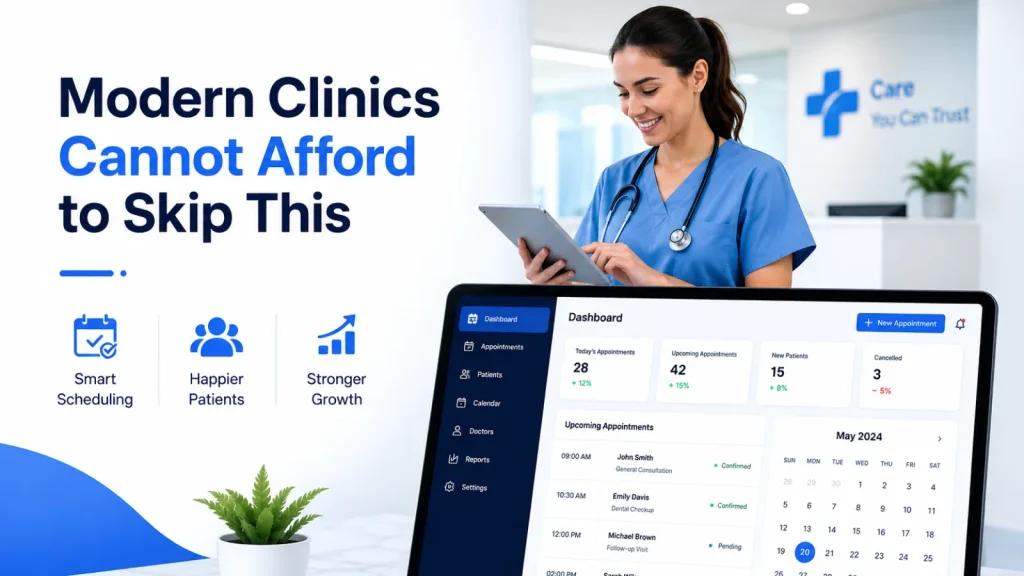
Walk into any busy clinic still running on manual scheduling, and you will find the same frustrations: long wait times, confused patients, missed follow-ups, and a front-desk team overwhelmed by routine calls. These are not people problems; they are system problems. A well-implemented patient scheduling system solves all of them simultaneously. Here is what changes immediately:
- Wait times drop significantly: Real-time queue management and slot optimisation reduce patient waiting from 40+ minutes to under 15 minutes in most implementations
- No-shows decrease: Automated reminders via SMS, WhatsApp, email, and push bring no-show rates down by 30 to 50 percent
- Front desk workload reduces: When patients self-book, cancel, and reschedule digitally, reception staff handle genuine queries instead of routine call volume
- Revenue improves: Fewer missed appointments and more efficient slot utilisation mean more consultations completed daily without adding doctors
Investing in the right scheduling solution is one of the fastest ways to improve both patient satisfaction and clinic profitability at the same time.
Key Features of the Best Patient Scheduling System
Not all scheduling tools are built equally. When evaluating a patient scheduling system, these are the features that separate genuinely useful platforms from ones that create new problems:
- Multi-channel booking: Patients should be able to book via phone, app, web, or WhatsApp, with all channels updating the same real-time schedule
- Automated reminders: SMS, WhatsApp, email, and push notifications sent at configurable intervals before each appointment
- Real-time queue visibility: Staff and patients both see live queue status, token numbers, and estimated wait times without needing to ask
- EHR and billing integration: Scheduling should automatically create or link a patient record and pre-populate billing fields
- No-show prediction: AI-powered scoring flags at-risk appointments so staff can proactively confirm high-risk bookings before the day
- Multilingual support: Essential for clinics serving diverse populations who prefer scheduling in their own language
- Role-based access: Different team members need different visibility into the schedule without compromising patient data privacy
The Power of a Patient Self-Scheduling System
One of the most impactful changes a clinic can make is enabling patients to book their own appointments. It removes the clinic from the middle of the booking process entirely. Patients log in, see real-time doctor availability, choose a slot, confirm, and receive instant acknowledgement all without placing a call or waiting on hold. The impact is measurable and consistent. Clinics implementing self-scheduling report a 40 to 60 percent reduction in inbound booking calls, lower front-desk stress, and higher patient satisfaction scores. It also reduces booking errors. When patients enter their own details and confirm their slot, the miscommunication gap that exists in phone bookings disappears entirely. Self-booking is not a luxury feature for clinics managing thirty or more consultations daily; it is a core operational necessity that pays for itself through reduced call volume and higher slot utilisation within the first month of deployment.
Why an Online Patient Appointment Scheduling System Matters Today
Patients have changed their expectations. They research symptoms online, compare doctors on review platforms, and expect to book appointments the same way they handle every other service, instantly and digitally. This approach meets patients where they already are: online, on their phones, and at times that suit them rather than clinic hours. Instead of your facility being reachable only nine to five, a cloud-based system means a patient can book a Monday morning slot at eleven on a Sunday night and receive confirmation immediately. The result is a consistently fuller appointment book, better patient engagement across the entire care journey, and a clinic that feels modern and trustworthy to new patients, comparing their options.
Strong online booking capability also directly supports patient acquisition, not just operations, transforming your scheduling platform into a growth tool that works while your team is focused on delivering care. For clinics in competitive areas, this advantage grows over time, drawing new patients who already expect to book without a call.
How to Choose the Right Patient Scheduling System
Choosing a patient scheduling system is a long-term decision, so it is worth slowing down before committing. These practical questions will help you evaluate any platform honestly:
Does it integrate with your EHR: A scheduling tool that does not connect with clinical records creates duplicate data entry which defeats the purpose of going digital.
Does it support the channels your patients actually use: If most of your bookings come via WhatsApp, a system without that integration only solves part of the problem.
How does it handle cancellations? The best platforms make cancelling and rescheduling as simple as the original booking with automatic slot release and waitlist management.
Is implementation fast? For busy clinics, weeks-long deployments are impractical. Look for a system that goes live within 48 to 72 hours with built-in onboarding support.
Is it compliance-ready: For Indian clinics, ABDM linking, DPDP Act compliance, and DLT-registered SMS routing are non-negotiable requirements that must come built in.
Clinic Types That Benefit Most from Digital Scheduling
A well-chosen patient scheduling system delivers its highest return where scheduling friction costs the most. Multi-speciality hospitals gain from cross-department coordination and a unified queue across all OPDs. General practices benefit most from self-scheduling and automated reminders that sharply reduce no-shows.
Diagnostic centres need real-time slot allocation tied directly to equipment availability and lab workflows. Paediatric clinics see significant impact from parent-friendly mobile booking and multilingual reminders. Mental health practices, where appointment sensitivity is high, benefit from secure, discreet digital booking with minimal phone interaction.
In all of these settings, replacing manual coordination with a reliable patient scheduling system creates measurable improvements in patient flow, staff morale, and clinic revenue often within the first four to six weeks of going live and without any changes to the clinical team’s workflow. The right patient scheduling system is not a luxury for any of these settings it is a foundational upgrade.
Run Smarter Scheduling with MedCore
MedCore is an AI-native platform for Indian clinics, with a patient scheduling system that connects booking, queue, reminders, billing, and clinical records in one place. Key features:
- 24/7 AI Voice Receptionist books callers into the OPD queue, even outside clinic hours
- Live OPD Queue real-time token display for every counter, visible to staff and patients
- Patient app live token tracking, appointment booking, and lab report access
- Online self-bookin patients book at medcore.globusdemos.com/book with instant confirmation
- Outbound Follow-up Agent AI voice and WhatsApp follow-ups that turn enquiries into booked slots
- Automated reminders WhatsApp, SMS, email, and push, configurable per appointment type
- No-show predictions ML scoring flags high-risk appointments before the day begins
- 8 Indian-language multilingual support across triage, booking, and patient communications
Book a free demo at medcore.globusdemos.com.
Tips for a Smooth Implementation
Switching to a new scheduling platform is straightforward when you approach it in the right order. Start by exporting a clean patient data file from your current system before going live; this gives you a verified baseline and makes data migration faster. Set up doctor schedules, slot durations, and break times at least one week before launch so staff can navigate the system confidently before patients arrive. Run a soft launch with a reduced patient load for two days before opening full booking capacity. Train front-desk staff on exception handling: how to manage same-day walk-ins alongside pre-booked slots, and what to do when patients call despite having online booking access.
Configure your reminder cadence before go-live rather than adjusting it post-launch. Early configuration means your first patients immediately experience the system working well, which builds confidence and reduces cancellations from the start. A well-configured patient scheduling system sets the tone for every patient interaction that follows.
Conclusion
A reliable patient scheduling system is one of the highest-impact investments a modern clinic can make. It reduces wait times, cuts no-shows, eases front-desk pressure, and delivers the kind of smooth booking experience that keeps patients returning and referring friends and family. Whether you run a single-doctor practice or a multi-speciality hospital, the right system pays for itself quickly and continues compounding returns every month.
FAQ
Q: How long does it take to implement a patient scheduling system?
Most modern cloud-based platforms go live within 48 to 72 hours. Full staff training takes one to two days.
Q: Can patients book appointments outside clinic hours?
Yes. With online booking and an AI voice receptionist like MedCore’s, the booking channel stays open 24 hours a day, 7 days a week.
Q: Will it work alongside my existing EHR?
Most platforms offer EHR integration. MedCore includes an integrated EHR so scheduling and clinical records are always synchronised.
Q: Is it right for a small clinic?
Yes, it scales from a single-doctor practice to a 150-bed hospital without any changes to the underlying platform.