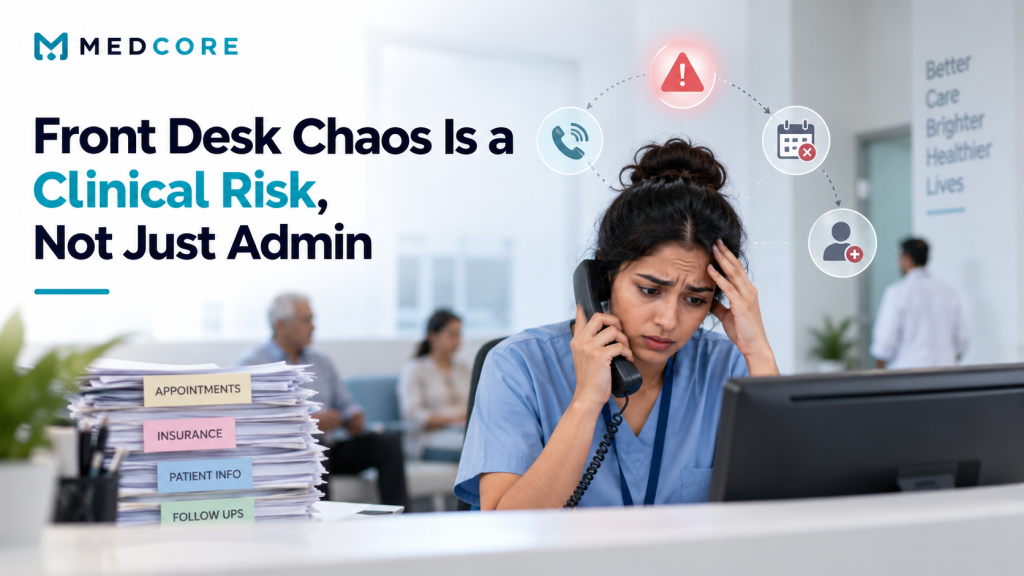
Twenty-nine percent of medical groups reported higher staff turnover in 2026 than the year before, according to the latest MGMA Stat poll. Most clinic owners read that and think: hiring problem. I read it and think: patient safety problem.
The framing matters. When your front desk turns over, the first thing that breaks isn’t morale or culture. It’s the patient intake chain the 90-second window between a caller describing symptoms and someone deciding how urgently they need to be seen. A new receptionist who hasn’t learned your triage logic doesn’t just slow things down. She routes a chest-pain patient into next Tuesday’s general slot because it “didn’t sound like an emergency.” That is a clinical error dressed in administrative clothing.
The Failure Cascade Nobody Draws on a Whiteboard
Most clinics think about front-desk breakdowns as discrete inconveniences: a missed call here, a double-booked slot there. The actual failure cascade is compounding.
A new enquiry calls at 11:40 a.m. The receptionist is managing the walk-in queue. The call goes unanswered. The patient doesn’t call back they move on to the next number on Google. Over 70% of global healthcare C-suite executives cited efficiency as a top organisational priority for 2025; patients are running the same mental arithmetic every time they hit a dead end. The enquiry evaporates. Nobody logged it. The no-show rate for the week looks flat because the appointment was never made. The revenue impact is invisible. That’s the version of the story clinics tell themselves.
The version patients experience: a worrying symptom went unaddressed for four days because the first call went nowhere and the energy to try again ran out.
Where Automation Actually Belongs in This Chain
There is a lot of vendor noise around “AI receptionists” that overpromises and underdelivers. Automation earns its place in two specific zones: moments where the cost of a missed human touchpoint is high and the task itself is repeatable. Outside those zones, a human is still better.
The first zone is the inbound call. MedCore‘s AI Voice Receptionist qualifies callers and books them directly into the live OPD queue or, when the situation needs a person, hands off to reception with the full call transcript already waiting. That last part is underrated. The hand-off problem in most “AI receptionist” products is that the human who takes over has no context. They ask the patient to repeat everything. The patient is already frustrated. The transcript-first hand-off eliminates that rework entirely.
The second zone is the follow-up gap. Between a first enquiry and a confirmed appointment, most clinics do nothing systematic. If the receptionist remembers, she calls back. If she’s busy or if she left last week the enquiry dies. MedCore’s Outbound Follow-up Agent contacts new enquiries via voice and WhatsApp until they book, then bridges to reception. That kind of persistence is something a human team simply cannot sustain at scale without burning out.
The Triage Layer Most People Skip
Booking the patient is only half the problem. The other half is routing them correctly once they arrive.
India’s healthcare context makes this harder than it sounds. A patient describing symptoms in Kannada at a primarily English-language clinic creates a real information gap at triage. Not because the receptionist is incompetent. Real-time translation with clinical precision is a different skill set entirely from front-desk coordination. MedCore’s Triage Agent handles symptom triage in 8 Indian languages and routes based on SNOMED-anchored clinical logic. The routing decision is standardised regardless of which language the patient speaks or which staff member is on duty that day.
That consistency is the point. A high-turnover front desk produces inconsistent triage. Automated, protocol-anchored triage produces the same routing output whether it’s Monday with a seasoned team or Friday with two new hires.
The Live Queue Problem Most HMS Products Ignore
Once a patient is booked and triaged, they wait. In Indian outpatient settings, the waiting room is where trust is built or destroyed.
A patient who can see their live token on a phone app with a real estimated wait time behaves differently from one sitting in the dark. They don’t crowd the front desk asking for updates. The receptionist’s cognitive load drops. The queue moves faster because it’s not being interrupted every three minutes by status questions. MedCore’s live OPD queue pushes real-time token updates to the branded patient app, with Socket.IO keeping the display current without manual refresh. The queue also flags vulnerable patients an elderly patient who’s been waiting past a threshold, for instance so staff aren’t relying on passive observation to catch someone who needs attention.
This is the kind of feature that sounds minor until you’ve watched a 78-year-old sit silently for 90 minutes because she didn’t want to bother anyone.
What Automation Cannot Replace (Take This Seriously)
The research on ambient scribes offers a useful parallel. A 2026 study published in npj Digital Medicine tracked 535 patient consultations across GPs using an ambient scribe tool. Documentation time fell but the authors explicitly noted that new challenges were introduced. A separate study of 12 GPs across 271 consultations found the same tension: workload down, new failure modes up, human oversight still required. It’s the same dynamic we describe for AI medical scribes the technology handles capture and structure; the clinician handles judgement.
The pattern holds for front-desk automation. Inbound call handling, follow-up sequencing, queue management these automate well. Nuanced de-escalation with an anxious patient, judgement calls about whether a walk-in with vague complaints needs flagging immediately, the relational tissue of a long-term patient relationship those don’t. Clinics that automate everything and cut headcount accordingly often discover that the human moments they eliminated were the ones patients were actually paying attention to.
The right staffing model isn’t fewer humans. It’s humans freed from repeatable tasks so they can be fully present for the ones that matter.
A Framework for Auditing Your Intake Chain
If you’re deciding where to start, here is the diagnostic I’d run at any clinic:
- Track missed inbound calls for two weeks. Not just voicemails calls that rang and disconnected. That number is your baseline patient leakage rate from the top of the funnel.
- Map what happens to new enquiries after first contact. Is there a defined follow-up sequence? Who owns it? What happens when that person is out?
- Audit your triage consistency. Pull five recent cases where routing was unclear and ask: would a different receptionist have made the same call? If the answer is no, you have a protocol gap, not a staffing gap.
- Count front-desk interruptions per hour during peak OPD. Most are queue-status questions the exact type a patient app eliminates entirely.
The answers will tell you where automation earns its cost and where you’re better off investing in training and protocol.
The Handoff Is the Most Important Moment in the Whole Chain
One point that rarely gets enough attention: the moment AI hands off to a human is the highest-risk moment in any automated intake workflow. A clumsy hand-off one where the human starts the conversation from scratch wipes out every efficiency gain upstream in patient frustration.
MedCore’s Agent Console gives the receiving staff member a unified escalation screen with the full conversation transcript and one-click hand-off. The patient doesn’t re-explain. The staff member doesn’t apologise for not knowing the history. The transition is invisible to the patient, which is exactly what it should be. For clinics evaluating any automation platform, this is the feature to test hardest. Not the AI demo. The handoff.
India’s healthcare market approximately $200 billion, with around 80% of facilities still running on fragmented manual workflows has no shortage of HMS vendors promising transformation. The ones worth taking seriously are built around the operational details: the transcript that travels with the call, the triage that holds in eight languages, the queue that talks to the patient’s phone. Those details are where the clinical risk actually lives.
If your front desk is your single point of failure for patient intake, the fix isn’t another hire. It’s rearchitecting the chain. MedCore’s 45 modules were built after a beta with hospitals across Karnataka and Tamil Nadu. They were designed for this gap specifically: the mid-size clinic that can’t afford a corporate HMS but also can’t afford what fragmented workflows actually cost. Start your free 14-day MedCore trial and run your own intake audit with a system built for how Indian clinics actually operate.