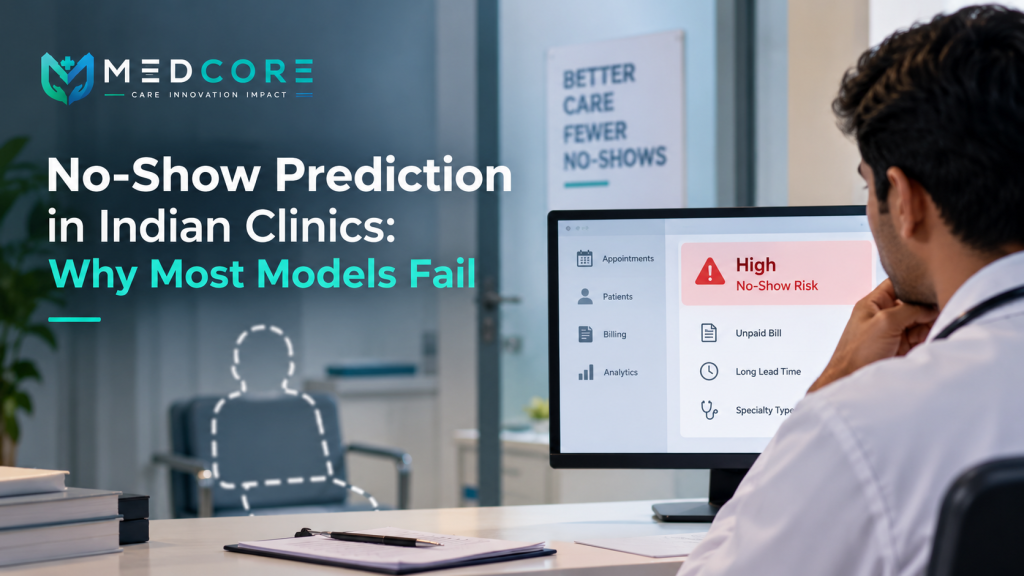
Forty-six percent of providers see no-show risk jump when a patient carries an unpaid bill and most clinic software has no idea that bill even exists by the time the appointment reminder fires. That single data gap is why most no-show prediction tools under-perform in practice, even when the underlying model is solid.
The problem is more specific than “our reminders aren’t working.” The research is clear: no-show risk is measurable and predictable, but only when billing history, speciality type, and appointment lead time are visible to the same system doing the predicting. In specialities like Cardiology, Otolaryngology, and Pulmonology, prediction performance can fall below an AUC of 0.7 worse than a coin flip for the trickiest patient segments precisely because those departments tend to operate with the longest lead times and the most disconnected scheduling and billing stacks.
That is not a model problem. That is a data problem.
The Fragmentation Tax Every Clinic Pays
MedCore was built inside a 40-bed hospital in Bangalore, which means the team watched this play out in the real world before writing a line of product code. The pattern is consistent: 80% of facilities run on fragmented workflows that force staff to re-enter the same data across separate tools. Appointment data lives in one place. Billing history lives in another. Clinical notes if they exist at all are in a third system, or in a paper file somewhere.
A no-show prediction model that only sees the appointment slot and the patient’s phone number is flying half-blind. Institutions with siloed EHR systems, scheduling platforms, and communication tools find it extremely difficult to integrate predictive models because the inputs those models need are scattered across systems that don’t talk to each other. You can buy the best ML model available and it will still underperform because it’s working with an incomplete picture.
The result is a clinic that sends the same SMS to the 22-year-old with a clean payment history as it does to the patient who owes three months of bills and last cancelled 48 hours out. Both get one reminder. Neither gets a phone call. And then someone stares at the day’s no-show rate and wonders why the software isn’t helping.
What Good Risk Scoring Actually Requires
The ML literature on no-show prediction is consistent about which features matter most: prior no-show history, appointment lead time, specialty, payment history, and in certain populations distance from the facility and time of day. At least three of those five features live outside the scheduling module in most HMS setups.
This is where the architecture of your platform matters more than the sophistication of the model. If your scheduling tool can’t see billing status, it can’t weight unpaid-bill risk. If your OPD queue system doesn’t log no-show history in a format the prediction layer can consume, you’re scoring on demographic proxies instead of actual patient behaviour. That’s how you end up with specialty-level AUC scores below 0.7.
The imaging and diagnostics context makes this even sharper. MGMA research recommends a day-before “readiness check” for high-lead-time modalities like MRI, combined with risk-based micro-overbooking. That readiness check is only useful if the person making the call knows whether the patient fasted correctly and whether they’ve cancelled before. Whether it’s a human or an automated agent placing that call, none of that context lives in the appointment slot.
The Unified-Data Approach: What It Changes
MedCore’s Predictions Agent scores no-show risk as part of the same system that manages the OPD queue, holds the patient billing record, and logs clinical history. The scoring isn’t a bolt-on it runs against data that already exists in the platform because the platform was built as one thing, not assembled from integrations.
That matters operationally in a specific way. When a patient’s risk score crosses a threshold, the Live OPD queue which uses Socket.IO for real-time updates can flag that appointment for front-desk attention before the day even starts. Staff can see vulnerability flags alongside token assignments. The Outbound Follow-up Agent can be triggered to contact the patient via voice or WhatsApp rather than a passive SMS. The intervention is matched to the risk level, not applied uniformly.
The same Predictions Agent also runs pharmacy demand forecasting. This matters because no-shows and pharmacy demand are linked: when no-show rates spike unexpectedly, it creates downstream ripple effects in prescription fulfilment and inventory planning. A system that only predicts no-shows in isolation misses that connection.
A Practical Framework for Clinic Administrators
Here is how I’d approach this if I were evaluating whether a platform’s no-show tooling is real or cosmetic:
- Ask where the input data comes from. If the answer is “just the appointment record,” the model is severely limited. You need billing history, prior attendance, and specialty context feeding the score.
- Ask what happens when risk is flagged. A score that surfaces in a report the next morning is nearly useless. The flag needs to trigger an outreach action ideally automated before the appointment window closes.
- Check specialty-level performance separately. Aggregate no-show rates hide the specialties where prediction fails worst. Cardiology and high-lead-time modalities are where the gap between a good model and a mediocre one is most expensive.
- Look at whether readiness checks are operationalized. For imaging appointments, a day-before contact with prep instructions is standard best practice in the research. If your system doesn’t support that workflow natively, you’re adding manual steps that staff will eventually stop doing.
- Verify the data doesn’t have to be re-entered. Physicians already lose minutes per consult re-keying data across tools, compounding across 150-plus OPD patients per day. If building the data set for risk scoring requires manual work, it won’t stay current.
The Cost of Getting This Wrong
A 40-minute OPD wait time is not a staffing problem. Dr. Meera Rao, Medical Director at Asha Hospital, described how switching to a live token display and shared-state EHR dropped OPD wait time from 40 minutes to 12 minutes. That improvement came from information flowing to the right people at the right time not from hiring more staff or buying a standalone queue tool.
No-show prediction works the same way. The model isn’t the hard part. The hard part is making sure it sees everything it needs, and that the output triggers the right human or automated action fast enough to matter. That requires the scheduling, billing, clinical, and communications layers to share state which is exactly what choosing an integrated clinical documentation and EHR platform is designed to solve.
MedCore’s own market research puts India’s hospital and healthcare sector at approximately $200 billion, with 75% of the market still underserved by tech built for corporate hospitals. The mid-size clinics and 10-to-30-bed hospitals that form the backbone of primary and secondary care in Karnataka, Tamil Nadu, and across the country are running on tools that were not built with their workflows in mind. No-show prediction is a clear example of where that mismatch costs money every day. The empty chair at 11:15 wasn’t inevitable it just required the billing flag and the appointment slot to talk to each other, and they never did.
That is a solvable problem. It requires the right architecture, not a better reminder template.
Start your free 14-day MedCore trial and see how unified no-show scoring, live queue management, and automated outreach work together in a single platform built for Indian clinics and hospitals.