Twenty-seven percent of medical practices saw patient no-show rates rise in 2025, according to an August 2025 MGMA Stat poll of 265 practices. Most of those clinics already send appointment reminders. The reminders are not the problem. They send the same reminder to everyone. The reliable patient who hasn’t missed an appointment in four years gets the same nudge as the high-risk patient who booked impulsively on a Tuesday and has already rescheduled twice.
Treating every booked slot as equally likely to fill is the most expensive assumption in outpatient operations. It shapes staffing, overbooking decisions, and quietly bleeds revenue every single day.
The Reminder Trap
The standard playbook SMS the day before, call the morning of does move the number. Practices that layer automated two-way reminders with clear no-show policies can dramatically cut rates; Atlas Medical Centre, a Curogram client, dropped from 14.2% to 4.91% in three months. That is a real improvement worth pursuing.
But there is a ceiling. Once your reminder stack is in place, you are still sending the same message to every patient. You have no way of knowing which appointments are genuinely at risk and which are solid. So you overbook to compensate and then the low-risk patients all show up at once and your OPD is chaos. Or you under-book to protect quality, and you leave slots empty that a walk-in could have filled.
The fix is not a better reminder. It is knowing, before you send anything, which patients need active intervention and which don’t.
What No-Show Scoring Actually Does
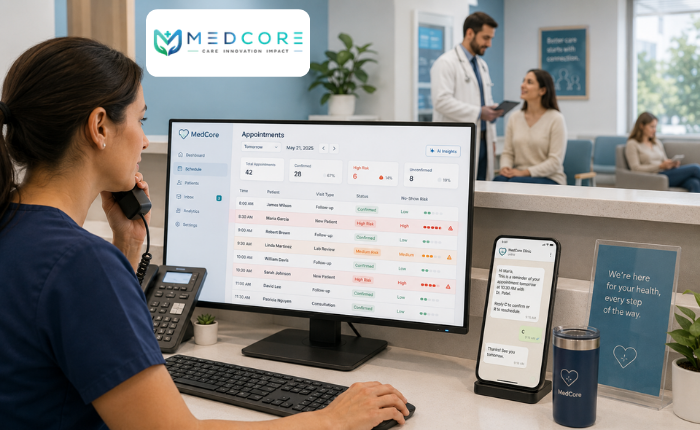
No-show prediction scores each upcoming appointment on its likelihood of being missed. The score draws on appointment history, booking lead time, the channel the patient used to book, time of day, day of week, and other signals baked into the patient’s record. The output is a ranked list of at-risk slots before the day starts not a list of patients who already didn’t come.
That distinction matters more than it sounds. A reminder is reactive: it nudges someone who may or may not have been planning to skip. A no-show score is operational intelligence: it tells your reception team where to focus, which slots to protect with a waitlist, and which patients to contact personally rather than via automated message.
MedCore‘s Predictions Agent builds this scoring into the daily workflow without requiring a separate analytics tool or manual export. No-show risk is surfaced alongside the appointment list not buried in a report that no one opens at 8 AM.
The Workflow That Changes the Number
Prediction is only useful if it triggers a different action. Here is how the logic flows in practice.
Step 1: Score runs the night before
The Predictions Agent processes the next day’s appointments and flags high-risk slots. Reception staff see these when they open the OPD queue the next morning not after the appointment was missed.
Step 2: High-risk slots get active outreach, not just a reminder
This is where the AI-driven scheduling workflow changes what’s possible. MedCore’s Outbound Follow-up Agent contacts flagged patients via WhatsApp and voice, following up until the patient confirms, with a capped attempt limit and quiet-hours awareness built in so you are not harassing people at 11 PM. If the patient is unreachable or declines, the slot is flagged as genuinely at risk so reception can offer it to a wait-listed patient or walk-in.
Step 3: The OPD queue reflects reality
MedCore’s Live OPD queue updates in real time via Socket.IO. When a high-risk appointment is confirmed, the queue updates. When a slot looks shaky, reception can act on that information before the doctor is left waiting. The queue also carries vulnerability flags so patients who may need extra support at check-in are visible before they arrive, not after they’ve caused a bottleneck at the front desk.
Step 4: The AI Voice Receptionist handles inbound confirmations
Many patients call back to confirm, reschedule, or cancel after receiving outreach. MedCore’s AI Voice Receptionist answers the line 24/7, qualifies the caller, and either confirms the booking directly into the OPD queue or hands off to a human with the full call transcript. Staff are not tied up fielding confirmation calls. They are handling the exceptions.
What Commonly Goes Wrong
Three mistakes I see clinics make when they try to act on no-show prediction data.
Using the score to punish, not to help. Some practices see a high no-show score and immediately flag the patient as a problem. That misreads what the score means. A patient with a high predicted no-show rate may be dealing with transport barriers, work shift conflicts, or health anxiety. The score tells you to reach out differently not to de-prioritise that patient’s care.
Overbooking into the high-risk slots. If you know a slot is at risk, the temptation is to double-book it. Resist this. Double-booking works until both patients show up, and then you have created a worse problem than an empty slot. Better to fill from a wait-list a named patient who wants the appointment than to hedge with a double.
Ignoring the Predictions Agent on high-volume days. Multi-speciality hospitals running 150+ OPD patients per day across departments are exactly where predictive scoring pays off most. It is also exactly where staff are most likely to skip the list because they are already overwhelmed. Building a short daily review of flagged appointments into the morning huddle five minutes, not fifty is the habit that makes prediction actually reduce no-shows rather than just measure them.
The Broader Operations Picture
No-show prediction does not sit in isolation. MedCore names predictive operations including no-show forecasting as one of five deployed AI use cases alongside staffing and inventory planning. A no-show rarely stays contained. The missed appointment ripples outward into a pharmacy that ordered based on expected dispensing volume, a pre-allocated lab slot, a doctor whose schedule now has an awkward gap mid-morning.
The Predictions Agent also includes a pharmacy demand forecast. When no-show prediction runs alongside demand forecasting, you are not just protecting revenue on a single appointment you are smoothing the operational knock-on effects that a surprise empty slot creates further down the day.
India’s healthcare market is approximately $200 billion, with roughly 80% of facilities still running on fragmented workflows. For most clinics and mid-size hospitals, that fragmentation means no-show data lives in one place, reminder logs in another, and OPD scheduling in a third. No one is connecting the signal to the action. A unified platform changes the equation not by doing something exotic, but by making information available to the people who need it before the slot is already lost.
A Framework You Can Apply This Week
- Audit your current reminder stack. Are reminders going to everyone equally? If yes, you are spending effort on low-risk appointments that don’t need it.
- Identify your highest no-show categories. New patients? Long lead-time bookings? Specific time slots? Even a manual review of last month’s missed appointments will show patterns.
- Build a wait-list habit. Prediction only reduces revenue loss if you have someone to fill the slot. A lightweight wait-list even a WhatsApp group the front desk manages is the minimum viable version.
- Route confirmations away from staff. If reception is spending time on inbound confirmation calls, that time is coming from somewhere. An AI receptionist that handles those calls and books directly into the queue frees the team to act on the actual at-risk slots.
- Review flagged appointments as a morning ritual, not an afterthought. Five minutes before the first patient arrives. That is the cadence that makes prediction operational rather than decorative.
The MGMA data is useful context here. The 60% of practices that held steady on no-show rates in 2025 are not all running sophisticated prediction models most have solid reminder workflows and consistent policies. But the 27% seeing rates climb are almost certainly still applying the blanket approach to a patient population that has changed. Booking behaviour shifted post-pandemic. Lead times shifted. Reliable reminders alone are no longer enough for a meaningful share of the market.
Prediction does not replace reminders. It tells you where to aim them.
MedCore was built inside a 40-bed hospital in Bangalore and shaped by 45 modules shipped after a beta with doctors, nurses, and administrators across 12 hospitals in Karnataka and Tamil Nadu. The no-show problem was visible from day one. The Predictions Agent reflects what actually happens in a busy OPD not what looks good in a product demo.
If your no-show rate is not moving despite a solid reminder stack, the next lever is prediction. MedCore’s 14-day free trial is the lowest-friction way to see whether the Predictions Agent surfaces patterns your current setup is missing.
Start your free MedCore trial and put no-show prediction to work in your OPD queue.