

80% of Indian healthcare facilities still run on fragmented workflows (Source: MedCore Stats 2026), which is why ai radiology, lab, pharmacy, and blood bank management matters now. For a 1–5 doctor clinic, the fastest path to relief is to connect lab orders, pharmacy stock, and billing on one patient record, then train your team for two to three days. This guide shows you exactly how to do ai radiology, lab, pharmacy, and blood bank management in 2026, no fluff, only what works.
You will see the phrase ai radiology, lab, pharmacy, and blood bank management here because many modern systems bundle these modules. You do not need to buy all of them on day one. Start with lab orders, reports, and pharmacy stock tied to GST billing and UPI receipts. Then add ABDM/ABHA linking and drug-safety checks. Finally, expand to imaging or blood bank only if your clinic actually offers those services as part of ai radiology, lab, pharmacy, and blood bank management.
For clinics that see 50–150 OPD patients a day with 2–4 staff members, minutes matter. Small errors lead to delays, angry patients, and expired stock losses. The steps below help you fix handovers between doctor, lab tech, and pharmacist first within ai radiology, lab, pharmacy, and blood bank management. Then you add alerts and audits that protect revenue and patient safety.
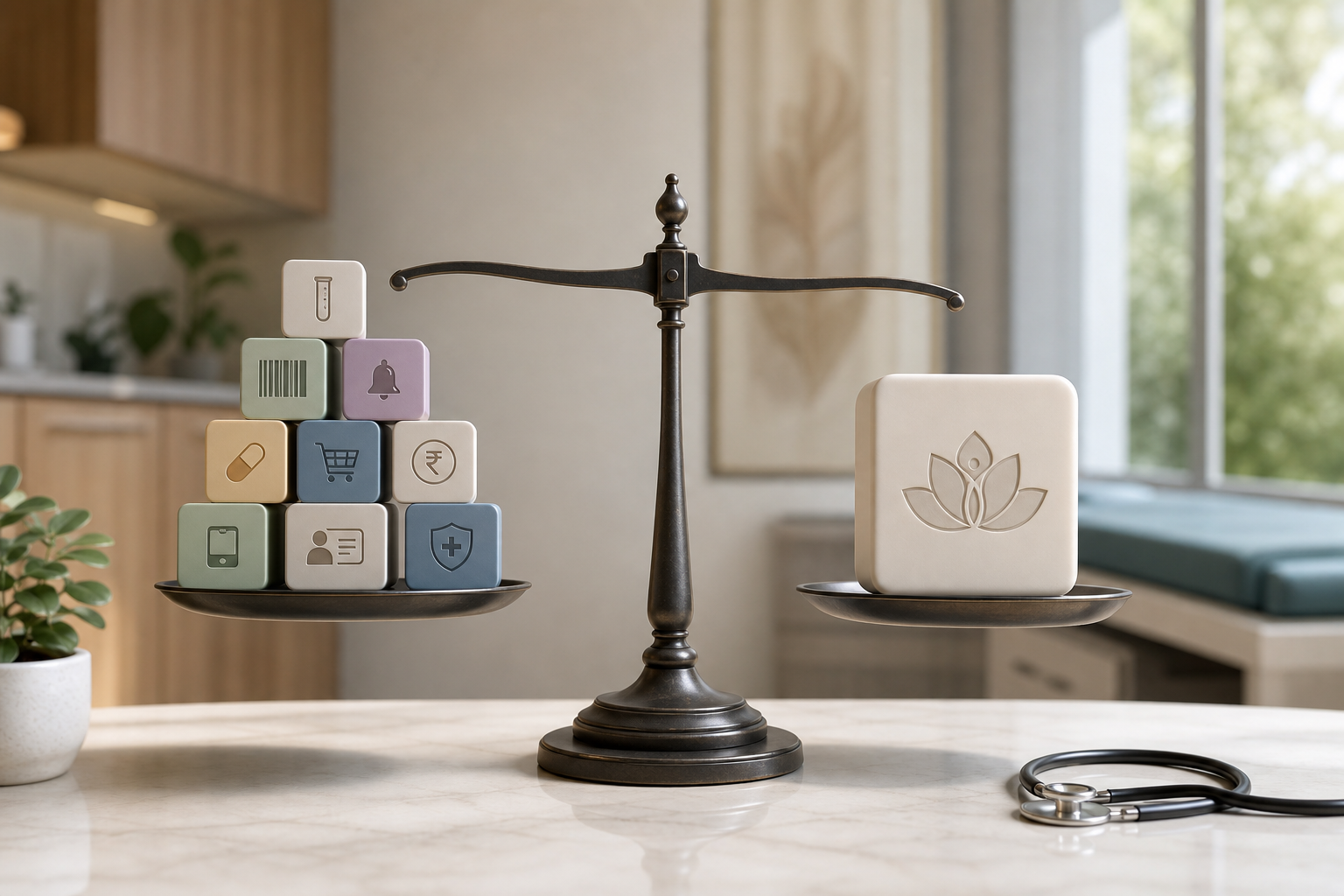
Why ai radiology, lab, pharmacy, and blood bank management Is the Bottleneck Most Small Clinics Ignore
Handwritten registers without ai radiology, lab, pharmacy, and blood bank management. Doctor scribbles a test on paper, the lab tech re-enters it, and the pharmacist re-enters the prescription again for billing. As a result, you burn time and lose money. Per MedCore Stats 2026, 80% of facilities run on fragmented workflows and 75% of the market is underserved by existing tech. If you see 150+ OPD in a day, that friction shows up as long queues and missed follow-ups in ai radiology, lab, pharmacy, and blood bank management.
In real clinics, the same two to four people juggle blood collection, analyzer runs, report prints, pharmacist dispensing, and GST invoicing. Meanwhile, a patient calls on WhatsApp to ask, “Is my report ready?” The lab flips pages to check. The pharmacist later finds a batch that expired last month. No one meant harm. The system made it easy to miss.
Moreover, duplicate data entry in ai radiology, lab, pharmacy, and blood bank management causes mismatched patient IDs. Therefore, bills and lab reports may not align. You chase corrections after hours. Patients lose trust when a report is delayed or a drug is out of stock. You lose ₹ because expired stock sits on the shelf and insurance claims get raised with errors.
Specifically, “lab and pharmacy management” for a small clinic means these jobs get done without re-entry:
- Lab: order capture, barcode/sample tracking, delta-flag alerts, report sign-off, and DLT/WhatsApp notifications.
- Pharmacy: QR-scan from the digital prescription, batch/expiry tracking, controlled drug logs (Schedule H/H1), and GST/UPI billing from the same record.
“We replaced three tools with MedCore. Billing, pharmacy and lab now talk to each other without exports.” — Ravi Prasad, Administrator, Sunrise Clinic
What this unlocks in practice
- One patient record from doctor to lab to pharmacy to bill.
- Fewer mistakes, faster queues, and less expired stock risk.
- Clear audit trails for inspections and peace of mind for you.
Also Read!
How to Set Up WhatsApp Patient Reminders for Mid-Size Hospitals
MedCore vs Practo for Mid-Size Hospitals: Which Is Better for Patient Engagement WhatsApp Reminders?
Step-by-Step: Setting Up Integrated ai radiology, lab, pharmacy, and blood bank management Workflows
Here is a clear 8-step framework you can finish this month. It is shaped by dozens of small Indian clinics that went live in days, not months. It touches ai radiology, lab, pharmacy, and blood bank management only where helpful, and keeps your team’s time in mind.
- Step 1: Audit your current workflow
Walk the path end-to-end. Map doctor → lab tech → analyzer → report → patient. Then map doctor → prescription → pharmacist → dispense → billing. Mark where re-entry happens, where you lose time, and where errors occur. - Step 2: Define must-have modules
List non-negotiables for ai radiology, lab, pharmacy, and blood bank management: lab orders, sample tracking with barcodes, delta-flag alerts, report templates, pharmacy inventory with batch/expiry, controlled substance logs, and GST-compliant invoices. Add UPI and Razorpay links on bills. Note ABDM/ABHA and DLT SMS/WhatsApp alerts as “phase one” too. - Step 3: Standalone tools vs.
- Standalone: a LIMS for lab + a separate pharmacy POS can be cheaper up front. However, you will re-enter patient data and risk ID mismatches.
- Integrated: one EHR where lab, pharmacy, and billing share the same patient — ideal for ai radiology, lab, pharmacy, and blood bank management. You get a single tenant-scoped EHR with shared state, GST-aware invoicing, and fewer handoffs. Pick based on your OPD volume and staff capacity for ai radiology, lab, pharmacy, and blood bank management.
- Step 4: Ensure ABDM/ABHA readiness
ABDM/ABHA linking helps patients carry records between facilities and future-proofs you. Ask for FHIR R4 and HL7 v2 support so your reports and prescriptions can exchange with national rails. Read the Ayushman Bharat Digital Mission overview from the National Health Authority: ABDM. Government of India. - Step 5: Set up digital prescriptions with QR
Doctors e-prescribe. The pharmacy scans the QR to load the order. No re-entry, fewer errors, faster billing. Patients can store the QR in a mobile app and share it on WhatsApp when needed. - Step 6: Add drug-safety checks and interactions
Turn on alerts for allergies, duplicate therapy, and key interactions. AI agents for drug-safety checks are now standard in newer platforms. Train your pharmacist to review and document overrides. - Step 7: Configure inventory rules
Set reorder points per drug and per vendor. Enable expiry alerts by batch at least 90 days before date. This step alone can save ₹15,000–50,000/year in a small clinic. - Step 8: Train your staff for 2–3 days
Focus on daily workflows, not every feature. Practice 10 real cases end-to-end: order a CBC, sign the report, send a WhatsApp alert, scan a QR prescription, and issue a GST bill with UPI. Keep cheat sheets at the counter.
 , doctor issues e-prescription with QR, pharmacy scans QR, checks interactions, dispenses with batch/expiry, GST invoice with UPI)
“Our OPD wait time dropped from 40 minutes to 12. The live token display alone was worth the switch.” — Dr. Meera Rao, Medical Director, Asha Hospital
A note on privacy and data
Pick an ai radiology, lab, pharmacy, and blood bank management tool that states DPDP Act 2023 compliance and India data residency. Confirm role-based access, audit trail, and export policies before go-live.
5 Mistakes Small Indian Clinics Make With ai radiology, lab, pharmacy, and blood bank management Systems
Small clinics do not have the time or budget to fix the same mistake twice. Use this list to avoid the common traps. It also touches ai radiology, lab, pharmacy, and blood bank management so you can plan add-ons later without rework.
- Mistake 1: Buying separate lab and pharmacy tools that do not sync
Fix: Choose an integrated record or confirm a tested LIMS–POS bridge before you pay. - Mistake 2: Ignoring GST rules in billing
Fix: Use GST-aware invoicing and, if you accept insurance, tools with claim management to reduce filing pain. - Mistake 3: Skipping controlled drug logs (Schedule H/H1)
Fix: Turn on controlled substance tracking and keep daily dispense registers with batch and patient ID. - Mistake 4: No expiry and reorder alerts
Fix: Set batch-level alerts and minimum stock rules. This saves ₹15,000–50,000/year in expired stock loss. - Mistake 5: Over-buying big-hospital software
Fix: Start with core lab + pharmacy + billing. Add OT, AI radiology, or blood bank within ai radiology, lab, pharmacy, and blood bank management later only if you need them.
Moreover, insist on flat per-month pricing without per-bed or per-user fees. As a result, your costs stay predictable as you grow staff. If your clinic later adds day-care beds, you can add discharge summaries or demand forecasts without switching the base system.
Also Read!
How to Set Up WhatsApp Patient Reminders for Multi-Specialty Hospital Chains
Small Clinic’s Guide to Hospital Billing, Insurance Claims, and GST in India
Tools and Software Options for ai radiology, lab, pharmacy, and blood bank management in India
You have four practical categories. The right pick depends on OPD volume, budget, and whether you need tight lab–pharmacy integration now. Keep ai radiology, lab, pharmacy, and blood bank management in view, but buy only what you will use in 2026.
- Open-source LIMS (e.g.
- Pros: No license fee, solid for lab orders and results.
- Cons: Technical setup, limited support, and no pharmacy module. You will need a separate POS and manual bridges.
- Standalone pharmacy tools (e.g.
- Pros: Strong retail features, purchase and batch tracking.
- Cons: Not tied to your clinic EHR. You will re-enter prescriptions and risk ID mismatches and billing errors.
- Integrated HMS platforms for ai radiology, lab, pharmacy, and blood bank management (tools like MedCore)
- Pros: Lab, pharmacy, and GST billing on one patient record; ABDM/ABHA linking; AI agents for drug-safety checks; pharmacy demand forecasts; self-serve onboarding wizard, live in days; flat per-month pricing for small clinics from ₹9,999/mo.
- Cons: Higher monthly fee than a single POS; may include modules you will not need on day one.
- Use this path if you want less re-entry and faster handovers.
- Government-supported options (e-Hospital by NIC)
- Pros: Free, backed by the government, basic modules.
- Cons: Limited customization and slower change cycles; may need external add-ons for pharmacy stock depth or delta-flag alerts.
“The patient mobile app reduced our front-desk calls by half in the first month.” — Shalini Kumar, Operations Head, Greenleaf Care
For deeper comparisons across hospital sizes, see these explainers:
- How to Choose and Implement Lab, Pharmacy, and Radiology Management for Mid-Size Hospitals
- How to Set Up Lab, Pharmacy, and Blood Bank Management for Medical Tourism Hospitals in India

What to Do This Week: Your ai radiology, lab, pharmacy, and blood bank management Setup Action Plan
Here is a seven-day plan you can run with your current team. It respects your staff time and budget and keeps ai radiology, lab, pharmacy, and blood bank management as future add-ons.
- Day 1–2: Walk the floor
Document every touchpoint for lab orders and pharmacy dispense. Note who touches what, where data is re-entered, and where errors happen. Photograph current registers for reference. - Day 3: Write your non-negotiables
List must-haves: GST invoices with UPI, ABDM/ABHA linking, controlled drug logs, sample barcodes, delta-flag alerts, and DLT-compliant SMS/WhatsApp notifications. - Day 4–5: Shortlist and test
Pick 2–3 tools. Use trials or demos. Enter 10 real patient cases end-to-end: order a test, sign the report, send a WhatsApp alert, scan a QR prescription, and bill with UPI. - Day 6: Get staff buy-in
Make your lab tech and pharmacist drive the tests. Their comfort matters more than yours. Adjust templates and labels they will use daily. - Day 7: Decide and set go-live
Pick a date within two weeks. Block 2–3 days for hands-on training. Perfection slows you down. A basic integrated flow for ai radiology, lab, pharmacy, and blood bank management beats paper and Excel.
**See Pricing and Plans →
Mid-rollout guardrails
- Confirm DPDP Act 2023 compliance and India data residency for ai radiology, lab, pharmacy, and blood bank management.
- Turn on audit trails and role-based access.
- Save one fallback day after go-live for troubleshooting.
Key Takeaways
- Start with one patient record that ties lab orders, pharmacy stock, and GST billing. Add ai radiology, lab, pharmacy, and blood bank management only when needed.
- Cut re-entry with digital prescriptions (QR) and sample barcoding; add delta-flag alerts and interaction checks for safety.
- Choose integrated systems when you want fewer handoffs; demand FHIR R4/HL7 v2 and ABDM/ABHA readiness to future-proof.
- Stop expiry losses with batch/expiry alerts and reorder points; even small clinics save ₹15,000–50,000/year.
- Train for 2–3 days on real cases; use DLT/WhatsApp and UPI to meet patients where they are.
As you act on this in 2026, keep your scope tight: lab + pharmacy + billing first. Then switch on ABDM/ABHA, interactions, and WhatsApp reminders. Finally, consider add-ons like imaging or a blood bank within ai radiology, lab, pharmacy, and blood bank management if your services expand.
Sources cited: MedCore Stats 2026; ABDM. Government of India.