
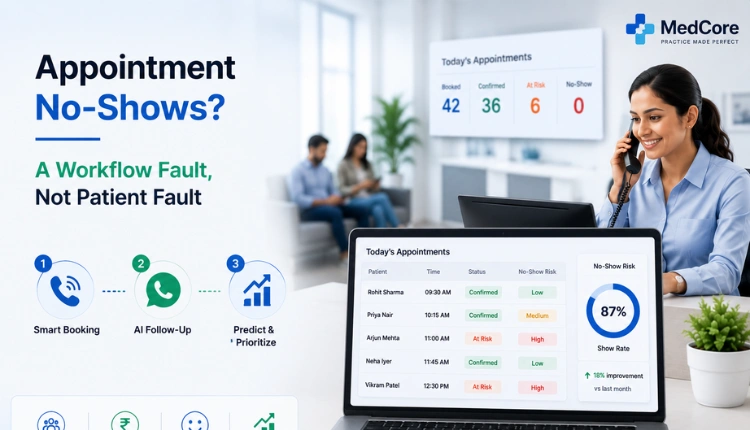
Empty chairs are a billing problem disguised as a behaviour problem. And most clinics are solving the wrong one.
The pattern is stubborn. A Medscape survey of US practices found 73% reported steady or declining no-show rates in 2024 — yet 27% saw increases, and the overall problem persists despite more reminders, more portals, more tools. India’s healthcare figures aren’t tracked as cleanly. The structural conditions are different anyway: approximately 80% of facilities run on fragmented workflows and manual coordination, with appointment booking spread across WhatsApp threads and phone logs. The proportional revenue hit is almost certainly worse.
The standard response is a reminder SMS. Send one at 48 hours, another at 24, close the ticket. That’s fine. It does not move the needle much — because the reminder fires too late, targeting the wrong moment in the patient journey entirely.
Where the Slot Actually Dies
Think about how a typical OPD booking works at a mid-size clinic. A patient calls. A receptionist — managing walk-ins, a ringing phone, and a pending lab result — takes a name and a rough complaint, books a slot, hangs up. No qualification, verification of insurance or payment method. No structured follow-up if the caller doesn’t confirm.
That patient may never have been fully committed. They might have called three clinics and may not have understood the prep instructions. They might have had a coverage question no one answered. By the time the reminder fires the next evening, the decision to skip has already been made.
MGMA’s 2025 analysis puts it plainly: no-show patterns now look like overlapping waves, not a single trend line. Economic pressure and coverage churn are driving different patient segments to disengage at different points in the pre-visit cycle. A one-size reminder does nothing to address that.
Patient no-show reduction happens upstream — at three distinct workflow failure points — and each has a concrete fix.
Failure Point 1: The Booking Conversation
Most receptionists are not trained to qualify callers. They’re trained to book them. There’s a difference. Qualifying means confirming the patient understands the appointment type, knows where to go, has the right documentation, and has been told the payment or insurance expectation upfront. A qualified booking is a stickier booking.
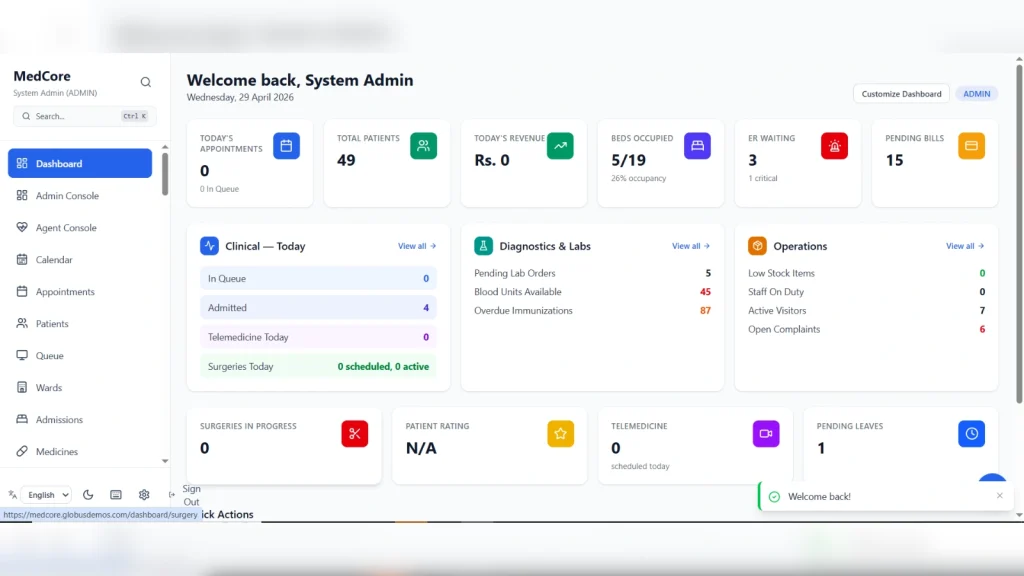
MedCore‘s AI Voice Receptionist handles this differently. It qualifies callers — confirming complaint type, insurance, and slot appropriateness — before locking a booking into the live OPD queue. Available around the clock, it means an 11pm inquiry gets the same structured conversation as a 10am call. If the caller’s need falls outside what the system can resolve, it bridges to a human with the full conversation transcript already loaded. The receptionist picks up mid-context, not mid-repeat.
The consequence is subtle but material. Slots are filled by patients who have already been walked through the basic commitment questions. Take the patient who isn’t sure which department to visit — or whether their TPA card is accepted. That question gets answered during the booking call, not by guessing at home the night before.
Failure Point 2: The Gap Between Booking and Visit
A patient books. Nothing happens for three days. Then a generic reminder arrives. This is where most clinics lose patients they didn’t need to lose.
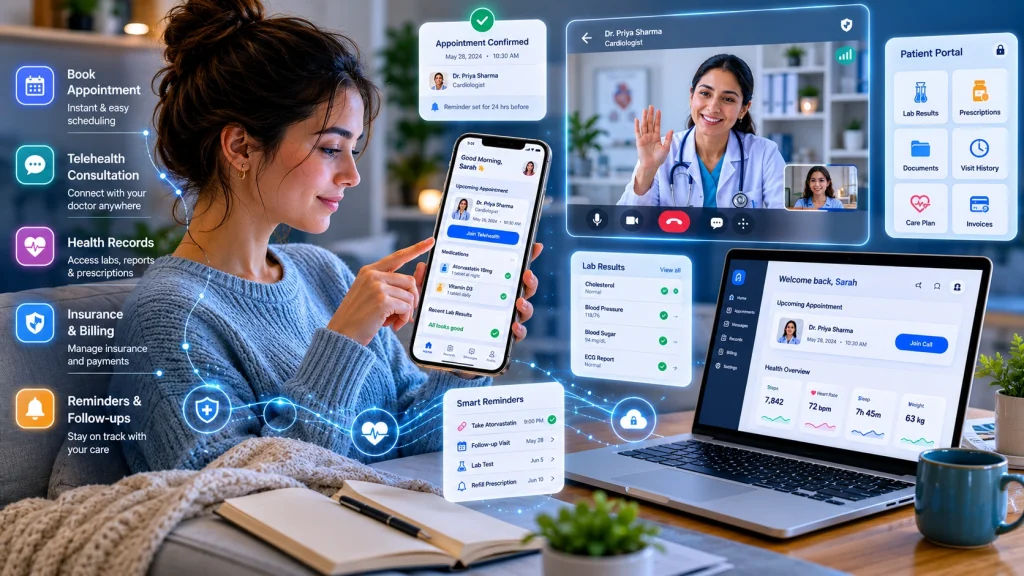
The Outbound Follow-up Agent in MedCore contacts new enquiries via voice first, then WhatsApp — moving channel if the first attempt doesn’t get a response. That sequence matters. A voice call establishes intent; a WhatsApp message gives the patient something to reply to on their own schedule. If neither gets a confirmation, the loop continues until there is one. The front desk only enters the picture when a patient has a specific question the agent flags for hand-off, or when the booking is confirmed and the thread is closed.
Compare that to what happens in most mid-size hospitals: a human follow-up call, attempted once, logged as “no answer”, never retried. The gap between “expressed interest” and “confirmed attendance” is where most appointment no-shows are born. Closing it requires more contact attempts than a single team of human receptionists can sustain across a full day’s booking list. That’s arithmetic, not criticism.
Failure Point 3: Not Knowing Which Slots Are at Risk
Even with better booking and smarter follow-up, some no-shows will happen. The question is whether you know which ones before the day starts.
MedCore’s Predictions Agent runs no-show scoring across the appointment list. The score surfaces in the Agent Console alongside the booking, giving the front desk a prioritised view of which confirmed slots are statistically fragile. A high-risk slot gets a targeted intervention — an additional call, a WhatsApp nudge, or an overbooking decision for that specific slot. A slot that scores low doesn’t need the extra touch.
This matters because the alternative is treating every appointment as equally at risk. That means either over-investing staff time on patients who were always going to show up, or under-investing everywhere and accepting the loss as normal. No-show scoring lets you triage your retention effort the same way a triage nurse prioritises a waiting room.
The Compounding Effect on Revenue
A single no-show is a missed consultation fee. Compounded across a week, it’s a staffing cost that doesn’t shrink: the doctor’s session runs regardless. The room is heated, lit, and staffed. The slot just doesn’t generate revenue.
That invisibility is exactly why it persists — no-show leakage appears nowhere on a standard billing report, because it registers as ghost slots rather than failed transactions. Most practice managers only discover the true scale when they run a manual reconciliation of booked versus attended appointments across a full month.
For a clinic running a full OPD day, even a modest improvement in show-rate moves real rupees. Fewer empty chairs means the fixed cost of that session is spread across more revenue-generating visits. The downstream effect on patient experience scores compounds that further — patients who receive timely, structured contact before their visit arrive less anxious and rate the encounter higher. And giving patients live queue token access via MedCore’s mobile app removes the uncertainty that makes some simply not bother showing up at all.
What Doesn’t Work (and Why Clinics Keep Doing It)
Overbooking alone is not a strategy. It displaces the problem rather than solving it, and when every patient does show up, the queue collapses and wait times spike. Patients who waited too long become the next cycle of no-shows.
Deposit requirements help at the margin but create friction during booking that drives some patients to competitors — particularly in price-sensitive markets where patients are choosing between two or three nearby clinics before committing.
The only durable fix is earlier and better contact, combined with predictive prioritisation. That requires workflow infrastructure, not willpower from front-desk staff who are already managing five things at once.
A Practical Audit: Three Questions to Start
Before changing anything, answer these:
- What percentage of bookings involve zero follow-up contact after the initial call? If more than half, the gap between booking and visit is your biggest leak.
- Does your front desk know, at 8am, which of today’s appointments are statistically at risk? If not, all interventions are reactive rather than preventive.
- Are new enquiries followed up until they confirm — or until a staff member runs out of time? The second scenario is the most common. The gap it creates is real and measurable.
None of these require advanced technology to diagnose. But fixing them sustainably — especially across a multi-doctor practice or a facility with several departments — does require proper infrastructure: systems that run follow-up loops without consuming staff time, and surface risk scores before the day begins, not after the slot is gone.
MedCore started inside a 40-bed hospital in Bangalore, and its beta ran across 12 hospitals in Karnataka and Tamil Nadu. These are problems that look like patient behaviour problems — until you watch the front-desk workflow for a day. Then they look exactly like what they are: operational gaps that technology can close.
Running a solo clinic, a mid-size hospital, or a multi-specialty practice? A 14-day free trial is available with no per-bed or per-user fees — see how no-show scoring and AI-driven follow-up behave in a live queue, not a demo environment.
Start your free 14-day MedCore trial at medcore.software/pricing and close the gap between booking and attendance — before next Monday’s OPD list tells you the same story it told last week.