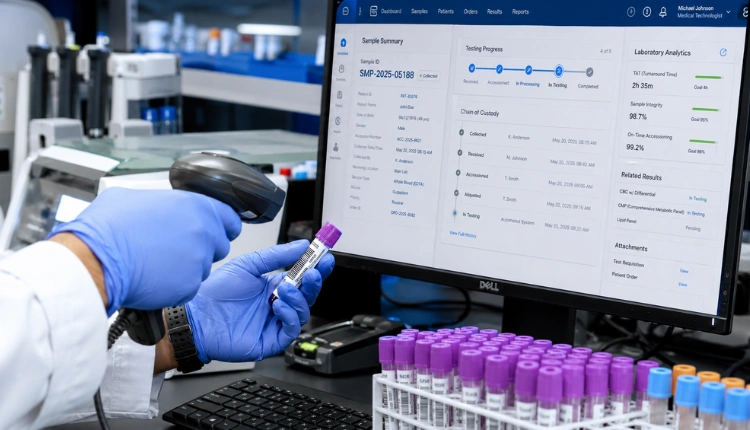
The denial letter arrives three weeks after discharge. By then, the coder has moved on, the physician can’t recall the encounter, and re-filing costs more staff time than the claim is worth. That’s the trap and it’s almost entirely avoidable if you catch the problem before the claim leaves your system.
Denials are cutting deeper into practice revenue, and the industry response has shifted: physicians are now turning to AI-driven tools to catch errors before submission, automate appeals, and reduce administrative burnout. The emphasis is on before. Reactive denial management appeals, re-billing, write-offs is expensive and slow. Predictive denial prevention is fast and, if your pipeline is built right, nearly automatic.
This is the workflow gap most clinics and mid-size hospitals I talk to haven’t closed. They’ve digitised their billing. They’ve maybe added an EHR. But the clinical documentation and the claims engine still don’t share state in real time. That disconnect is where most preventable denials are born.
Why Denials Start in the Consultation Room, Not the Billing Department
A TPA or insurer denying a claim almost always traces back to one of three problems: wrong or missing diagnosis codes, a mismatch between the documented procedure and the billed CPT, or insufficient clinical justification for the treatment. All three originate in clinical documentation not in billing. By the time a coder sees the claim, the damage is done.
The AI-native EHR architecture addresses this at the point of care rather than downstream. In a bolted-on system, an AI layer listens and transcribes, but each generated sentence floats free of any coded concept. In a natively integrated system, every term links back to a coded concept with provenance SNOMED, ICD-10, CPT at the moment it’s generated. Not hours later, when a coder tries to reconstruct intent.
That distinction matters enormously for denial rates. A SOAP note that already carries validated ICD-10 codes and a SNOMED-anchored problem list gives the claims engine something to work with. One that’s just dictated text gives it nothing but ambiguity.
The Pipeline That Closes the Gap
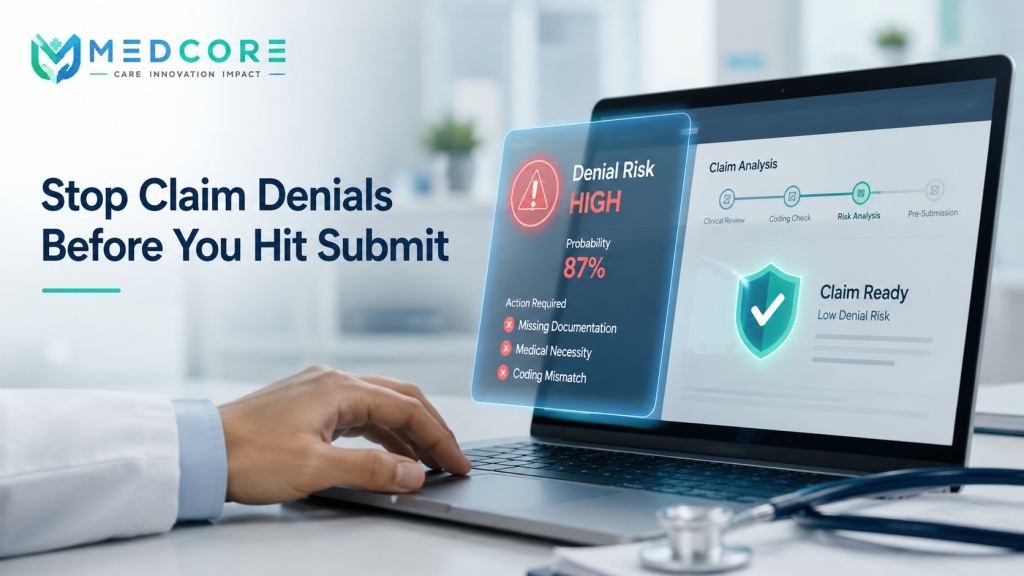
MedCore surfaces this as a single connected workflow across two agents. The Scribe Agent runs ambience during the consultation capturing the encounter, tagging speakers, and producing a SOAP note with ICD-10 and CPT codes pre-filled at the point of care. That structured note then flows directly into the Claims Agent, which auto-drafts the TPA claim and, critically, runs denial-risk prediction before the claim ever leaves the system.
The result, as described in MedCore’s published documentation on AI in clinical billing, is that reception staff can review a drafted claim in about 30 seconds rather than building it from scratch. The predictive model flags claims likely to be denied, letting staff fix the specific issue a missing diagnosis code, a CPT mismatch in seconds rather than re-filing rejected paperwork days or weeks later.
This is what Experian’s 2025 State of Claims report calls identifying high-risk claims before submission and routing them for human review. The human doesn’t disappear from the process they move upstream, correcting predictable problems before they become denials.
What “Denial-Risk Prediction” Actually Checks
I want to be precise here, because the phrase gets thrown around loosely. Prediction isn’t magic. It’s pattern matching against known payer rules and historical denial reasons. A well-built model checks things like:
- Whether the primary diagnosis code is on the payer’s accepted list for the billed procedure
- Whether the clinical justification in the SOAP note supports the treatment level being claimed
- Whether required authorisation fields are populated for high-cost items
- Whether the ICD-10 and CPT combination has historically triggered denials for this TPA
None of those checks require a human to run them manually. They require the clinical data and the billing engine to be talking to each other in real time. That’s the architectural pre-condition most legacy HMS platforms fail.
KFF’s analysis of AI in claims review notes a genuine concern worth naming: predictive systems can themselves generate incorrect signals, particularly on nonclinical administrative tasks, if the underlying rules aren’t current. The answer isn’t to avoid prediction it’s to ensure the output is always routed through a human decision point before submission, not treated as an automatic pass or fail. MedCore’s Claims Agent does exactly that: it flags, it drafts, and a staff member approves. The final submission is a human action.
The Discharge-to-Billing Hole
There’s a specific failure mode I see repeatedly in mid-size hospitals that have otherwise digitised well. The discharge summary gets completed sometimes well, sometimes hastily but it doesn’t automatically close billing and pharmacy in the same pass. So month-end reconciliation becomes a firefight: pharmacy charges not linked to the episode, procedures documented but not billed, consumables that fell through because nobody connected the inpatient record to the claims queue.
This is a structural problem, not a coder competence problem. MedCore’s EHR documentation cites roughly 80% of facilities working on fragmented flows as the core reason claims, billing, and clinical modules must share state continuously rather than syncing via nightly batch jobs. A discharge summary that closes the billing and pharmacy record in one pass eliminates an entire category of month-end exceptions before they accumulate.
Auditability Is Not Optional
One thing I’ll push back on in almost every vendor conversation: the assumption that if AI flags something, you don’t need to know why. You do. Every AI decision in a billing context should be traceable you need to know exactly why a claim was flagged as high-risk, which field triggered the prediction, and what the system recommended. Without that, you can’t train your coders, you can’t dispute a false positive, and you can’t demonstrate compliance with DPDP Act 2023 requirements around consent artifacts and data retention.
MedCore’s architecture versions every AI prompt with one-click rollback. If a prediction model changes or a rule is updated, you can trace exactly what version of logic produced a specific claim recommendation on a specific date. For a TPA dispute or an audit, that’s the difference between being able to defend your process and being unable to reconstruct it.
A Practical Checklist Before You Evaluate Any Claims AI Tool
Here’s what to actually test when evaluating a system that claims to do denial prevention:
- Does the clinical note feed the claim directly, or does a human re-key fields? Re-keying reintroduces the error risk you’re trying to eliminate.
- Does the ICD-10/CPT suggestion come with a confidence score and an explanation? “Suggest ICD-10” is table stakes. “Here’s why this code, and here’s the alternative if you disagree” is what you actually need.
- Does denial-risk prediction happen pre-submission, not post-rejection? Post-rejection analysis is useful. Pre-submission flagging is the only thing that prevents the denial.
- Is the audit trail per-claim and per-decision, or just system-level logs? System logs don’t help you in a TPA dispute about a specific encounter.
- Does the system link to your TPA stack directly, or does it export for re-import? Export-then-import workflows create version drift and manual reconciliation.
The Real Cost of Waiting
India’s hospital and healthcare market sits at approximately $200 billion, with roughly 80% of facilities still running on fragmented workflows and manual coordination. For most of those facilities, claim denials aren’t a billing department problem. They’re a systems architecture problem that won’t be fixed by hiring more coders or switching to a faster re-filing workflow.
The shift that actually moves denial rates is architectural. Get clinical documentation and claims onto a shared data model. Run prediction before submission. Route human review to the cases that genuinely need it not every claim equally. That’s not a future state. The tooling exists now. The question is whether your current HMS is built to support it, or whether it’s adding AI as a layer on top of a structure that was never designed to share state across departments.
MedCore was built inside a 40-bed hospital in Bangalore and beta-tested across 12 hospitals in Karnataka and Tamil Nadu before general release. The claims workflow wasn’t designed in isolation from clinical documentation they were designed together, because that’s the only architecture that closes the denial gap at the source rather than the symptoms.
If you’re evaluating whether the Scribe-to-Claims pipeline would change your denial rate, the fastest way to find out is to run the real workflows on your own case mix. MedCore’s 14-day free trial includes full access to the Claims Agent and Scribe Agent, so you can test pre-submission flagging against your actual TPA rules before committing.