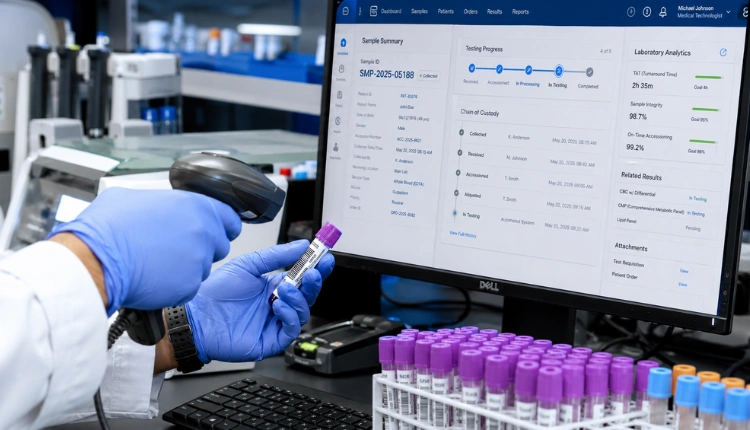
Hospital management is the coordinated administration of every resource inside a healthcare facility – people, processes, technology, and finances – so that patients receive timely, safe care and the institution stays operationally and financially viable. It covers everything from scheduling a surgeon’s theatre block to reconciling an insurance claim at midnight.
That definition sounds clean on paper. In practice, it means juggling six or seven departments that rarely share the same priorities, under regulatory scrutiny, in real time. A ward nurse running low on IV fluids and a billing team chasing an unpaid insurer are both hospital management problems, just at opposite ends of the building.
Why Hospital Management Directly Affects Patient Care and Cost

Poor hospital management shows up in ways patients feel immediately. Long waits in a busy outpatient department. A prescription that can’t be filled because the pharmacy wasn’t notified. A claim was rejected because a discharge code landed on the wrong form. These aren’t clinical failures; they’re operational ones, and they’re largely preventable.
The financial stakes are equally concrete. Research on AI in hospital front-desk operations puts US hospitals’ annual cost of fighting payer denials at an estimated $19.7 billion in 2022, and registration-related issues alone account for 27% of all claim denials. A single coding error on a complex surgical claim can cost thousands of dollars and weeks of rework.
On the clinical side, hospitals using standardised triage protocols such as the Emergency Severity Index depend on coordinated bed management, real-time data visibility, and staffing calibrated to surge hours to hit their response benchmarks. Every one of those dependencies is a hospital management problem, not a clinical one.
Core Functions of Hospital Management
Clinical Operations
This is the heartbeat of any facility. Clinical operations cover patient admission and discharge workflows, operating-theatre scheduling, pharmacy inventory, infection control, and the hand-off processes between departments. A breakdown anywhere, an understocked pharmacy, a miscommunicated discharge, can cascade quickly into delayed beds and patient harm.
Administrative and Financial Management
Billing, coding, insurance pre-authorisation, accounts receivable, and budgeting live here. Revenue cycle discipline isn’t optional. Registration-related issues drive more than a quarter of all hospital claim denials; a rigorous pre-submission review process recovers more money than most software investments combined.
Human Resources and Staffing
Healthcare is labour-intensive. Shift planning, credentialing, mandatory training compliance, and burnout prevention all fall under this function. Chronic understaffing in nursing, a persistent issue since 2020, demonstrates exactly what happens when staffing is treated as a back-office concern rather than a strategic priority.
Quality, Safety, and Compliance
Accreditation bodies, government payers, and patients themselves expect documented quality metrics: readmission rates, hospital-acquired infection rates, patient satisfaction scores. Hospital management sets the standards, tracks the numbers, and drives corrective action when something goes wrong. In India, NABH and JCI surveyors specifically check lab turnaround times, chain of custody for blood and samples, and full audit trails, so this function carries direct compliance consequences.
What Good Management Looks Like on the Floor
Consider a mid-sized district hospital on a Monday morning, the busiest admission point of the week. A well-managed facility runs a bed-management huddle that lasts fifteen minutes flat. Every department lead reports the current census, expected discharges, and any supply or staffing gaps. By the time the outpatient department opens, the ED charge nurse knows which inpatient beds will free up and when.
Contrast that with a hospital where bed status lives on a whiteboard updated sporadically. Patients queue not because beds don’t exist, but because no one has a real-time view. The clinical outcome may look identical. The management outcome is not.
Or look at surgical scheduling. Hospitals that analyse historical case durations and block-schedule theatres by surgeon specialty consistently outperform those relying on ad hoc booking in theatre utilisation, revenue per operating day, and team morale. It is a planning problem with a planning solution.
How Technology Is Transforming Hospital Management
The question for most hospitals is no longer whether to use digital systems. It is how intelligently those systems talk to each other.
As our analysis of integrated hospital workflows found, 80% of facilities run on fragmented workflows that split diagnostics, medications, and billing across disconnected tools. The failure modes are specific and dangerous. A pharmacist cannot see the latest creatinine reading when dispensing gentamicin, a life-threatening risk. A delta flag that catches a creatinine spike surfaces 48 hours later at a ward round rather than immediately at the pharmacy counter. Unbilled tests fall through the cracks without an order-to-bill link. Integration isn’t a feature to evaluate on a procurement checklist. It is a patient safety requirement.
The opposite is equally documentable. A real integrated workflow runs like this: A doctor places a CBC order → a result delta-flags a haemoglobin drop → the ward order updates → pharmacy adjusts the iron dose → the bill updates with GST → the discharge summary pulls medications and results. Nobody typed the MRN twice. That isn’t a theoretical efficiency gain. That is what connected systems produce on an ordinary Tuesday.
At the radiology end, AI-assisted reporting can cut turnaround time by 60–70% for common studies. The gain only holds, though, when the downstream bed and billing workflow can absorb that speed. Technology that outruns its operational context produces bottlenecks, not improvements.
How MedCore Supports Modern Hospital Management
MedCore is a purpose-built hospital and clinic management platform that connects clinical, administrative, and financial operations in one place. It originated inside a 40-bed hospital in Bangalore and opened in beta to 12 hospitals across Karnataka and Tamil Nadu in February 2026. Built over two years alongside doctors, nurses, and administrators, it now spans 45 integrated modules covering the full patient journey.
- Live OPD Queue with vulnerability flagging: Socket.IO pushes real-time token updates to waiting-area TVs and reception screens simultaneously. Vulnerability flags surface before a high-risk patient reaches the counter, not after.
- No-show prediction: the Predictions Agent scores no-show likelihood on every booked appointment. Front-desk staff see the score before the clinic opens and can fill slots proactively, not scramble after a no-show.
- Ambient SOAP Scribe: structured clinical documentation with speaker tagging for DOCTOR, PATIENT, and ATTENDANT roles. Physicians stop typing during consultations. Notes exist before the patient leaves the room.
- Claims Agent auto-drafts TPA claims from the Scribe Agent’s SOAP and ICD-10 output, then predicts denial risk before submission. Reception corrects weak claims at the draft stage, not after a payer rejects them weeks later.
- AI Voice Receptionist qualifies callers for booking, lab reports, billing queries, or emergency triage, then books directly into the OPD queue or bridges to a human agent. Front-desk call volume drops without cutting patients off.
- Triage Agent supports symptom triage in 8 Indian languages with SNOMED-anchored routing, running through India-region Sarvam ASR, so data never leaves the country, a direct DPDP compliance requirement.
- Pharmacy demand forecast: the Predictions Agent applies Holt-Winters forecasting to pharmacy demand, flagging stock gaps before they become mid-shift crises.
- ABDM/ABHA linking consent artefacts and ABHA ID linking are built in, keeping the platform aligned with India’s national digital health mission without manual workarounds.
“We replaced three tools with MedCore. Billing, pharmacy, and lab now talk to each other without exports.” Ravi Prasad, Administrator, Sunrise Clinic
Pricing starts at ₹9,999/month for the Starter plan (up to 5 users, single branch). The Professional plan at ₹24,999/month covers up to 25 users across 2 branches and includes the patient mobile app. A 14-day free trial with no setup fee is available on self-serve tiers.
Ready to see it in action? Explore MedCore’s full feature set and walk through the platform with a specialist who understands healthcare operations.
Common Hospital Management Mistakes
Treating IT as a one-time project. A hospital management system is not a plug-and-play appliance. Without change management, staff training, and ongoing configuration, adoption stalls and staff revert to workarounds inside six months.
Optimising departments in isolation. A radiology department running at peak throughput while the downstream ward has no discharge capacity just moves the queue. Measure patient journey time, not departmental cycle time. AI-assisted radiology reporting can cut turnaround time by 60–70% for common studies, but only if the rest of the workflow keeps pace.
Ignoring the revenue cycle until it breaks. Billing errors and claim denials are silent drains. Hospitals that review denial rates weekly and track payer-specific rejection patterns recover meaningfully more revenue than those that audit quarterly.
Under-investing in staff wellbeing. Turnover in nursing carries substantial cost; recruitment, onboarding, and temporary agency cover add up fast. Better scheduling tools and workload visibility are among the highest-return investments a hospital management team can make.
The Future of Hospital Management
Value-based care, where hospitals are reimbursed for patient outcomes rather than service volume, is reshaping what hospital management must measure and optimise. The shift demands real-time quality data, proactive chronic-disease management, and care coordination that extends well beyond the hospital walls.
AI will accelerate this. Early clinical decision-support tools are already reducing diagnostic delays in radiology and flagging deterioration risk hours before traditional indicators would trigger an alert. Ambient voice documentation, where an AI listens to a physician-patient conversation and drafts the clinical note, is moving from pilot to standard practice. The hospitals that lead this era won’t necessarily be the largest. They’ll be the ones who built strong management foundations first: clean data, integrated systems, and a culture that treats operational performance as a clinical priority rather than a back-office concern.
Frequently Asked Questions
What is the difference between hospital management and healthcare administration?
Healthcare administration is the broader field; it covers insurance companies, public health agencies, and policy organisations. Hospital management is specifically about running a hospital or clinic: the day-to-day operations, staffing, and patient-flow decisions that keep a facility functioning.
What qualifications do hospital managers need?
Most senior roles require a master’s degree in health administration (MHA), public health (MPH), or business administration (MBA) with a healthcare concentration. Clinical background in nursing, pharmacy, or allied health is increasingly valued at the department-head level because it bridges the gap between operational data and what is actually happening at the bedside.
How does technology help hospital management specifically?
The biggest gains come from integration. When scheduling, EMR, billing, and inventory share a single data layer; problems become visible before they reach patients. A spike in ED admissions, a drop in theatre utilisation, and a surge in denial rates are all detectable early. MedCore’s integrated platform is built around exactly this principle, connecting clinical, administrative, and financial workflows so no department operates blind to what the others are doing.
Can a small or mid-sized hospital benefit from a management system?
Often more than large hospital networks, which have dedicated IT teams to stitch together legacy systems. Mid-sized facilities running 150+ OPD patients per day feel fragmentation most acutely: too complex for paper and Excel, too budget-tight for 12–18-month enterprise installs. A purpose-built solution scales to the facility’s actual size and delivers the data visibility that previously required enterprise-level infrastructure.
Final Thought
Get the staffing visibility, revenue cycle discipline, and integrated data right, and better patient outcomes follow naturally. Let any one layer drift, and even the best clinical teams hit daily friction: a pharmacist dispensing without a current creatinine reading, a billing team catching a denial two weeks after the fact, a reception desk managing a 150-patient OPD day on a whiteboard.
If your facility is ready to replace fragmented systems with a platform built for modern healthcare operations, start your free MedCore trial and see the dashboards, workflows, and integrations for yourself no setup fee, no commitment for the first 14 days.